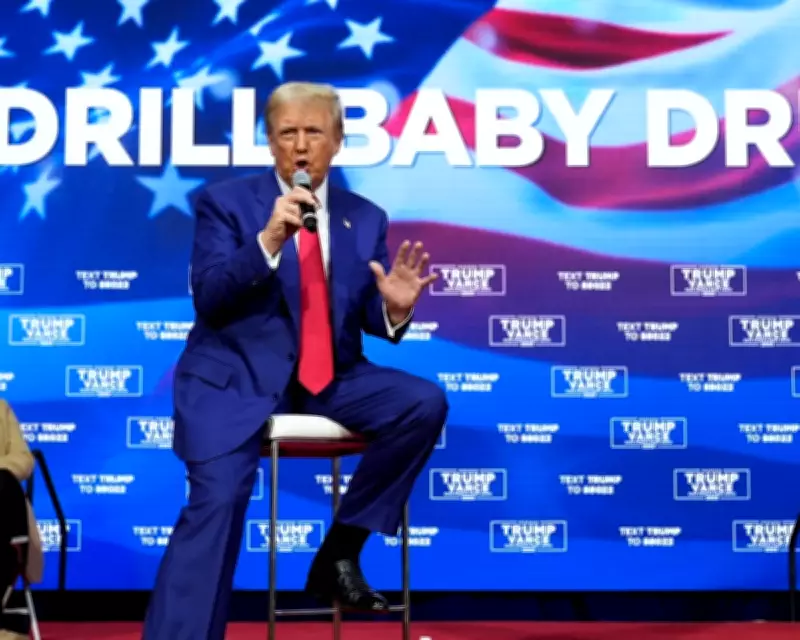
Donald Trump's persistent characterisation of climate change as a "hoax" has drawn sharp criticism from legal experts, with a former Supreme Court justice describing the policy approach as potentially catastrophic. This perspective comes amid renewed scrutiny of the former president's environmental record and his repeated withdrawal from international climate agreements.
Legal Expert Condemns Climate Policy Abdication
Robert Carnwath, a retired Supreme Court justice and visiting fellow at the London School of Economics' Grantham Institute, has highlighted what he terms the "perverse" nature of Trump's climate change policies. In a detailed analysis, Carnwath points to the former president's dismantling of environmental protections and his encouragement of unfettered fossil fuel development as particularly concerning trends.
The criticism follows Trump's second withdrawal from the Paris climate agreement, which Professor Jeremy Wallace of Johns Hopkins University described as "abdication" of environmental responsibility. Carnwath's assessment builds upon this characterisation, suggesting that among all presidential policy initiatives, this approach represents the most dangerous and misguided.

Court Cases Reveal Undisputed Climate Science
Drawing from extensive observation of climate litigation in courts worldwide, Carnwath notes a significant pattern: "I am aware of none in which there has been any serious challenge to the relevant science or the consequences of failure to act." This observation underscores the scientific consensus that has emerged within legal proceedings, even as political rhetoric continues to question climate realities.
The 2019 Juliana v United States case provides a particularly revealing example. During proceedings under the first Trump administration, government lawyers made no attempt to challenge the claimants' evidence regarding climate change impacts. The majority judgment recorded what it described as a "largely undisputed" record showing that federal authorities "has long promoted fossil fuel use despite knowing that it can cause catastrophic climate change."
Judicial Recognition of Impending Calamity
Even dissenting voices within the judiciary acknowledged the severity of the situation. One minority judge noted that "the government accepts as fact that the United States has reached a tipping point crying out for a concerted response – yet presses ahead toward calamity." This judicial recognition of impending environmental crisis, coupled with governmental inaction, creates what Carnwath describes as a particularly troubling paradox.
Despite this clear judicial recognition of climate threats, the majority in the Juliana case felt constrained by constitutional limitations from taking direct action. This legal context, Carnwath suggests, makes the continued promotion of climate denial and fossil fuel development even more problematic from a policy perspective.
The Broader Implications of Climate Denial
Carnwath's critique extends beyond specific policy decisions to question the fundamental approach to environmental governance. The former justice emphasises that Trump's professed view of climate change as a hoax has informed a comprehensive dismantling of environmental measures, creating what he terms "the most potentially catastrophic" of all presidential initiatives.
This assessment comes as climate litigation continues to expand globally, with courts increasingly called upon to adjudicate disputes involving governments and major fossil fuel corporations. The consistency of scientific evidence presented in these cases, Carnwath observes, stands in stark contrast to the political rhetoric that continues to question climate realities.
The intersection of legal proceedings, scientific evidence, and political decision-making creates what Carnwath describes as a particularly dangerous situation – one where acknowledged environmental threats meet with policies that exacerbate rather than mitigate them.