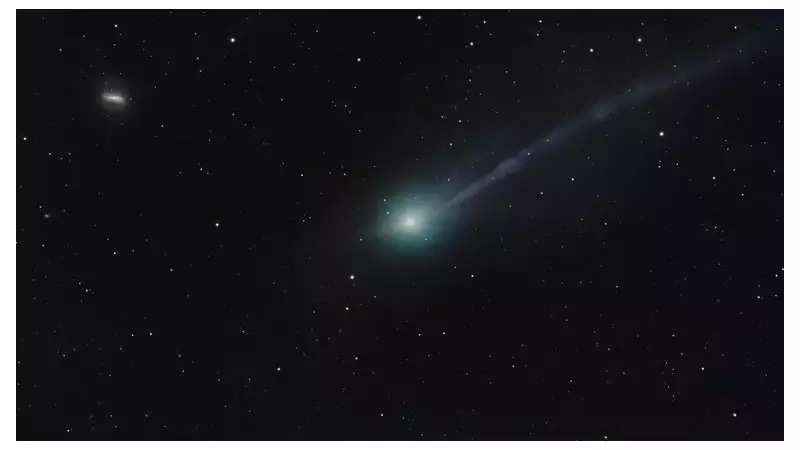
A mysterious object from deep space, which a controversial Harvard scientist has suggested could be an alien craft, is making its closest approach to Earth on Friday, 19 December 2025. The celestial visitor, known as 3i/ATLAS, will hurtle past at a staggering 130,000 miles per hour, though it poses no danger as it will be a safe 170 million miles away—roughly twice the distance from Earth to the Sun.
The Scientific Consensus vs. The Alien Hypothesis
While the vast majority of astronomers are in agreement that 3i/ATLAS is an interstellar comet, Professor Avi Loeb, an astrophysicist at Harvard University, has ignited a fierce scientific row. He warns that the possibility of it being extraterrestrial technology cannot be dismissed and that humanity should be on high alert for a potential "black swan event."
"Alien technology is a potential threat because when you go on a blind date of interstellar proportions, you never know whether you have a friendly visitor as your dating partner or a serial killer," Professor Loeb told Sky News. He points to several unusual features: an atypical tail that could indicate propulsion, nickel in its gas cloud hinting at surface mining, and a trajectory aligned with planetary orbits that seems too coincidental.

NASA and ESA Confirm Natural Origins
In stark contrast, space agencies including NASA and the ESA have trained numerous spacecraft cameras on the object. Amit Kshatriya from NASA stated unequivocally, "This object is a comet. It looks and behaves like a comet. All evidence points to it being a comet."
Scientists estimate this cosmic traveller is a remarkable eight billion years old—twice the age of our solar system—making it a fossil from the formation of another star. It was first spotted in July 2025, passed Mars in October, and after skirting Earth's orbit, will journey past Jupiter before vanishing from view.
A Clash of Scientific Philosophies
The debate has exposed a deep rift in scientific approach. Professor Chris Lintott, an astronomer from the University of Oxford, dismissed the alien theory as "just nonsense," comparing it to speculating the moon is made of cheese. He attributes the comet's changing appearance to solar heating of its ancient ices.
However, Professor Loeb accuses the mainstream of intellectual arrogance, stating, "At the foundation of science is the humility to learn... They're not willing to learn something new." This echoes his earlier claims about the interstellar object ‘Oumuamua in 2017.
Professor Lintott countered that while searching for cosmic intelligence is valid, starting with unremarkable objects like 3i/ATLAS is unhelpful. "You start by looking at things that are odd," he said, "and this thing is not odd." The object's flyby may be fleeting, but the debate over how we interpret the cosmos is sure to continue.