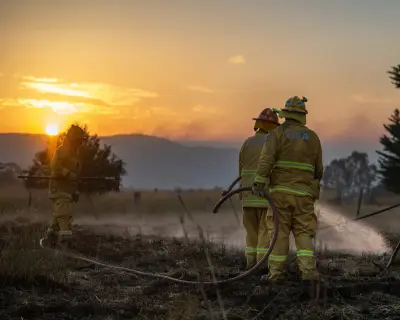
For the second consecutive year, more than 28,000 hectares of vineyards will be uprooted in France as the industry faces a crisis driven by declining wine consumption, repeated droughts, foreign competition, rising energy prices, and a record-smashing heatwave in June that pushed temperatures to 44°C. The extreme heat has damaged vineyards and ruined the taste of grapes, while in England and Wales, hotter temperatures have produced the highest-quality wine and largest yields ever seen.
French wine in crisis
Grape vines are highly sensitive to temperature changes, producing their best wines within narrow heat ranges. French vines, accustomed to a warm Mediterranean climate, are now experiencing temperatures spiraling out of control. Dr Alistair Nesbitt, an expert in climate change and viticulture, told Metro: 'When it gets too hot, the vines shut down. The soils become very dry. If there is no moisture in the soil, then no moisture is being pulled into the vines. It creates a really unsuitable growing environment.'
Grapes are also being burnt by the sun. Per Karlsson, who runs BKWine Magazine, said a winemaker in the Loire Valley reported that 40% of their grapes had been burnt in the recent heatwave and could not be used. Heatwaves are causing earlier harvests and smaller grapes that have lost their world-famous taste. Karlsson explained: 'The rapid evolution of the grapes means that the grape juice will be unbalanced and will not have the best balance of acidity and flavours. If the grapes become smaller, which is likely if there is a lack of water, you will get more skin and less juice. It can mean the wine will get harsher.'

Advantage England
While soaring temperatures put French vineyards under strain, they are turning England and Wales into increasingly favourable places to grow. Dr Nesbitt, director at Vinescapes, said: 'We have seen a really rapid rise in temperatures during the growing season over the last 30 years. Regions that were previously unsuitable are now suitable. That has really enabled these vineyards and varieties to expand and grow.'
The UK's ten warmest years on record have all occurred since 2002. From 2004 to 2021, British viticulture expanded nearly 400%, from 761 to 3,800 hectares. New vineyards are concentrated in south-eastern and southern England, particularly Essex, Sussex, and Hampshire, but have also stretched to Yorkshire and Wales. A landmark harvest in England and Wales last year produced the equivalent of 16.5 million bottles of wine.
English sparkling wines are excelling. Philip Stephenson-Oliver, a wine influencer, said: 'Thirty years ago, a Frenchman would not have been seen dead drinking a glass of English sparkling wine. Now there are so many blind tastings where English sparkling wine is beating some of the best Champagnes. The south of England is fast becoming a master of producing excellent sparkling wines in the traditional Champagne style.' In September last year, British company Nyetimber won Champion Sparkling Wine at the International Wine Awards, the first time the trophy has been lifted by a producer from outside Champagne.
Opportunities and challenges ahead
As the climate continues to warm, there is now 'an even wider range of wine we can produce', says Dr Kate Gannon from the London School of Economics. She added: 'On one level it really appears that climate warming has offered a real opportunity for the UK. A short-term window opened.' Gareth Maxwell, founder of The Heretics Wine, agreed: 'We are right on the edge of being able to make top-class wines. In the wine world, people know England makes good quality sparkling. The thing to follow is good quality still wine.' An English Chardonnay from Danbury Ridge in Essex won third place in London Wine Fair's 'Greatest Chardonnay Showdown' in May this year.

However, climate change also brings risks. Dr Gannon's research predicts more extreme weather, including heavy rainfall and droughts at key moments. A deluge of rain risks waterlogged soils, and warming temperatures bring new pests and diseases. Dr Gannon said: 'Climate change will become very bad news for the UK wine sector too, if we don't find ways to reduce the rate of warming.' Unexpected temperature fluctuations can also cause damage, as Dr Nesbitt explained: 'Vine buds are dormant over winter, and in the spring, when the soil and the air warms up, their buds open up. Then if you have a late-spring frost, those young small buds are very exposed to cold temperatures. It can really injure or kill them.'
The world has 7 million hectares of vineyards, while England has just 4,500. One answer is regenerative viticulture, which protects and enhances soil and biodiversity, making vines more resilient to heat spikes. According to the International Organisation of Vine and Wine, this includes covering crops between vine rows, compost, and minimal use of persistent chemical pesticides and fertilizers. Dr Nesbitt added: 'The result is we can store more water in soils and we can build resilience to climate change. It is not all doom and gloom – there is a positive story coming out of this.'