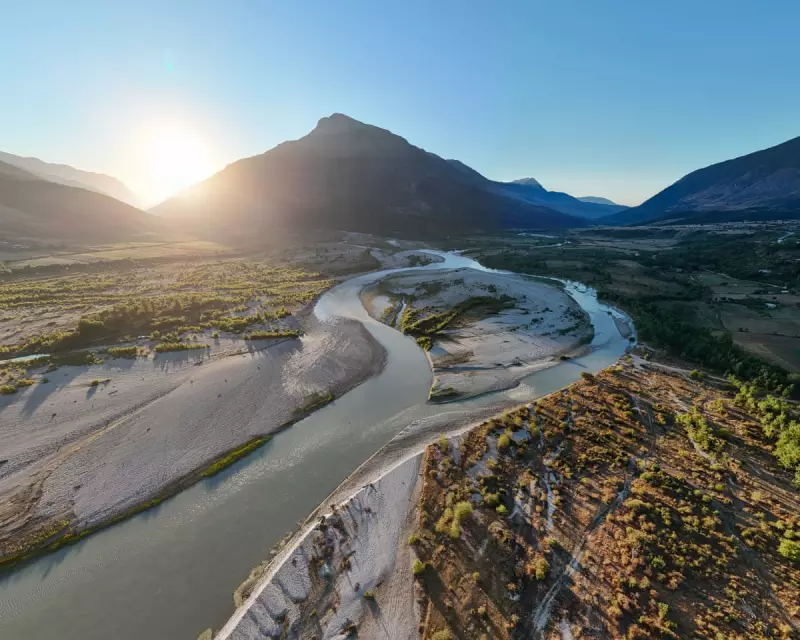
The Vjosa River winds its way from north-western Greece into south-western Albania, creating one of Europe's last remaining wild river landscapes. This majestic waterway has recently gained protected status as a national park, yet its fragile ecosystem requires ongoing conservation efforts to ensure its survival for future generations.
A Conservation Mission in the Heart of Albania
Our introduction to the vital work of river preservation comes from Pietro, an Italian hydromorphologist overseeing a group of approximately twenty volunteers. We gather in a temporary nursery filled with delicate willow and poplar saplings situated above the Vjosa's banks. The river itself presents a graceful, meandering presence as it flows east to west across southern Albania, originating 169 miles upstream in Greece.
Pietro demonstrates the careful technique of extracting a young willow from the clay-rich soil, holding the plant aloft to reveal its exposed, vulnerable root system. "The crucial skill involves avoiding damage to the stem or breaking the roots," he explains. With this guidance firmly in mind, we collect our tools and begin working in pairs to follow his detailed instructions.

The Birth of a Conservation Initiative
This volunteer programme represents the collaborative vision of EcoAlbania and Austria-based Riverwatch. These conservation organisations successfully campaigned for the Albanian government to designate the Vjosa as Europe's inaugural "wild river national park" in 2023. Their intervention proved particularly timely, as recent research co-funded by Riverwatch reveals Albania has lost 711 miles of "nearly natural" river stretches since 2018 – proportionally more than any Balkan nation.
During our initial evening, Riverwatch's chief executive Ulrich Eichelmann presents his organisation's vision for the park's future. Before his presentation, we enjoy a traditional dinner of lamb and locally grown vegetables at the Lord Byron guesthouse in Tepelenë. This small town in the Vjosa valley serves as EcoAlbania's field office and our base for the week.
Historical Context and Contemporary Challenges
While Tepelenë today features a somewhat dilapidated castle, two centuries ago it formed the political centre of Ali Pasha, a local ruler during the early nineteenth century Ottoman period. The town's connection to literary history includes a visit from Lord Byron himself in 1809.
Eichelmann delivers a compelling presentation about the threats facing Europe's river networks, reserving particular criticism for the continent's proliferation of dams. These structures, he argues, cause irreversible damage to fish populations and freshwater ecosystems. The Vjosa represents a rare exception as one of the Balkans' last wild rivers, yet significant challenges remain.
"Although the river appears beautiful," Eichelmann notes, "critical elements are missing." Foremost among these are trees, with substantial losses occurring due to fires, logging, road construction, and intensive grazing. The consequences include severe erosion and increased flood risks, motivating our renewed dedication to replanting efforts.
Diverse Volunteers United by Conservation
Our volunteer group includes a London-based book illustrator inspired by David Attenborough's documentaries, a United States geospatial analyst hoping to create "an Albania where Albanians might want to stay" (referencing the country's 1.2 million emigrants), and an Italian university student interested in eco-tourism development.
During lunch on our second day, I converse with Aida, a Tirana-based tour guide seeking deeper familiarity with the Vjosa region. She observes that visitors rarely explore this part of Albania, perhaps making brief stops in historic Gjirokastër on the neighbouring Drino River before continuing their journeys. We both agree this represents a significant oversight, as the region boasts rich cultural and religious history, distinctive gastronomic traditions, and abundant natural attractions.

Weather Challenges and Cultural Discoveries
Heavy rainfall temporarily suspends our planting activities when the designated zone becomes submerged. This unexpected break allows for impromptu exploration, beginning with the slow-food town of Përmet, whose confident slogan declares: "Except for the Sea, We have Everything." We continue to the hidden Orthodox church of St Mary in the hills, where a local shepherd serves as doorkeeper, before hiking through Langarica canyon despite challenging weather conditions.
Persistent rain prevents rafting or kayaking on the swollen river, instead prompting a hike through Peshtura gorge to witness a spectacular waterfall bursting from the hillside. A subsequent visit to Gjirokastër confirms its reputation through an illuminating ethnographic museum and imposing clifftop castle.
Balancing Tourism and Conservation
I share my discoveries with Olsi Nika, executive director of EcoAlbania and recent recipient of the prestigious Goldman Environmental Prize. While appreciating my enthusiasm, Nika expresses concern about tourism development. Albania's coastline already attracts package holidaymakers, and an airport construction project threatens the river's delta despite its protected status.
"Tourism resembles fire," Nika observes thoughtfully. "You can prepare your soup with it, but it can also burn your house down." He welcomes Tepelenë's new visitor centre but urges faster government implementation of the park's management plan.
Historical Perspectives and Future Hopes
Departing towards Tirana, I stop at the archaeological site of Apollonia north of the river's mouth. This ancient Greek trading settlement, later colonised by Romans, sits remarkably undisturbed by tourists. According to Herodotus, Apollonia originally occupied the Adriatic coast before centuries of Vjosa silt deposits pushed it inland.
The river's course has shifted throughout history, and further changes inevitably approach. As a protected national park, however, the Vjosa will hopefully continue flowing freely – untamed and unbroken – preserving one of Europe's last wild river ecosystems for generations to come.
This conservation trip received support from Patagonia, which backs EcoAlbania's work. The organisation arranges accommodation, meals, and transport from Tirana to Tepelenë for approximately £700 weekly, while volunteers organise their own travel to Tirana. The next volunteer week commences 16-21 February.