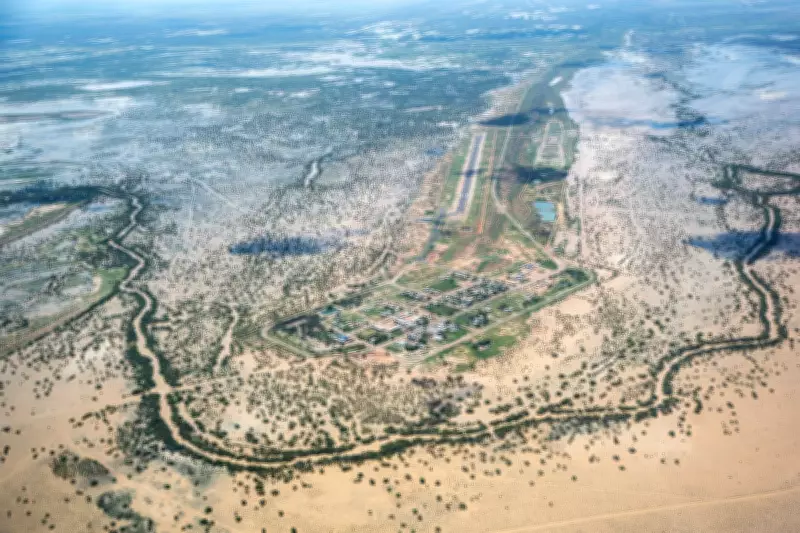
Remote Outback Towns Isolated by Flooding Demonstrate Extraordinary Resilience
The isolated Queensland towns of Birdsville and Bedourie, situated on the edge of the vast Munga-Thirri Simpson desert, have been completely cut off from road access for more than five weeks due to extensive flooding. While this scenario might alarm urban dwellers, these remote communities with a combined population of approximately 260 people have adapted with characteristic resourcefulness and resilience.
Infrastructure Protection and Supply Challenges
Bedourie, home to 150 residents, has successfully avoided flood damage thanks to its protective levee bank, which stands an impressive 1.2 metres above the historic 1974 flood levels. However, both towns now face significant supply challenges, with access limited to air transport only since early February.
Jenna Brook, who operates Birdsville's service station, post office, and grocery store, reports that her establishment is down to just two flavors of chips, neither of which are selling particularly well. "We just adjust and try to lengthen out how long our supplies will last," she explains, highlighting the community's pragmatic approach to their situation.

Essential Supplies and Community Spirit
Under Queensland government guidelines, only essential items can be resupplied by air during such isolation periods. This includes fresh produce, meat, bread, basic groceries, pet food, and medical supplies. Last Friday marked a significant moment for Bedourie when it received its first mail delivery in five weeks, with 519 kilograms arriving by aircraft.
Despite these limitations, community spirit remains strong. The Birdsville Hotel has been organizing themed Friday nights to entertain locals, with events ranging from disco nights to an upcoming American prom night. Ben Fullagar, the hotel's general manager, notes that residents aren't feeling trapped. "They're not feeling like 'oh we're stuck in Birdsville'," he observes.
Historical Context and Environmental Transformation
Isolation is not unfamiliar to these communities. In 1974, locals were cut off for approximately four months when flooding severed the Birdsville Track, requiring goods to be transported by boat. Last year brought another six-week isolation period with flooding exceeding 1974 levels.
The current deluge has led to the cancellation of the Big Red Bash festival, recognized as the world's most remote music festival, which was scheduled for July in Birdsville. However, the rainfall has also transformed the landscape dramatically. Parts of the Simpson desert are turning from red to green, with wildflowers beginning to bloom in vibrant purple, red, and yellow hues.
David Brook, a lifelong Birdsville resident born in 1947, describes the rainfall as extraordinary. "It's hard to believe these falls," he says, noting that while flooding isn't unusual for the region, the current extent reaching halfway through South Australia is remarkable.
Long-Term Implications and Community Adaptation
Francis Murray, mayor of the Diamantina shire that encompasses both towns, acknowledges that while he's accustomed to isolation, many community members are experiencing this for the first time. "There's enough old hands here, too, to guide the new ones through," he remarks, highlighting the intergenerational knowledge transfer occurring within these remote settlements.
Jenna Brook points out a significant disparity in expectations between remote and urban communities. "A double standard here is that we are asked to be resilient more often and for longer periods of time than places where there's more votes and where there's more people," she observes, emphasizing the unique challenges faced by isolated populations.
Looking ahead, similar isolation events may become more frequent. Australia experienced its fourth-warmest year on record in 2025, according to the Bureau of Meteorology, with climate change increasing the frequency and severity of extreme weather events globally.

Despite the challenges, residents maintain perspective about their situation. Ben Fullagar reflects on the different lifestyles between remote and coastal communities. "They look at us and think we've got all these challenges with weather, whereas we look at the coast and go, well, they've got all these challenges with social pressures and traffic," he says. "It's just a different lifestyle, you know?"
Once the floodwaters recede, these communities anticipate a spectacular transformation of their environment. Lake Eyre is filling to levels not seen since the 1970s, creating what Fullagar describes as "an oasis of health and growth." Mayor Murray, who recently witnessed the changing landscape from a helicopter, confirms that "the desert has been completely transformed," with brown terrain turning green and water surfaces appearing like glass.
While the tourism season will begin later than usual due to current access limitations, the remarkable resilience demonstrated by Birdsville and Bedourie residents serves as a testament to human adaptability in the face of environmental challenges.