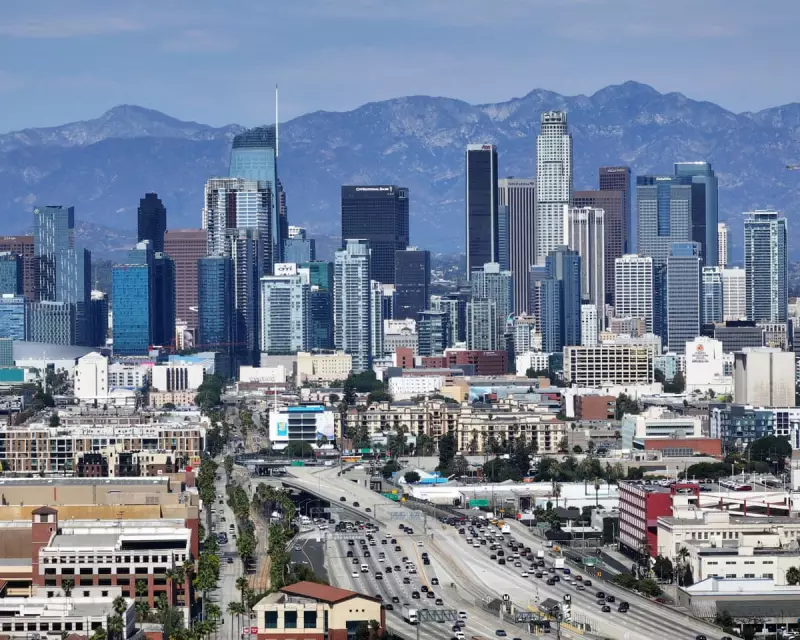
Los Angeles stands among numerous global metropolises confronting severe water stress, a situation intensifying due to climate breakdown. This alarming trend highlights a worldwide urban water crisis that demands immediate attention and action.
Widespread Urban Water Stress Revealed
Groundbreaking analysis has uncovered that precisely half of the planet's one hundred largest cities are located in areas experiencing high water stress. Within this group, a staggering thirty-nine urban centres are situated in regions classified as suffering from "extremely high water stress." This condition occurs when water withdrawals for public supply and industrial use approach or exceed available resources, often worsened by inadequate water management practices and the accelerating impacts of climate change.
Global Cities on the Frontline
Mapping conducted by Watershed Investigations and the Guardian has identified several major cities facing extreme water stress, including Beijing, New York, Los Angeles, Rio de Janeiro, and Delhi. Meanwhile, other significant global hubs such as London, Bangkok, and Jakarta are categorised as highly stressed. These findings underscore the universal nature of the water security challenge affecting urban populations across continents.

Satellite Data Reveals Drying and Wetting Trends
Separate analysis of NASA satellite information, compiled by University College London scientists, illustrates which of the largest one hundred cities have experienced drying or wetting trends over two decades. Locations like Chennai, Tehran, and Zhengzhou demonstrate pronounced drying patterns, whereas Tokyo, Lagos, and Kampala show strong wetting trends. A newly launched interactive water security atlas allows detailed exploration of all one hundred cities and their specific hydrological trajectories.
Approximately 1.1 billion people reside in major metropolitan areas within regions undergoing significant long-term drying, compared to around 96 million living in or near cities in areas with strong wetting trends. However, researchers caution that satellite data lacks the granularity to provide local-scale context and details.
Geographical Patterns and Critical Cases
Most city regions within notably wetting zones are located in sub-Saharan Africa, with Tokyo and Santo Domingo in the Dominican Republic being notable exceptions. Conversely, urban centres in areas with the strongest drying signals are predominantly concentrated across Asia, particularly in northern India and Pakistan.
Tehran presents a particularly critical case, now enduring its sixth consecutive year of drought and perilously approaching "day zero" when water becomes unavailable for citizens. Last year, Iran's president Masoud Pezeshkian warned that the city might require evacuation if drought conditions persist. Cape Town and Chennai have both narrowly avoided their own day zero scenarios, while numerous rapidly expanding cities situated in drying zones face imminent future water shortages.
Expert Warnings and International Responses
Mohammad Shamsudduha, Professor of Water Crisis and Risk Reduction at UCL, emphasised the importance of satellite monitoring: "By tracking changes in total water storage from space, the NASA GRACE project shows which cities are drying and which are getting wetter, offering an early warning of emerging water insecurity."
This week, the United Nations declared that the world has entered a state of "water bankruptcy," where deterioration of certain water resources has become permanent and irreversible. Professor Kaveh Madani, Director of the United Nations University Institute for Water, Environment and Health, stated that poor water management frequently constitutes the primary cause of this bankruptcy, with climate breakdown seldom being the sole factor. He analogised: "Climate change is like a recession on top of bad management of business."
Alarming Global Freshwater Losses
The World Bank Group has been issuing urgent warnings about plummeting global freshwater reserves. Over the past two decades, the planet has been losing approximately 324 billion cubic metres of freshwater annually—enough to meet the yearly needs of 280 million people, roughly equivalent to Indonesia's entire population. These losses impact major river basins across every continent.

Projections for England's Water Future
By 2055, England may need to source an additional 5 billion litres of water daily to satisfy public water supply demands—representing more than one-third of the 14 billion litres currently entering the public water system, according to Environment Agency estimates. Other sectors including agriculture and energy might require a further 1 billion litres per day.
Professor Shamsudduha highlighted that "the hidden resource of groundwater offers the UK a more climate-resilient water supply," but cautioned that "without sustained monitoring and better management we risk managing it blindly amid intensifying development and climate pressures."
Recent water outages in parts of southern England, which South East Water attributed to winter storms, occurred despite regulators having previously expressed "serious concerns" about the company's supply security in written communications.
Governmental Initiatives and Regulatory Changes
This week, the government published a water white paper proposing comprehensive reforms to the water system. Key measures include establishing a new chief engineer position, implementing "MOT checks" on water infrastructure, and granting enhanced powers to a newly formed water regulator. These steps aim to address systemic vulnerabilities and improve long-term water security management.