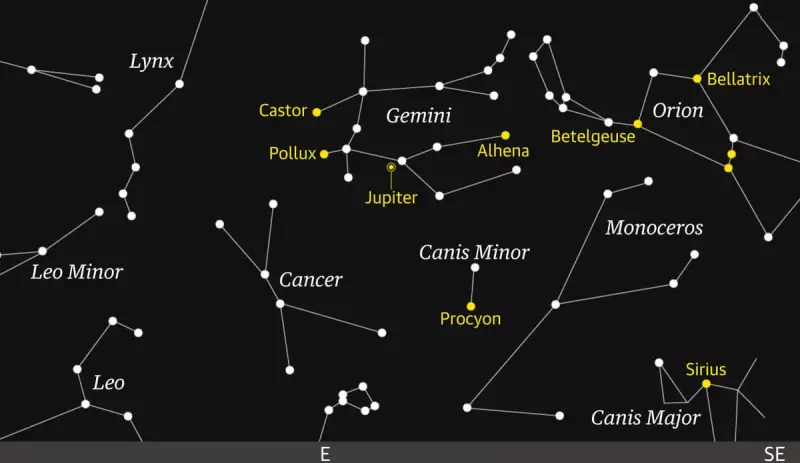
Stargazers across the UK are in for a spectacular treat this week as the giant planet Jupiter makes its closest approach to Earth for the year 2026. The solar system's largest world will be brilliantly bright and perfectly positioned for easy observation from both the northern and southern hemispheres.
A Beacon in the Night Sky
From this week, Jupiter becomes an unmissable feature of the evening sky. It will shine with exceptional brightness, outshone only by Venus, despite being vastly more distant. The planet will be located within the constellation of Gemini, the twins, forming a distinctive, lopsided triangle with Gemini's two brightest stars, Castor and Pollux.
The reason for its dazzling appearance is twofold. Firstly, Jupiter's diameter is more than 11 times that of Earth. Secondly, its expansive cloud decks are highly reflective, bouncing back a tremendous amount of sunlight towards us.

Prime Viewing Details for Astronomers
This celestial event sees Jupiter come within 633 million kilometres of our planet. To put that immense distance in perspective, the sunlight we see reflecting from Jupiter's clouds will have taken just over 35 minutes to travel from the planet to Earth. The light's total journey time from the Sun's surface to Jupiter and then to us is about 43 minutes.
The best time to look for Jupiter will be in the evening. On 9 January at 20:00 GMT, observers should face east to find this beautiful beacon. Its proximity offers a fantastic opportunity for amateur astronomers and curious onlookers alike.
What You Can See with Simple Equipment
The planet's closeness means even modest equipment will reveal its secrets. A standard pair of binoculars will be powerful enough to show Jupiter's four largest moons – Io, Europa, Ganymede, and Callisto – as tiny points of light orbiting the gas giant.
For a more detailed view, small telescopes or binoculars with a magnification of x10 or above should also allow observers to glimpse the planet's distinctive cloud belts, the bands that stripe its atmosphere. This makes it one of the most rewarding and detailed planetary sights accessible without professional-grade equipment.
This week's close approach is a reminder of the dynamic nature of our solar system and a perfect chance to connect with the cosmos from your own backyard. So, wrap up warm, grab your binoculars, and look east to witness the king of the planets in all its glory.