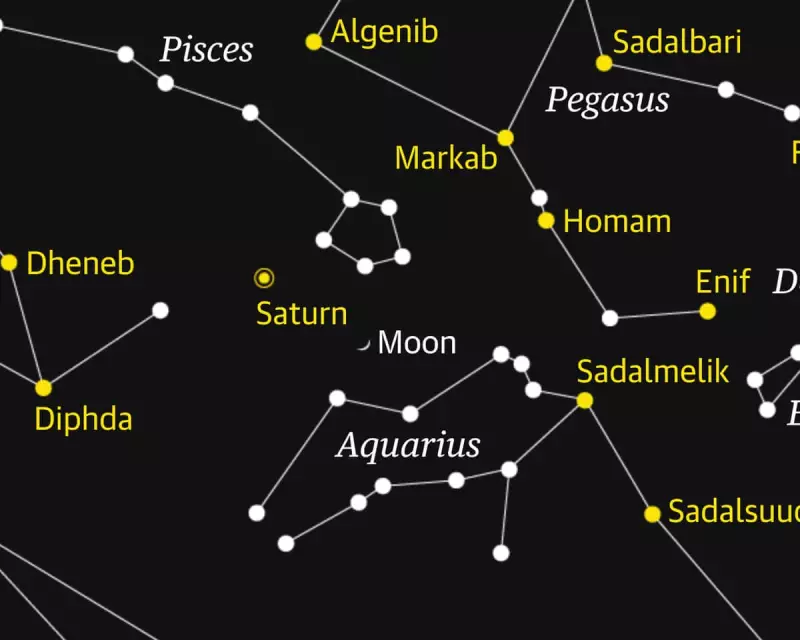
Stargazers across the United Kingdom are in for a celestial treat this week as a delicate crescent moon glides past the ringed planet Saturn in the evening sky. This close approach, known as a conjunction, offers a perfect moment of quiet contemplation as dusk deepens into night.
When and Where to Look
The celestial pairing will be visible from the moment dusk begins to gather. The optimal viewing time from London is around 18:00 GMT, looking towards the south-west. The spectacle is not exclusive to the UK; observers in the southern hemisphere will also have a clear view of the event.
At the time of the conjunction, the moon will be a little less than four days old, with only about 15% of its visible surface illuminated by the sun. This slender crescent phase presents an excellent opportunity to witness the beautiful phenomenon known as "Earthshine." This occurs when sunlight reflects from our planet onto the unlit portion of the lunar surface and back to our eyes, faintly illuminating the moon's dark side.

Spotting Saturn's Steady Glow
Saturn will appear as a steady, creamy-hued point of light. Unlike the surrounding stars that will begin to pop into view as the sky darkens, the ringed planet will hold a constant, untwinkling glow. This difference arises from the nature of how we see these distant objects.
Stars are so far away they are mere points of light. The movement of Earth's atmosphere distorts these points, causing the familiar twinkling effect. Planets, however, are closer and appear as tiny discs to telescopes. While this disc is too small for our unaided eyes to resolve, it is large enough that atmospheric turbulence averages out across its face, resulting in a steady, unwavering light.
A Simple Skywatching Guide
You won't need any special equipment to enjoy this event. Simply find a clear view towards the south-western horizon after sunset. The moon, with its familiar crescent shape, will act as a brilliant guidepost to locate Saturn shining steadily nearby. It's a gentle reminder of the clockwork motion of our solar system, playing out in real-time above our heads.
This conjunction serves as a beautiful and accessible invitation to look up and reconnect with the night sky, a fleeting moment of cosmic alignment visible from back gardens and city parks alike.