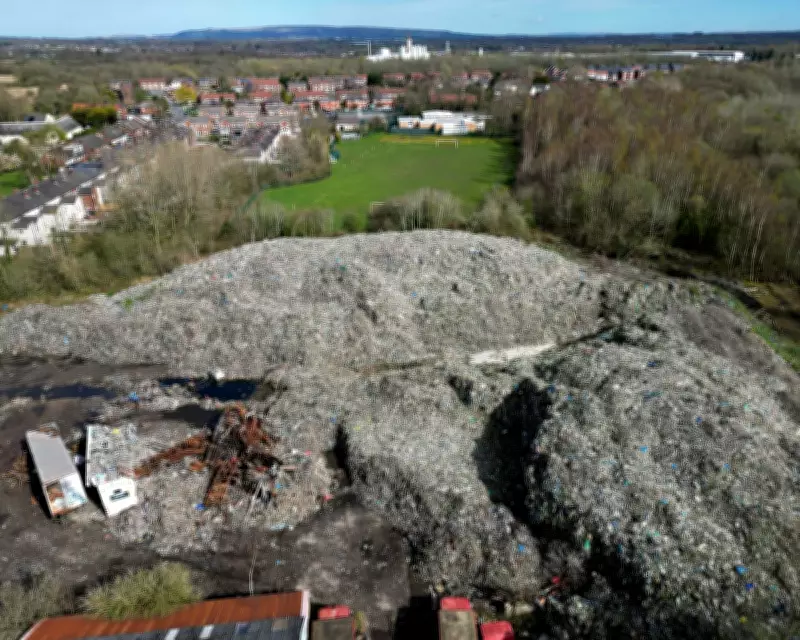
Organised Waste Crime: The UK's Most Successful Growth Industry
Welcome to Britain's most thriving sector: organised waste crime. Thanks to a prolonged ideological campaign against regulation, our nation has been transformed into an actual dumping ground. This isn't metaphorical—it's literal. From the perspective of criminal waste gangs, the UK represents one massive potential landfill site where detection risks are minimal to nonexistent and penalties are largely laughable. Successive governments have effectively handed criminals a license to print money.
Out of Control: The Scale of Illegal Dumping
Last week, the Commons public accounts committee declared that illegal waste dumping is completely "out of control." The UK now suffers from between 8,000 and 13,000 illegal waste sites. While most contain just a few lorry loads, some amass tens of thousands of tonnes of waste, including household products, asbestos, heavy metals, and highly toxic, flammable, and explosive organic chemicals. This rubbish blows through neighbourhoods, flows into rivers, and seeps into soil and groundwater. In most instances, no action is taken.
This situation isn't a glitch—it's the inevitable outcome of a sustained ideological assault on regulation. Governments have treated essential public protections as "red tape" to be slashed and regulators as "checkers and blockers" to be vanquished. Ministers avoid deleting protections from statute books to prevent public outrage, so instead they slash funding for monitoring and enforcement: deregulation by stealth. Over the past fifteen years, this approach has built an entirely new industrial sector almost from scratch: organised waste crime, arguably Britain's most successful growth industry.

Lucrative Business Model with Minimal Risk
The business model is straightforward and highly profitable. Someone paying for waste removal covers transit, landfill tax, and gate charges at official disposal sites. Instead of taking waste to registered landfills, criminals dump it on farmland, nature reserves, ancient woodlands, country lanes, or even—as seen in Bickershaw near Wigan—on green space adjacent to a primary school. The difference is pocketed: approximately £2,500 per articulated lorry load. The barrier to entry is so low that even registering a deceased goldfish with the Environment Agency as an upper-tier waste dealer demonstrates how accessible this criminal activity has become.
With detection chances so minimal and profits so substantial, waste dumping has evolved into a "gateway" to organised crime, as reported by the House of Lords environment and climate change committee. These networks branch into drugs, guns, money laundering, fraud, and modern slavery. Waste crime is altering the country's character both socially and physically.
Regulatory Failure and Community Devastation
Regulators have become so underfunded, demoralised, and ineffective that even when investigations and prosecutions begin—a rare occurrence—dumping often continues. This exact scenario unfolded at Bickershaw, where a 25,000-tonne illegal tip forced primary school closures, infested the neighbourhood with rats and flies, damaged local businesses, and ruined residents' lives. Locals first reported dumping in late 2024, prompting the Environment Agency to launch a "major criminal investigation." Yet drone footage from mid-February this year showed ongoing activity at the site, revealing that the agency, council, and police had failed to secure it.
The pattern repeats nationwide. When trucks began arriving on the banks of the River Cherwell north of Oxford in summer 2025, local anglers, neighbours, and landowners reported them. The Environment Agency's response was merely issuing "a cease-and-desist order" without blocking the entrance or installing trail cameras to monitor activity and identify culprits. Unsurprisingly, lorries kept coming. Months later, the agency finally secured the site, but by then a 20,000-tonne waste mountain slipping into the river had become a "critical incident."

Ancient Woodlands and Bureaucratic Runarounds
At Hoad's Wood in Kent, a "strictly protected" ancient woodland, locals reported in 2020 that several acres of trees had been illegally cleared—dumpers preparing their site. Authorities failed to respond. Between 2020 and 2023, gangsters deposited over 30,000 tonnes of construction and household waste there. Residents provided authorities with footage of dumping and even names of companies involved, yet nothing happened. A restriction order wasn't imposed until January 2024, and arrests only occurred in February 2025. As Kent's police and crime commissioner told a House of Lords inquiry, people "report it to the borough council, which will tell them to report it to the police, who will tell them to report it to the Environment Agency, which will tell them to report it to the council, which will tell them to report it to the police. They will just keep going round and round and round, and no one cares." The cleanup operation will now cost taxpayers £15 million.
The True Cost of Deregulation
This is deregulation in action—another example of successive governments' bizarrely lopsided version of "fiscal discipline" that counts costs of action but ignores costs of inaction. Conservative estimates place illegal dumping's annual economic cost in England at £1 billion. Cleaning up criminal dumps accumulated over the past fifteen years could cost tens of billions, not accounting for potential aquifer contamination from toxic waste seepage, whose impacts could be exponentially greater. All this stems from cuts inflicted on regulators in the name of "efficiency," saving a tiny fraction of these costs.
Inadequate Government Response
A fortnight ago, the government published its "waste crime action plan." While some measures are welcome, they don't match the crisis scale. An extra £15 million annually for waste crime enforcement represents a mere wooden sword against vast organised crime networks grown in the regulatory vacuum. Notably, £15 million equals the cleanup cost for just one of 8,000 sites: Hoad's Wood. Every proposal in this plan is undermined by the prime minister's ongoing deregulation agenda, which also appears "out of control."
Broader Implications of Neglect
Underfunding and deregulation, now in their fifth decade, are destroying our country. They prevent problem-solving, spreading hopelessness and passivity while opening doors to economic mafias and political profiteers exploiting misery and despair. The waste piling up around us serves as a potent symbol of dysfunction and neglect—the literal dump becoming a metaphorical one.