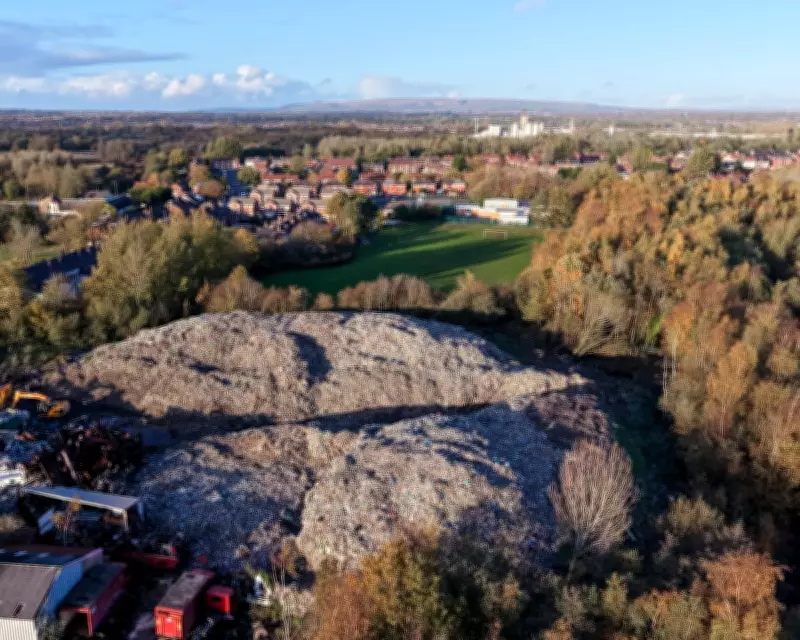
A massive illegal waste dump in Wigan, containing approximately 25,000 tonnes of refuse, has been labelled as presenting a grave environmental hazard by the chair of the House of Lords environment committee. Shas Sheehan has directly challenged the Environment Agency's refusal to clean up the site, which is situated perilously close to a local primary school in the Greater Manchester town.
Immediate Public Health Imperatives
Lady Sheehan, who personally visited the site in the village of Bickershaw, emphasised that a clean-up operation is not only environmentally critical but also an urgent public health imperative. The proximity to a school amplifies the risks, with the site having previously caught fire for ten consecutive days last summer. This major incident forced the temporary closure of the educational establishment and required nearby residents to seal their windows against hazardous fumes.
Risks of Proliferating Infestations and Fire
With warmer weather approaching, Sheehan warned of a heightened risk of further fires at the unstable site. She detailed how rising temperatures would inevitably lead to a proliferation of rat infestations, driving rodents towards nearby homes in search of food. The conditions are also ripe for flies and maggots to breed prolifically once again. The pervasive stench, already noticeable during a January visit, is expected to intensify markedly, creating an unbearable living environment for the local community.

Environment Agency's Contested Stance on Risk
The Environment Agency has developed plans for the removal of the waste in Wigan, but only on the condition that specific funding becomes available. This position was outlined by Sue Hayman, the parliamentary undersecretary of state for environment, food and rural affairs. The agency contends that the Wigan site does not carry the same level of significant environmental risk as other cases, such as the illegal dump in Kidlington, Oxfordshire, where a multi-million-pound clean-up is underway.
Minister Hayman noted that an ongoing clearance at Hoad's Wood in Kent was also deemed an exceptional case necessitating action. However, the government stated that the largest section of the land in Wigan where the waste was dumped is currently ownerless. Through the common law escheat principle, it has reverted to the ownership of the Duchy of Lancaster. At present, the Environment Agency and its partners have no legal powers to compel the Duchy to clear that land.
Parallel Criminal Investigations
Criminal investigations into the illegal dumping activities at both the Kidlington and Wigan sites are actively ongoing. In connection with the Oxfordshire case, four men have been arrested and subsequently released pending further investigation. A spokesperson for the Duchy of Lancaster affirmed their commitment, stating: We remain fully committed to working with Wigan council and the Environment Agency to address this issue and to counter the impact of illegal waste tipping.
A Call for Ministerial Direction
In her formal correspondence with the government, Lady Sheehan argued that while the committee acknowledges the Environment Agency is not routinely funded to clear illegal waste sites, clear circumstances exist where it can act under ministerial direction. She highlighted the apparent disparity in the agency's response, given the substantial resources being allocated to the Kidlington clean-up while the Wigan site, with its demonstrable public health dangers, remains in limbo.
The situation in Wigan underscores a broader national issue of waste crime, often described as the new narcotics for its profitability and severe environmental consequences. The standoff between parliamentary pressure for action and the cited constraints of funding and legal authority leaves a community facing continued exposure to fumes, pests, and the threat of fire from a towering illegal dump on their doorstep.