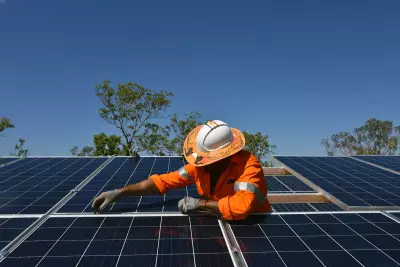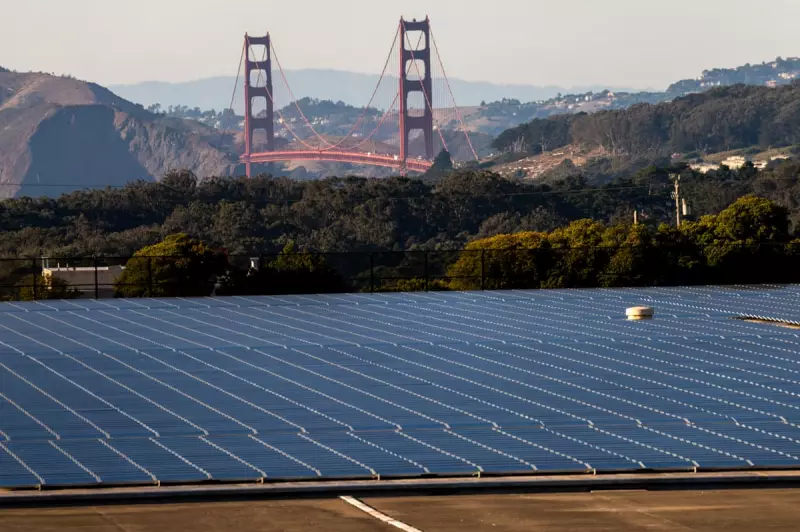
In a landmark achievement for the fight against climate change, the state of California powered its main electrical grid entirely with clean energy for at least part of nearly every single day in 2025. This historic milestone underscores the Golden State's rapid transformation into a renewable energy powerhouse, even as the federal government under President Donald Trump abandons national climate initiatives.
The Golden State's Grid Transformation
Governor Gavin Newsom has been championing California's progress on the global stage, most recently at the Cop30 climate summit in Brazil. With the Trump administration absent, Newsom positioned California as a "stable, reliable" climate leader ready to fill the void. He revealed that the world's fourth-largest economy now runs on 67% clean energy on nine out of ten days.
The state's journey is the result of ambitious policy and heavy investment. A 2018 bill set targets of 60% renewable and zero-carbon electricity by 2030 and a 100% clean grid by 2045. The progress is striking:

- Since 2019, California has added a colossal 30,800 megawatts of clean energy and battery storage capacity.
- Clean energy sources accounted for 67% of retail electricity sales in 2023.
- The state has witnessed its largest-ever annual drop in natural gas production.
Professor Mark Jacobson, a renewable energy expert at Stanford University, called the shift "remarkable," noting that solar and battery storage are decisively stepping up to replace fossil fuels.
Battery Storage: The Game Changer
Central to California's success has been an unprecedented expansion in battery storage capacity, a crucial technology for managing the intermittent nature of solar and wind power. The growth is exponential:
- In 2019, the state had 771 megawatts of battery storage.
- By October 2025, that figure had soared to nearly 17,000 megawatts.
- California now has 2.5 times more battery storage available than it did in 2022.
Mark Rothleder of the California Independent System Operator (Caiso) explained that these batteries allow excess solar energy generated during the day to be stored and released in the evening when demand peaks and the sun sets. "Having a mix of resources that are capable of producing when needed is an important addition," he stated.
This infrastructure has helped avoid rolling blackouts and is proving a cost-effective alternative to gas-fired "peaker" plants, especially during heatwaves and natural disasters, according to a 2025 report by Regenerate California.
Navigating Federal Headwinds and the Gas Dilemma
California's clean energy charge is occurring against a backdrop of active opposition from the Trump administration. The federal government has:
- Blocked California's rule banning new gas-powered car sales by 2030.
- Terminated a $7bn solar programme for low-income communities.
- Cancelled $679m in funding for offshore wind, including $427m for a pioneering West Coast terminal.
In response, the state has established a dedicated legal office to challenge these federal actions. "You're going to see California fiercely litigating every single effort," said environmental attorney Noah Perch-Ahern.
Despite the progress, challenges remain. Natural gas, while in decline, still provides roughly a third of the state's electricity and is a critical backup during peak hours. California operates nearly 200 gas plants. Julia Dowell of the Sierra Club noted the state is "struggling to figure out how we meet demand in those evening hours."
Nuclear power, contributing nearly 10% of generation in 2024, remains a contentious part of the energy mix, seen by some as necessary for reliable, carbon-free power.
Advocates like Maia Leroy argue the focus must now be on phasing out the expensive "insurance policy" of gas plants and expanding decentralised resources like rooftop solar. With its ambitious targets, massive battery investments, and determined political stance, California is forging a path that could redefine energy leadership for the 21st century.