Devon's Pioneering 'High-Density' Hydro System Begins Electricity Generation
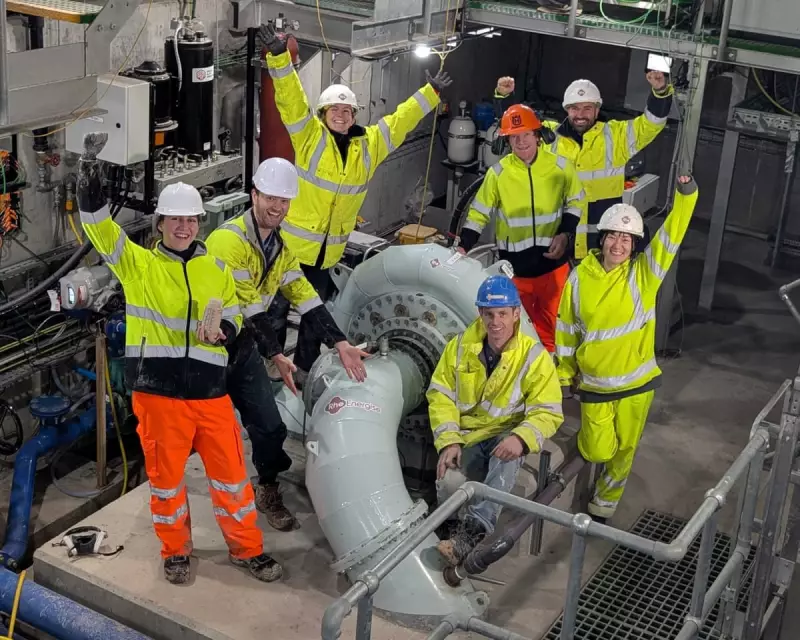
A revolutionary hillside battery located near Plymouth in Devon has commenced electricity generation, employing a first-of-its-kind hydropower system that operates underground. This innovative project utilises technology capable of storing and releasing renewable energy even on gentle slopes, marking a significant advancement in sustainable energy solutions.
Expanding Hydropower's Reach with Innovative Design
The pioneering system developed by RheEnergise allows one of the oldest forms of energy storage—hydropower—to function effectively without requiring the steep dam walls and mountainous terrain typically associated with traditional hydropower installations. This breakthrough design means hydropower principles can now serve as a form of long-duration energy storage in many more locations across the United Kingdom and worldwide than previously possible with conventional hydropower dams.
Furthermore, these innovative projects promise to be quicker and more economical to construct compared to traditional hydropower infrastructure, potentially accelerating the transition to renewable energy systems.

How the High-Intensity Hydro System Works
Engineers at RheEnergise have developed this project to emulate the United Kingdom's established hydropower plants, which have supplied the national grid for decades by using surplus electricity to pump water uphill during periods of abundant power, then releasing that water through turbines to generate electricity when supplies diminish.
However, the company's high-intensity hydro project employs a crucial innovation: instead of water, it uses a mineral-rich fluid with more than two and a half times the density of water. This allows the system to generate equivalent amounts of electricity from slopes that are less than half as high as those required for traditional hydropower systems.
Proven Performance and Global Expansion Plans
Stephen Crosher, the chief executive of RheEnergise, confirmed that the government-backed demonstration project has consistently achieved its target of generating 500 kilowatts—sufficient electricity to power approximately 400 homes for a year if operated continuously. This successful performance provides strong validation for the technology as the company prepares to develop commercial-scale projects internationally.
RheEnergise is currently engaged in discussions with independent developers across multiple countries, including the United Kingdom, Italy, Poland, Spain, and North America, with plans to construct the first commercial-scale project within the next three years. The company anticipates partnering with larger utility providers to develop more extensive projects during the 2030s, when widespread adoption of renewable energy is expected to create substantial demand for long-duration storage solutions.
Government Support and Environmental Benefits
The United Kingdom government has allocated more than £69 million in funding to advance long-duration energy storage technologies, recognising their potential to reduce the overall costs of achieving net-zero emissions. This innovative hydropower technology could help manage fluctuations in wind and solar power output by storing excess low-carbon generation for extended periods.
This capability could significantly decrease reliance on fossil fuels to supplement electricity supplies during periods of low renewable energy generation. Additionally, it could reduce instances where system operators must compensate wind and solar farms to curtail generation when their output threatens to overwhelm the electrical grid.
Patrick Vallance, the minister for science, innovation, research, and nuclear, emphasised the importance of this development, stating: "Storing energy will play an increasingly important role as we transition to clean power. RheEnergise's first-of-a-kind system has the potential to strengthen our future long duration energy storage capabilities. Scaling up innovations like these is essential as the UK's energy demand grows and we move to a clean power system that we control."