

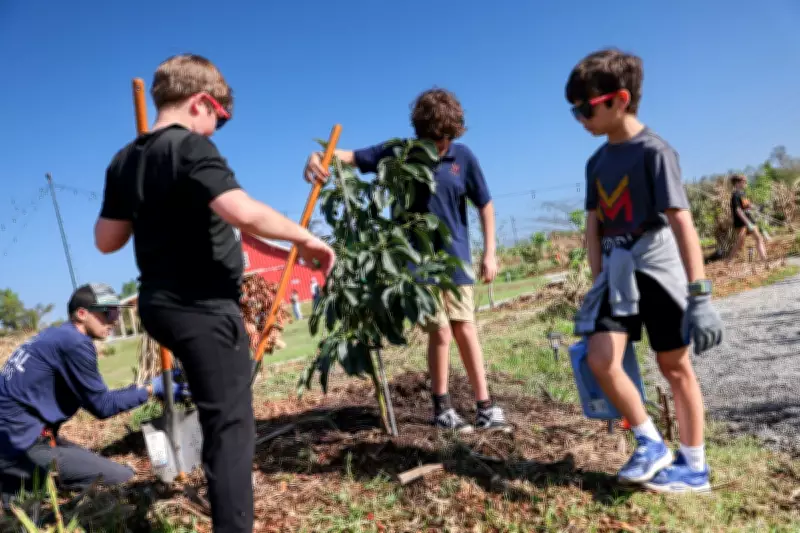
Florida Urban Orchard Initiative Fights Food Insecurity with 120 Fruit Trees
In a groundbreaking effort to combat food insecurity, dozens of newly planted fruit trees have transformed a Florida "food desert" into a thriving urban orchard. The initiative, a collaboration between the national Arbor Day Foundation and local organizations, aims to counter soaring grocery prices while providing fresh produce access to underserved communities in Orlando.
Addressing Critical Food Access Issues
The central Florida area where this partnership took place has been officially designated by the US Department of Agriculture as a food desert—a region characterized by low income combined with poor access to fresh grocery products. According to recent USDA statistics, nearly 50 million Americans experienced some degree of food insecurity during 2024, with 18.8 million living in food deserts located more than a mile from supermarkets in urban areas.
Dan Lambe, chief executive of the Arbor Day Foundation, emphasized the evolving mission of his organization: "For more than 50 years the foundation has been planting trees worldwide, but we're witnessing a sharp increase in demand for food forests and urban orchards—trees that provide not just shade and beauty, but also yield nuts, fruits, and food."

Educational Component and Community Involvement
The project, which involved planting 120 trees at the 4Roots farm west of downtown Orlando and several community sites around the city, incorporates significant educational elements. "One favorite aspect is helping children understand that food comes from the ground and from trees, not just from grocery stores," Lambe explained. "Education represents a huge piece of what we're doing, ensuring people comprehend the value of trees for shade, health, wellness, food, and numerous other benefits."
John Rivers, founder and chief executive of 4Foods, highlighted the importance of community participation: "We bring in students, volunteers, corporations, and companies who actively participate in planting. Being involved in construction creates better understanding and greater appreciation than merely observing finished work."
Beyond Temporary Solutions
Organizers stress that this initiative moves beyond temporary charity solutions toward sustainable food sovereignty. Rivers noted the heartbreaking reality of food deprivation amid American food waste: "Approximately 40% of food grown in the US goes unsold or uneaten while families struggle with affordability and access. Handing out more meals won't solve food insecurity alone—it's crucial to educate and inspire communities toward self-sufficiency."
The project specifically targets Florida's subtropical climate with citrus trees, mango, banana, avocado, and pecan plantings, though organizers emphasize the model can be adapted to local conditions nationwide. Lambe stated: "We're examining how to both feed and educate communities about new urban food production systems that can complement broader agricultural frameworks."
A Model for National Replication
Those behind the community forest venture believe the Orlando project can provide a replicable model for addressing food insecurity across the United States, particularly in impoverished areas. The collaboration between the Arbor Day Foundation, 4Roots, and the VoLo Foundation—a Florida nonprofit supporting climate-based science—began with an inaugural planting in November 2025, culminating in a recent ceremony marking the final 67 trees being planted.
Lambe concluded with a powerful statement about trees' contemporary importance: "Trees represent a must-have for our current era, not merely a nice-to-have, especially in communities lacking food resources where people struggle with food independence and sovereignty issues. In this extreme heat and amid global mental health challenges, trees are increasingly recognized as essential solutions."
The initiative comes at a critical moment when demand for affordable, healthy food has reached its highest level since the COVID-19 pandemic, offering both immediate relief and long-term sustainability for vulnerable communities.






