

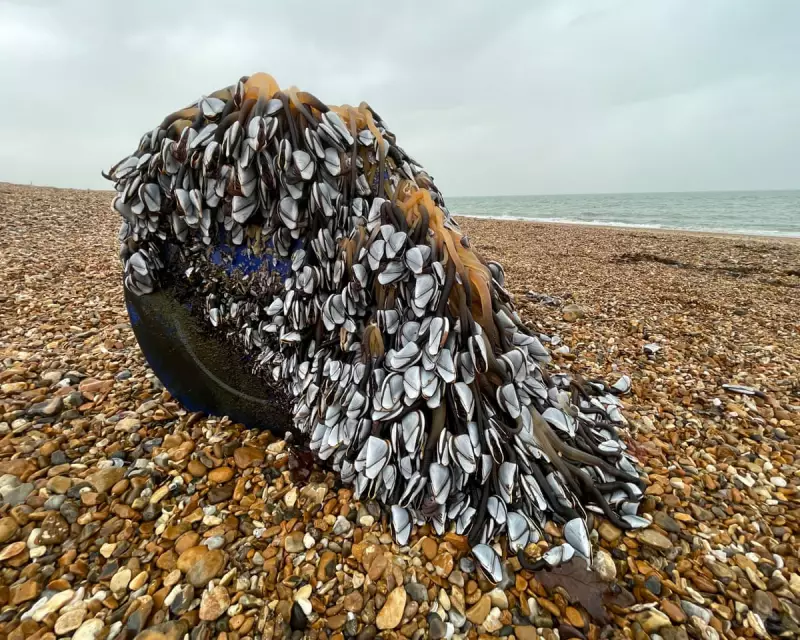
A curious discovery on a Hampshire beach has highlighted the perilous journeys of marine life carried by ocean currents. A blue plastic barrel, densely encrusted with colourful goose barnacles, was found stranded on the shingle of Hayling Island, a vivid testament to life adrift.
A Curious Discovery in the Storm Debris
The unusual find was first spotted by a local dog walker, whose whippet took a keen interest in the object. Despite heavy rain, the photographer Claire Stares ventured out to investigate. The barrel lay among a fresh line of storm-tossed wrack, cuttlebones, and ubiquitous plastic waste. But the living cargo spilling over its sides was the true spectacle: a large cluster of common goose barnacles, known scientifically as Lepas anatifera.
These creatures begin life as larvae, attaching themselves to any floating object they encounter, from driftwood and buoys to ships and even turtles. Their ultimate destination is left to the whims of wind and current. While most abundant in warmer, tropical waters, their range can extend to Britain's south-west coast, making them a rarity on the Hampshire shoreline.

The Fascinating Biology of Pelagic Castaways
Observed up close, the barnacles present an arresting sight. It becomes clear why medieval naturalists once believed that barnacle geese hatched from these crustaceans. Each barnacle is topped with a pale, heart-shaped shell, or capitulum, reminiscent of the goose's face. This 'head' is supported by a long, fleshy stalk called a peduncle, which arches elegantly like a bird's neck.
Ranging from 1cm to 8cm in size, their shells are composed of five subtly striated plates, edged with vivid orange tissue. They hinge open to allow delicate, feather-like feeding tentacles, called cirri, to unfurl and sweep the water for plankton. Swaying together in the water, a colony eerily mimics a flock of grazing geese.
A Grim Fate Sealed on the Shore
For these pelagic travellers, beaching is usually a death sentence. At the time of discovery, a few barnacles were still fluttering their cirri in the briny air, as if searching for food. Most, however, had tightly closed their shells in a desperate bid to conserve moisture. By the afternoon, their condition had deteriorated, with many hanging limply from darkened stalks.
Although they can survive for several days out of water, their prospects were bleak. With the sea calm and the barrel too heavy for would-be rescuers to roll back into the waves, their fate was effectively sealed. The stranding serves as a poignant reminder of the fragile intersection between ocean voyagers and human debris, with the plastic barrel itself underlining the persistent issue of marine pollution.






