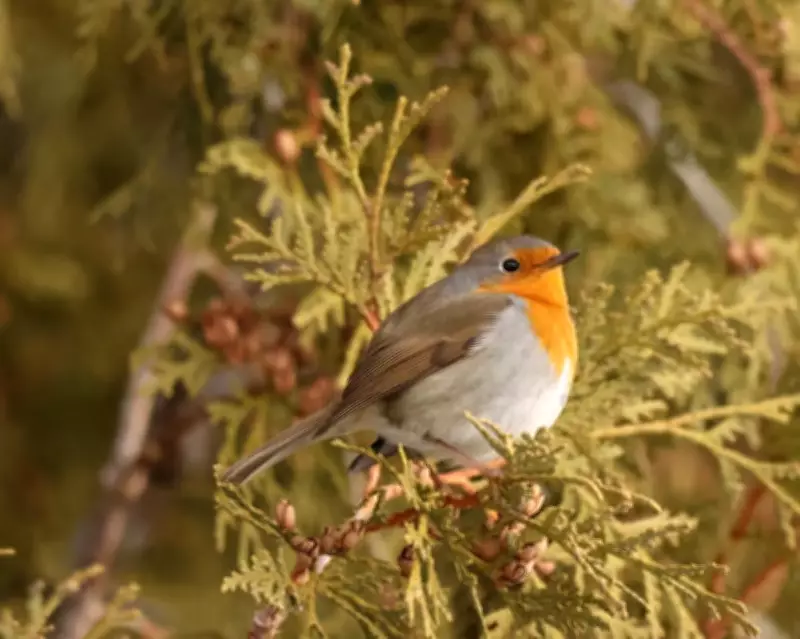
First European Robin in Canada Draws Birdwatchers to Montréal
In the midst of a frigid Montréal winter, an unexpected visitor has captured the attention of bird enthusiasts across North America. A European robin, a species never before recorded in Canada, has taken up residence in a quiet neighbourhood, sparking both excitement and concern among the birdwatching community.
An Unprecedented Sighting
This remarkable discovery represents the first documented appearance of a European robin anywhere in Canada, with only five or six previous sightings across the entire North American continent. The bird was initially spotted in early January, and since then, hundreds of birdwatchers have braved freezing temperatures to catch a glimpse of this rare visitor.
Ron Vandebeek, a birder from Ottawa, Ontario, was among those who made the journey to Montréal on a cold February morning. "It's neat to see a bird totally out of its environment," he remarked after successfully spotting the distinctive orange-breasted bird.

The Mystery of Migration
The European robin's normal habitat spans western Europe, from Scotland to Turkey, with seasonal migrations reaching as far north as Sweden and Iceland. This makes its appearance in Québec particularly puzzling for experts.
Maggie MacPherson, an evolutionary ecologist at Trent University in Ontario, expressed amazement at the sighting. "If the European robin migrates at all, it only travels short distances," she explained. "That makes this sighting just amazing."
Bird experts have proposed several theories about how this robin might have reached Canadian shores. The leading hypotheses suggest it either caught a ride on a container ship bound for the Port of Montréal or was swept across the Atlantic by powerful autumn storms.
Adapting to Unfamiliar Surroundings
The robin has chosen an unlikely home - a neighbourhood sandwiched between industrial areas with warehouses, railway lines, and port facilities along the St Lawrence River. Despite the challenging environment and Montréal's coldest winter in four years, with temperatures plunging to -25°C, the bird appears to be adapting well.
Sheldon Harvey of Bird Protection Quebec offered reassurance about the bird's chances. "For that type of bird, it's really driven by food," he said. "As long as they can find food, their metabolism will keep them through the cold."
Bird enthusiasts have been ensuring the robin receives adequate sustenance, supplementing its usual insect diet with other food sources available at platform feeders placed in the area.
A Growing Phenomenon
This sighting is part of a broader trend of increasing rare bird appearances. Ted Floyd, editor of the American Birding Association's Birding Magazine, noted there has been a sharp increase in rare bird sightings over the past decade, though he cautioned this might reflect increased birdwatching activity rather than actual population changes.
"There are many, many more people watching birds with really good cameras and social networks where they are discussing their findings," Floyd observed.
The phenomenon works both ways across the Atlantic. In 2008, a white-crowned sparrow native to North America drew crowds of birdwatchers in North Norfolk, England, demonstrating that these unexpected appearances occur in both directions.
Scientific Significance and Concerns
MacPherson suggested that climate change might be contributing to these unusual sightings. "I think it's not out of the question that if we're having more storms, we could get more vagrants that are being swept up in this storm situation," she said, noting that changes in North Atlantic storm patterns could lead to more birds being displaced from their normal ranges.
While researchers continue to investigate links between climate change and bird migration patterns, the Montréal robin represents a fascinating case study. MacPherson estimates the bird is likely a young adult of about two years old, with the species typically living five to eight years in the wild.

Community Response and Future Prospects
The robin has become something of a local celebrity, drawing birdwatchers from across the region. Serge Benoît from Laval, Quebec, explained the appeal: "It's a very rare bird and it's the first time it's been reported in all of Canada. We've never seen it before. So, when a bird is very rare, we'll travel farther."
Montrealer Valéry Landry successfully spotted the bird on her second attempt. "I was lucky," she said. "In 10 minutes, he was there."
Despite the excitement, there's concern about the robin's long-term prospects. Harvey expressed mixed feelings: "We always feel kinda bad when a solo bird of a species shows up. Other birds that have shown up like this robin, they tend to suddenly disappear. We don't know where they go or what happens to them."
Nevertheless, the birdwatching community continues to monitor the situation with keen interest, documenting this unprecedented occurrence while hoping for the robin's survival through the challenging Montréal winter.