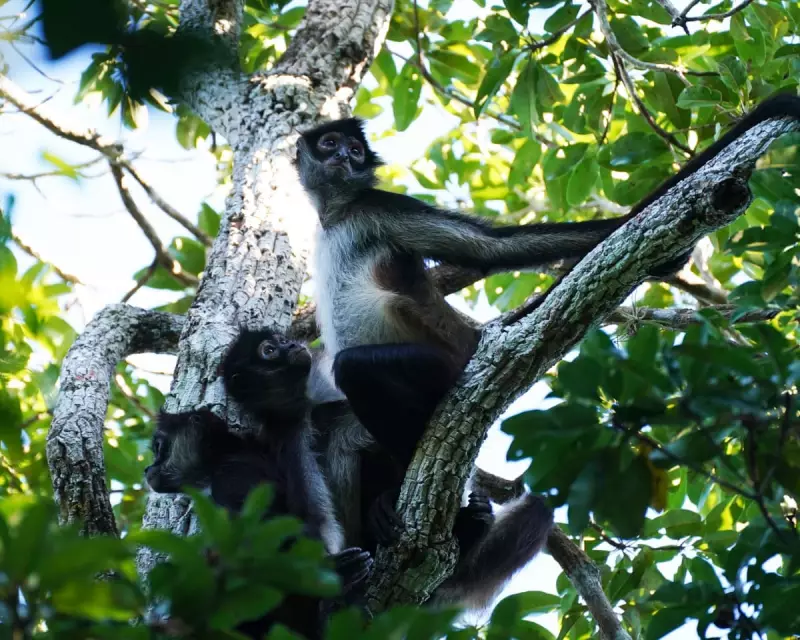
Spider Monkeys Share Insider Knowledge Through Social Swapping
Spider monkeys have been discovered to share tips about where to find the best food by strategically changing their social groups, according to new research. This behaviour represents a clever system for sharing insider knowledge that enhances the entire group's foraging success.
Observing Primate Information Exchange
Researchers observed Geoffroy's spider monkeys frequently switching between subgroups of three or more individuals. This social fluidity enables them to exchange crucial information about the location of fruit trees and the timing of when those fruits will ripen. The study, published in the journal npj Complexity, reveals that this behaviour allows the primates to combine their information to produce new knowledge.
As the report explains: "An example would be if one subset of individuals would contribute the location of a food source and another subset the timing of the fruiting of that source. The resulting, combined knowledge by both subsets of individuals would be synergistic in the sense of allowing all of them to exploit the food source according to its location and timing."

Seven Years of Field Observations
The research involved scientists from Heriot-Watt University, the University of Edinburgh, and the National Autonomous University of Mexico. Their findings are based on seven years of field observations conducted in Mexico's Yucatán peninsula between January 2012 and December 2017.
Dr Matthew Silk, an ecologist from the University of Edinburgh, emphasised the intentional nature of this behaviour: "It isn't random social mingling. It's a clever system for sharing insider knowledge about where the best fruit trees are located across their forest home. By constantly changing their subgroups, monkeys who know different parts of the forest can share information about where fruit is available."
Mapping Monkey Knowledge Networks
Scientists tracked individual monkeys' movements and mapped their core ranges—the specific areas each monkey knows well. Some forest areas are known by multiple monkeys, similar to a town's most popular restaurant, while others are known by only one or two monkeys, like hidden gems.
"There's enough overlap for monkeys to meet and exchange tips, but enough separation that each monkey scouts different parts of the forest," explained Dr Silk. "This maximises the whole group's collective coverage of the best feeding spots."
Mathematical Modelling Reveals Optimal Strategy
Ross Walker, a PhD student at Heriot-Watt University, developed mathematical modelling techniques to analyse what the monkeys gain from these relationships. "We've shown that there's an optimal middle ground between the monkeys sticking together and spreading out too far," he said. "It's best when individuals explore different areas, but still reconnect often enough to pool what they've learned."
Collective Intelligence in Natural Conditions
The research team concluded this represents a compelling example of collective intelligence in natural conditions. Professor Gabriel Ramos-Fernandez from the National Autonomous University of Mexico highlighted the significance: "We have shown that the fluid social dynamics of spider monkeys has an important consequence for their foraging success. By exploring their environment in a distributed fashion and then coming together to share their uniquely obtained information, the group as a whole can know the forest better than a single individual could on its own."
The Geoffroy's spider monkey, also known as the Central American spider monkey or black-handed spider monkey, is considered an endangered species. This research provides valuable insights into how these primates have developed sophisticated social strategies to thrive in their forest habitats.