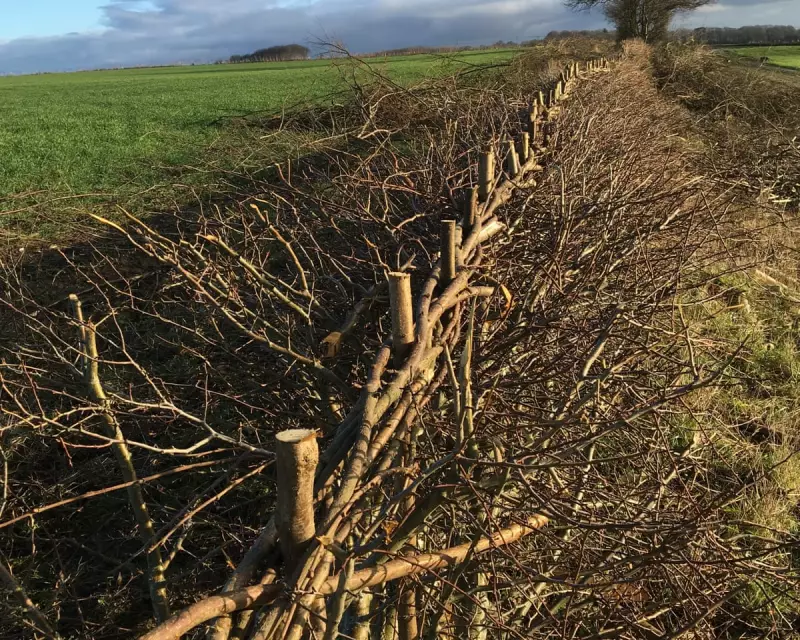
In the rolling fields of the Kent Weald, a timeless rural craft is being practised, one that shapes the very fabric of the British countryside. While modern wire netting and barbed fences now demarcate ancient pastures, the original boundary was the living hedge. This human-made feature, central to our pastoral landscape, requires skilled maintenance to survive, leading practitioners into the cold with billhooks and axes to perform the ancient art of hedge laying.
The Art and Purpose of a Living Boundary
Hedges were planted historically almost solely for the purpose of enclosure, long before the invention of stock fencing. However, an unmanaged hedge is not a permanent solution. As young trees mature, their trunks become bare and gaps appear, rendering them useless for containing livestock. The solution developed over centuries is hedge laying, an act of maintenance rather than creation, which reinvigorates these vital living structures.
This morning in Cranbrook, Kent, one such practitioner began work on a stretch of leggy hawthorn. The process starts with clearing undergrowth and low branches. Then, starting at one end, the first tree is freed from its neighbours. With an angled swing of an axe, a cut is made almost entirely through the base. This partially severed stem, known as a pleacher, is then bent over. It remains attached to its root by a slender tongue of living wood and is laid down in line with the hedge.

Regional Styles and Modern Motivations
This practice is not uniform; regional styles abound across Britain. In Devon, hedges growing atop banks are laid very low, while the robust "Midland style" is laid high and thick to withstand cattle. In the South East, learning the local style may not be complicated, but achieving proficiency takes years of dedicated practice.
The newly laid pleachers are vulnerable. To secure them, wooden stakes are driven through the hedge's central line. A rope-like binding of hazel wands is then woven along the top, holding everything firm until new growth knits the structure together. A well-laid and maintained hedge can last for decades, and when it eventually fails, it can simply be relaid, a cycle of renewal stretching back generations.
The hedge being worked on in Cranbrook will likely never hold livestock. Like most modern hedge-laying projects, the primary aim is environmental. The goal is to reinvigorate the hedge and reinstate it as a crucial environmental asset—a dense home and a safe conduit for wildlife, rather than merely a barrier.
Romantic Vision Versus Physical Reality
To an observer, hedge laying is a conspicuously romantic pursuit. It involves repairing the living arteries of the landscape using ancient skills and simple tools, a direct connection to an agrarian past. On the ground, however, the reality is one of harsh, physical labour undertaken in all weathers.
Yet, it is beyond these hardships that the true romance and satisfaction reside. To look, cold and exhausted, over a completed section of hedge—neat, strong, and ready for a new century of life—offers a hard, ancient, and profound pleasure. This craft ensures that these iconic features of the British countryside continue to thrive for both heritage and ecology.
The Guardian's collection of nature writing, 'Under the Changing Skies: The Best of the Guardian’s Country Diary, 2018-2024', is published by Guardian Faber.