

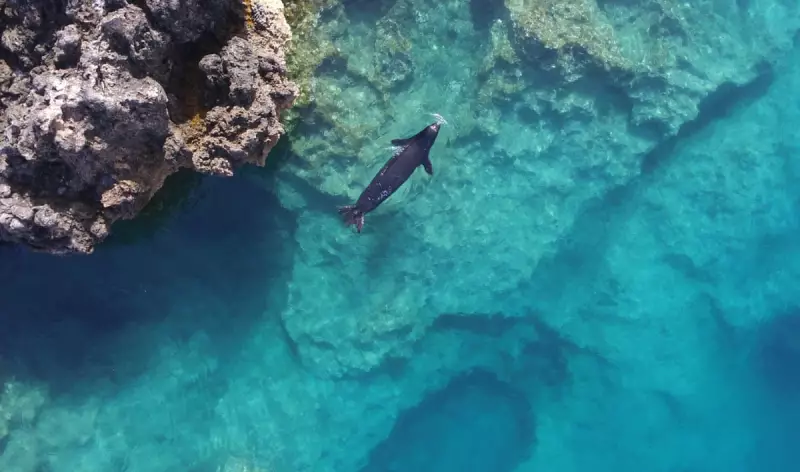
In the shadowy depths of a sea cave among Greece's Northern Sporades islands, a colossal figure stirs. On a nearby research vessel, binoculars are shared, revealing a magnificent sight: a Mediterranean monk seal, one of the planet's rarest and largest seal species, measuring up to 2.8 metres long.
A Sanctuary Under Pressure
The island of Piperi, part of the National Marine Park of Alonissos and Northern Sporades, serves as a critical sanctuary. This strictly guarded zone, Greece's largest marine protected area (MPA), permits only authorised researchers within three miles of its coast. It is a vital refuge for a species whose global population sits below 1,000 individuals.
Greece is home to roughly half of all monk seals, with numbers rebounding from about 250 in the 1990s to an estimated 500 today. This progress prompted the International Union for Conservation of Nature (IUCN) to reclassify the species from 'endangered' to 'vulnerable' in 2023. Yet, conservationists warn this fragile recovery is now at risk from a rapidly growing threat: Greece's largely unregulated marine leisure industry.

The Modern Peril: Boats and Disturbance
While historic hunting for pelts and blubber has declined, seals now contend with entanglement in fishing gear, pollution, and habitat loss. The explosion in boat-based tourism, however, presents an acute new danger. These sensitive mammals are highly susceptible to human disturbance, particularly during breeding.
"A week after giving birth, monk seal mothers go fishing, leaving their pup alone for hours," explains Panos Dendrinos, president of the Hellenic Society for the Protection of the Monk Seal (MOm). "If someone enters the cave, the pup may panic and flee. Its mother is unlikely to find it." MOm has rescued over 40 orphaned or injured seals, with rehabilitation playing a key role in the species' comeback.
The problem is starkly visible at Formicula, a key seal islet in the Ionian Sea. Marine biologist Joan Gonzalvo of the Tethys Research Institute recalls seeing multiple seals socialising daily just a few years ago. Now, after an influx of tourists seeking "seal experiences," sightings have plummeted. He recorded over 50 boats around the tiny shoreline on a single day in August 2024.
Protected Areas: A Paper Promise or a Lifeline?
In response, several initiatives launched this year. A national education campaign, Seal Greece, aims to raise awareness. Formicula was also given a strict 200-metre no-entry zone ahead of the summer season. In October, Prime Minister Kyriakos Mitsotakis confirmed plans for two new large-scale MPAs.
These designations could be a lifeline, but only with robust enforcement. Greece has long struggled with "paper parks"—protected areas on maps that lack proper policing. A recent study by nine environmental groups found that only 12 out of 174 marine Natura 2000 sites in Greece have any protective regime, and even those are often fragmented.
"The Natural Environment and Climate Change Agency needs more boats, more people," states Dendrinos. Currently, wardens report to port police, a process he describes as "time-consuming and ineffective." At Formicula, where no official wardens patrol, Gonzalvo is left to politely inform boat skippers they are in a forbidden area.
Back at the Alonissos MPA, there are encouraging signs. Freelance warden and marine biologist Angelos Argiriou points to a camera-monitored beach. "We often see seals resting here in the open," he says. "It's a good sign the protection measures are working." After 40 years of monitoring, Dendrinos confirms seals are starting to use open beaches again systematically.
The future of Monachus monachus, a creature once believed under the protection of gods Poseidon and Apollo, hangs in the balance. As Gonzalvo warns, "If we cannot protect this tiny habitat for one of the most charismatic marine mammals, there is little hope for anything else we wish to protect in our oceans."






