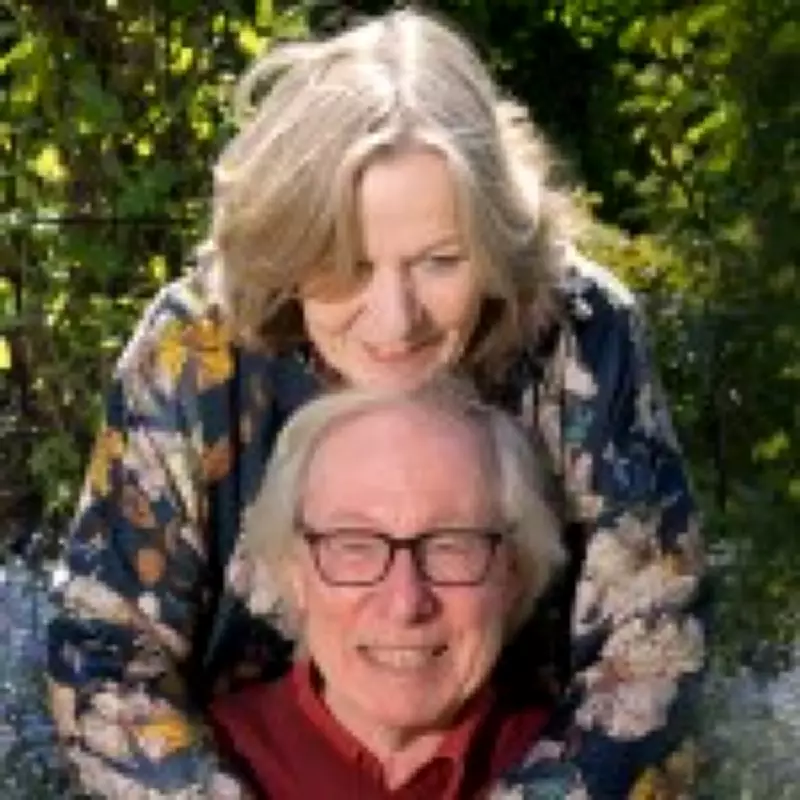
Retired judge Tony Scott-Gall was renowned for his intelligence and eloquence, so initially he masked dementia symptoms that emerged in his early seventies well. If his wife Caroline ever challenged him about forgetting their plans for the day, her husband would dismiss her with: 'There's nothing the matter with my memory. I'm just being lazy.' After half a century of marriage, Caroline knew better.
Despite the fact that he had been hiding forgetfulness and confusion behind his articulacy and excellent social skills, a number of symptoms had been emerging since 2018. Tony, who had always been an excellent driver, became frightening behind the wheel, on one occasion driving them into a ditch while on holiday in Scotland.
'And he developed very heightened anxiety,' Caroline, 75, tells Metro. 'We'd been on holiday to Paris and both went to the loo in a cafe. I told him I'd see him back at the bar, but when I returned, he didn't see me and his panic was absolute. I'd never heard such fear in somebody's voice. It wasn't like him,' she remembers.

When the usually socially ebullient Tony, now 80, became withdrawn in company, she knew something was very wrong. The final straw came in 2019. 'I had chosen some lovely gold-rimmed drinking glasses as gifts for our friends' golden wedding anniversary, shown them to him and asked his opinion on them. The following day he asked if we should get them a gift. I just burst into tears. I said: "There is something terribly wrong here Tony". And he just said, "Yes, I know." I don't know at which point in his own heart he knew. I suspect it was a long time before he admitted it.'
Dementia is hard to acknowledge for Caroline's generation, she explains. Leftover stigma from older relatives has left its mark, and she knows people who still struggle to admit the truth to their friends. But Caroline knew she needed help so the next day they made an appointment with the family GP.
'My biggest fear was that I wouldn't be believed, because Tony is so articulate, and he could mask symptoms brilliantly,' Caroline, from outside Haywards Heath, Sussex, remembers. The doctor did an assessment, which Tony passed with flying colours. But to be sure, he was referred to the local memory assessment service and a few weeks later, Tony sat another test where he was given memory, language and problem solving tasks. Caroline, sitting nearby, could see he was getting most all of the answers right.
'When Tony was asked to give as many words as he could that began with the letter P, he reeled them off, culminating in him saying "ptarmigan", which is a game bird in the grouse family. That just made me hoot with laughter!' Despite her amusement, Caroline's hope was mixed with concern. The nurse said Tony – then 74 – was unlikely to be suffering from dementia, but referred him for a brain scan anyway, in January 2020.
By March the couple received the heartbreaking diagnosis that Tony had Alzheimer's disease, the most common form of dementia. 'Tony had worked until he was 70. He spent the first 18 months of his retirement helping me care for my mother. We had so many plans, and suddenly you get that diagnosis and you realise your world is going to shrink. And it has. Quite rapidly. We knew that this disease was only going to go one way.' A nurse told Tony he would have to give up driving and the family GP prescribed drugs.
'Even though we'd been through the assessment process, the diagnosis was a shock. Tony said not being able to drive made him feel like he'd been chopped off at the knees. He was shattered. He's such a clever man. And your mind tends to jump straight to the end game. He developed this fear that I would want him to go into a nursing home, which wasn't helped by the fact that we were in lockdown. So we couldn't see people. He was angry. He was disappointed. And I felt bereft.'

Caroline knows now that Tony was harbouring one deep anxiety that he felt unable to air until he spoke to a consultant, which they had to fight to do. Eventually, they spoke to a specialist – two years after Tony's diagnosis. 'Tony told the doctor: "I am a lawyer. And I have to have the facts." And the doctor was absolutely brilliant. She showed us the scan and explained how they'd come to the diagnosis, and Tony said to her – this still brings a lump to my throat – Did I do something wrong? And she said, "Honestly, lots of people ask me that, and the answer Tony is, no. You have just been very unlucky."'
Although the appointment did nothing to alter the diagnosis, it did change the couple's mindset. Armed with the facts they felt empowered to do all they could to live well with dementia. So they continued to see their two adult children, five grandchildren and their large circle of friends as much as they could, went to the opera and ballet in London and kept busy.
'We tried to live fully and do the things we enjoy. We've been open with friends and family, and they've been wonderfully supportive and inclusive. We stay active, getting out for walks, days out, and meals, determined not to shut ourselves away. We see friends often, usually for lunch rather than supper, as Tony is better earlier in the day. By evening, he's tired because his brain must have worked so hard to keep up.'
They worked with the Brighton and Sussex Medical School and the Dementia Consultation Group, helping to inform research and train specialists and giving them a sense of purpose in the face of an uncaring disease. And they have raised money for the Alzheimer's Society by taking part in memory walks, and Caroline has found the charity's online resources a lifeline – especially in understanding stranger symptoms, like hallucinations.
'The other day the dog was out on the lawn, fighting its rug. And Tony thought it was a person. On another occasion he thought there was a lady with a purple hat in the garden when there was no-one there. And recently he was looking out of the front window and thought he was in the East End of London. That took him about two hours to come out of. And then he suddenly said, "Oh, I'm back". So he knew he had been somewhere else. My first line of defence if something cropped up that I felt was odd would be to have a look on the Alzheimer's Society website, and then would think – perhaps we do need to take this further or, it helps me understand that it is just another new symptom, of which there are many.'
The condition has accelerated recently and Tony now struggles to recognise names and faces, his mobility is compromised and he has to be shown to the loo in the home he's inhabited for 50 years. 'This disease is known as a living bereavement. Some people call it the long goodbye. I realise now that I have lost my soulmate. And that is very hard. It's a cruel disease.
'We have, and we continue to, live well with dementia. We are very fortunate to have a lot of family and friends' support. You don't get a prognosis with dementia. Some people accelerate very quickly. Some people become aggressive or need to be sectioned. We are six years from the diagnosis, and Tony has done really well comparatively,' Caroline says.
Caroline remains grateful for her own health and instead of dwelling on the future and the things they cannot do, the couple take pleasure in little joys. 'A text from a grandchild asking you out for lunch. A thoughtful message or gesture. A sunny day in the garden. Enjoying the blossom on the trees. We've accepted this diagnosis, but we're still living well, we haven't given into it. Our world may be small now, but it's still a world of good things.'