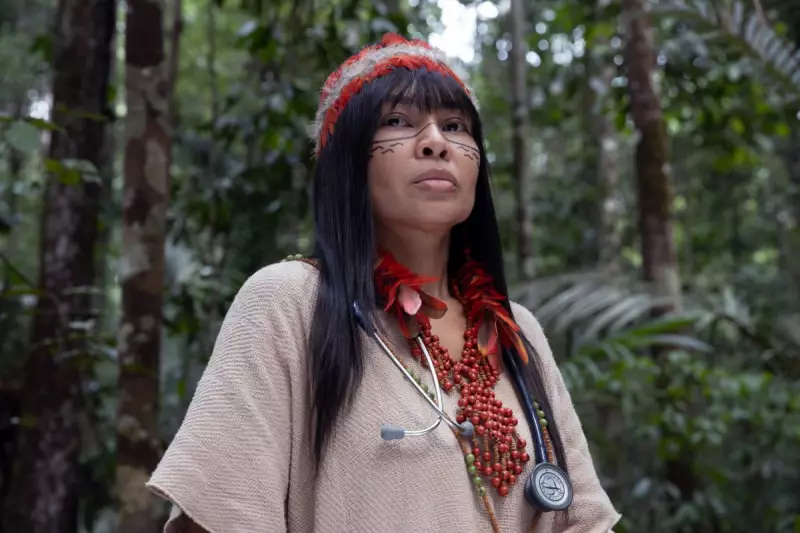
In a powerful fusion of ancient wisdom and modern science, Adana Omágua Kambeba has become a pioneering figure in Brazilian healthcare. She is the first person from her Indigenous Kambeba, or Omágua, people to graduate as a medical doctor, achieving this in a field where, according to the 2022 census, Indigenous people represent just 0.1% of graduates.
A Journey of 4,000 Kilometres and Two Worlds
Her remarkable journey began in 2012 when she travelled over 4,000 kilometres from her home in Manaus, deep in the Brazilian Amazon, to study medicine at the Federal University of Minas Gerais. Even before receiving her diploma, Adana embarked on a parallel path of spiritual fasting, striving towards her next goal: to become a shaman. She believes her calling is to act as a crucial bridge between Western biomedical practices and the rich, diverse healing traditions of Indigenous peoples.
This mission was powerfully articulated at a 2024 innovation conference in Rio de Janeiro, where Adana, adorned with long feather earrings and seed rattles, stood out among tech entrepreneurs. She delivered a compelling talk on the invisibility of Indigenous knowledge, arguing forcefully that scientific research must not usurp Indigenous expertise.

Mediating Conflict and Campaigning for Change
Now back in Manaus, Adana actively mediates the conflicts that arise in healthcare settings. She steps in when doctors dismiss Indigenous healing traditions or when Indigenous patients are wary of prescribed treatments. As an activist, she campaigns for a more open biomedical system that respects and learns from Indigenous knowledge, rather than subjugating it.
Her path has been fraught with difficulty. At university, she faced significant prejudice and nearly suffered a breakdown. Her resolve was fortified by an inner voice affirming her mission. "Something inside me said, 'This is your mission. Never doubt it,'" she recalls.
A Global Tapestry of Courage and Determination
Adana's story is one of several highlighted by Guardian reporters, showcasing individuals worldwide whose bravery and determination defy immense odds.
In Iran, Zhino Babamiri, 24, co-founded the Daughters of Justice while in exile, campaigning against a record number of executions. Her father, Rezgar Beigzadeh Babamiri, is on death row. Despite her terror, she fights daily, driven by her father's Kurdish saying: "Berxwedan jiyan e" – resistance is life.
In Uganda, politician Yvonne Mpambara, 33, experienced severe sexist abuse when she attempted to run for president. Undeterred, she is establishing a foundation to nurture future female leaders and founding an all-female political party.
From Gaza, Raed Jamal documented his daily, life-risking journeys to secure "American aid" for his family, lying on the ground as bullets flew overhead. His struggle for basic survival continues amid hunger and homelessness.
Zeynure Hasan, a Uyghur woman in Istanbul, waged a relentless four-year public campaign to save her husband, Idris, from deportation from Morocco to China. Her unwavering efforts led to their family being granted asylum in Canada in September this year.
In South Sudan, former gangster Alaak 'Kuku' Akuei, 25, founded the Young Dream Football Academy in Juba. Having escaped gang life himself, he now provides a safe alternative for 1,000 youths, using sport to combat rising violence.
Meanwhile, in Johannesburg, an outreach worker named Amanda was forced back to sex work at 39 after USAID cuts closed the specialist HIV clinic where she worked. Her story underscores the fragility of essential community-led health services.
Together, these narratives form a global mosaic of resilience, highlighting the extraordinary strength of individuals confronting systemic barriers, political persecution, and humanitarian crises with unwavering courage.