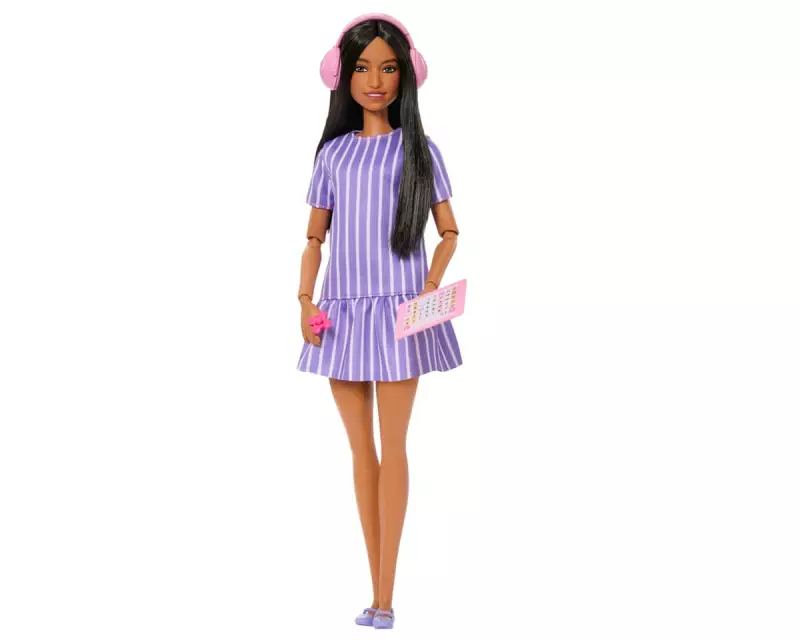
The launch of the first officially autistic Barbie doll by toy giant Mattel has sparked a complex conversation about representation, visibility, and the very purpose of a child's plaything. While some celebrate the increased mainstream visibility for autistic children, others have criticised the doll's design as lacking nuance.
A Parent's Perspective: Visibility in the Toy Box
Dr Erin Beeston, a parent and carer of autistic children based in Urmston, Greater Manchester, has expressed her personal pleasure at the doll's introduction. For her, the key benefit is the simple act of representation. Her children now see a reflection of themselves in mainstream culture, something that has historically been absent from the toy aisles.
"For the kids, they're interested," Dr Beeston notes, adding a touch of relatable humour by predicting her youngest's artistic tendencies will soon transform the doll into a version of "weird Barbie." Her primary point, however, is focused on the doll's intended audience. She argues that much of the criticism misses a fundamental fact: this Barbie is designed primarily as a toy for children, not as a comprehensive educational tool for adults.

The Criticisms: Can a Doll Capture a Spectrum?
The critical response, particularly from some within academic and activist circles, has been pointed. A central concern is the use of visible accessories, like noise-cancelling headphones and a fidget toy, to represent what is often a non-visible, or hidden, disability. Critics argue this approach risks oversimplifying the autistic experience.
There is also a recognition that a single doll cannot possibly embody the vast breadth, richness, and sometimes painful realities of life on the autism spectrum. As Dr Beeston acknowledges, she has read critiques questioning how the doll conveys concepts like autistic burnout—a valid point from an analytical perspective, but one she believes is answered in the hands of a child during play.
The Core Debate: Symbolism vs. Play
The divide highlights a tension between two viewpoints. One sees the doll as an important symbolic step towards inclusivity and a tool for fostering understanding among neurotypical peers. The other views it as a potentially reductive commercial gesture that may perpetuate stereotypes.
Dr Beeston observes that some of the strongest opinions are coming from individuals who would not typically purchase a Barbie doll regardless of its design. To these critics, she offers a succinct counterpoint: "She's just Barbie." Her argument champions the doll's primary function—to be a source of imaginative play for children, including those who are autistic and can now see a doll that carries their label.
The release of the autistic Barbie, announced by Mattel on 12 January, continues to generate discussion. It raises enduring questions about how corporations should approach representation, the limits of a toy's educational capacity, and who ultimately gets to define the success of such an initiative—adult commentators or the children for whom it is made.