A man whose son performed CPR on him under the guidance of a 999 call handler has said he would not be alive without their help, as he urges the public to learn the simple skill.
A Father's Collapse and a Son's Quick Action
Jeremy Hall, 60, suffered a sudden cardiac arrest at his home in North West London in the summer of 2025. With survival odds of less than one in ten, his life depended on immediate action. His son sprang into action, calling 999, where call handler Aminah Turay answered.
Aminah calmly and clearly instructed Jeremy's son on how to perform chest compressions, telling him exactly how much pressure to use and how fast to push. This vital intervention kept blood flowing to Jeremy's brain and heart in the critical minutes before professional help arrived.

The Emergency Team's 'Pitstop' Response
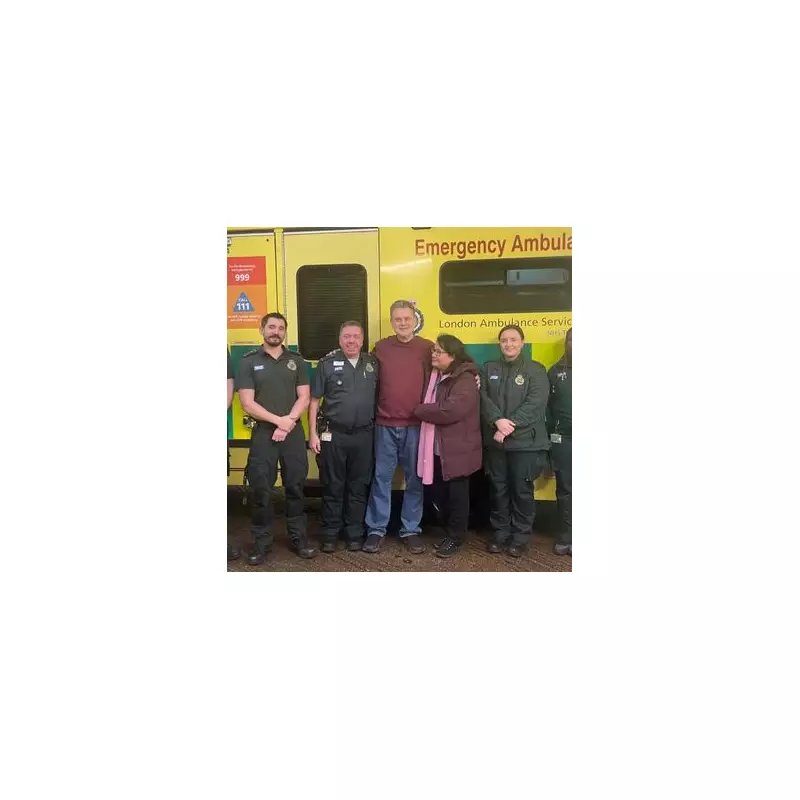
Paramedic Steve Hickman was first on the scene, taking over CPR and delivering the first of three shocks from a defibrillator to restore a normal heart rhythm. He was swiftly joined by colleagues Tim Weekes, Reinaldo Milani, Michael Bush, Elena Venturi and advanced paramedic Andrew Parker.
Elena Venturi explained the team's coordinated approach, known as the 'pitstop model'. "Everyone has a role," she said, describing how during serious emergencies, tasks like CPR, defibrillator use, airway management, and drug administration are handled simultaneously by different team members. Paramedic Tim Weekes added that this precise coordination is "pretty amazing especially when the outcome is a good one – which is sadly quite rare."
An Emotional Reunion and a Lifesaving Plea
At a recent emotional reunion organised by the London Ambulance Service, Jeremy and his family met the call handler and paramedics who saved his life. For call handler Aminah, such meetings are rare. "You guide a family through the worst moment of their lives," she said, "but meeting the person afterwards – and seeing how loved they are – really brings home why this job matters."
Paramedic Steve Hickman emphasised that "what happens in the minutes before we arrive can be the difference between life and death," praising Jeremy's son for giving his father the best possible chance.
Now fully recovered, Jeremy expressed his profound gratitude. "Thank you. You have given me a second chance at life," he told the team. "CPR saved my life. If my son hadn’t started chest compressions straight away, I wouldn’t be here." His survival meant he and his son could later celebrate their 60th and 30th birthdays together.
Jeremy is now supporting the London Ambulance Service’s London Lifesavers campaign, which encourages people to learn CPR and how to use a defibrillator. "Learning CPR could save someone you love," he urged. "I hope people make 2026 the year they learn these simple skills. It can be the difference between life and death."
With the majority of cardiac arrests occurring at home, the service stresses that these skills are most likely to be used to help a family member or friend.