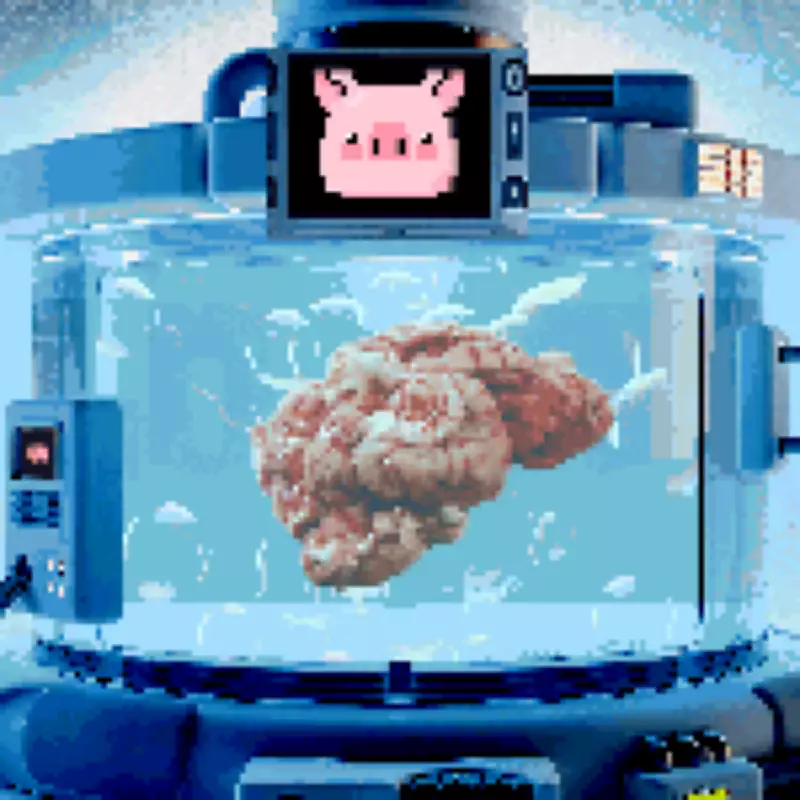
Scientists Achieve Breakthrough in Preserving Pig Brain, Hinting at Future Human 'Reanimation'
Death has long been considered an inevitable part of life, but a groundbreaking scientific development is challenging this notion. Researchers at Nectome, a Portland-based startup, have successfully preserved a pig's brain and body, marking a significant step toward potential future technologies that could one day allow human minds to be uploaded to computers or reanimated.
The Vision Behind the Experiment
Led by chief scientist Borys Wróbel, along with collaborators Aurelia Song and Anna LaVergne, the team aims to preserve human brains to prevent the loss of invaluable human experience and wisdom. Wróbel emphasizes the profound impact this could have, stating, 'It's a huge loss to us as humanity to be losing the experience of people every day.' He envisions a future where people in the year 3000 could converse with individuals alive today, comparing the technology to dialing the hands of a time machine.
The findings, currently in preprint form and awaiting peer review, have sparked excitement and caution within the scientific community. Wróbel stresses the need for further testing to validate the results.

Overcoming Technical Challenges in Brain Preservation
Preserving a brain is no simple task, as neuroscientists face two major enemies: ice and time. Ice can crush cells during formation, making traditional freezing methods ineffective, while time causes rapid deterioration post-mortem. To bypass these hurdles, Nectome developed a novel protocol.
Within 10 minutes of a pig's cardiac arrest, the team inserted a tube into its heart to flush out blood, leveraging the similarity between pig and human brain anatomy. They then injected preservation fluids containing aldehyde chemicals, which act as a cryoprotectant to replace water in tissues. This prevents jagged ice crystals from forming when the brain is cooled to -32°C.
Wróbel explains, 'If we wanted, we could lower this temperature so much that everything would become solid without forming crystals. It will turn the tissue, the whole body, into a glassy state.' This process aims to maintain the brain's structural integrity, including neurons and synapses, for potentially hundreds of years.
The Path to Human 'Reanimation'
Unlike cryogenics, which focuses on cooling bodies, Wróbel's concept involves 'reanimation'—preserving brains so well that future scientists could analyze their structure and recreate them in engineered tissue or computer simulations. However, he acknowledges current limitations, stating, 'This is not something that we could do right now with current technology, reverse and bring those brains back to life.'
Nectome is seeking terminally ill volunteers in Portland, Oregon, to donate their brains for research, taking advantage of the state's 'Death with Dignity' law. This ethical approach aims to advance scientific understanding without compromising human dignity.
Scientific and Ethical Considerations
Experts raise important questions about the feasibility and implications of reanimation. Ben Goult, a professor at the University of Liverpool, questions whether a reanimated brain could achieve true consciousness, noting that 'conscious experience is deeply embedded in bodily signals and interactions with the environment.'
Neuroscientist Bethany Facer adds that while capturing brain circuitry is a milestone, it doesn't fully account for the brain's complex activity. She remarks, 'The fact that we're even having this conversation shows how far neuroscience has come. The questions this raises are very interesting, we're just a very long way from having the answers.'
Eric Klein, founder of the Lifeboat Foundation, views the technique as a fascinating development in an era of existential risks, highlighting its potential to preserve human life for future revival.
This research opens new frontiers in neuroscience, blending scientific innovation with profound ethical debates about life, death, and the future of human existence.