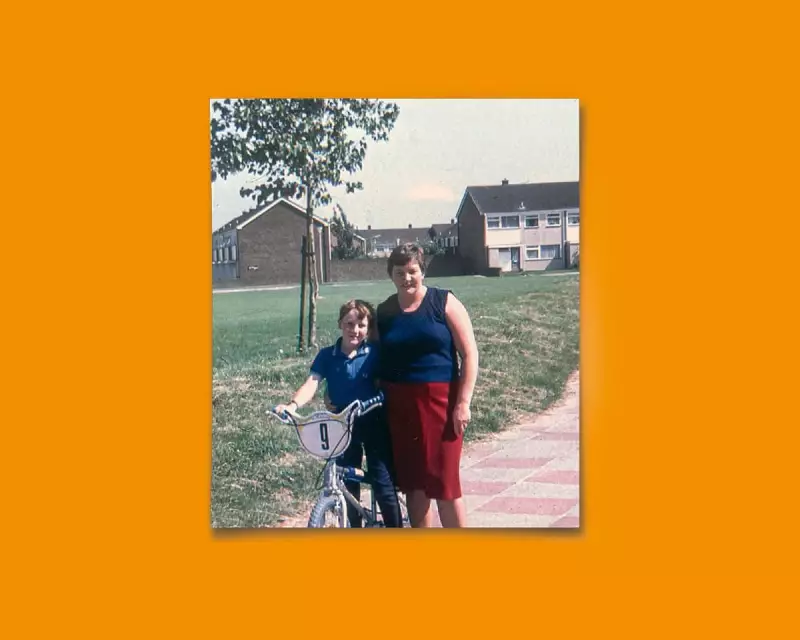
Facing the relentless advance of his mother's Alzheimer's disease, author Stephen Kelman has undertaken the emotionally fraught task of emptying her home of more than 50 years. With his mother now requiring round-the-clock care in a nursing home, Kelman must sift through a lifetime of possessions, deciding what to keep and what to discard, effectively becoming the curator of her life story.
The Weight of Memory in Every Photograph
The process is dominated by photographs, hundreds spilling from envelopes and pasted into albums. They are a portal to a complex past, featuring faces long unseen and hinting at a family history stretching beyond his own experience. Among them is a picture of a young Kelman, aged six or seven, kneeling in a scruffy back garden with an Action Man, smiling on a summer's day. His mother sits apart, her hand covering her face. Even then, he was oblivious to the unhappiness that defined her life, much of it caused by his father, who was presumably behind the camera.
Kelman recalls a childhood marked by financial strain and a loveless, functional marriage between his parents. Money was perpetually tight, with both working low-paid jobs and relying on expensive weekly credit from the Provident, a forerunner to payday loan companies, to cover holidays and unexpected bills. Rare escapes, like caravan holidays to Scarborough's Blue Dolphin Holiday Park, offered no real respite, as his mother's burdens travelled with her.

Confronting a Legacy of Violence and Breaking the Chain
It was on such holidays that Kelman's memories of his father's violence are vividly rooted. He recalls the smell of wet linoleum, a spilled glass of juice, and an eruption of temper ending in a punch. His mother, while often unable to protect him in the moment, would comfort him afterwards, creating a painful cycle of infraction, choosing sides, and uneasy truce that fuelled his chronic anxiety from his teens.
Yet, he exempts his mother from blame, understanding she was trapped by circumstance and financial dependency. He now sees his role as her carer – wiping her chin, massaging her back, rigging domino games so she wins – as a form of repayment for her sacrifices. In caring for her without resentment, he enacts a promise made young: to break the chain of inherited abuse. His father's violence became the negative example against which he defined himself, fostering a gentle devotion he now shows his mother.
Clearing the house reveals the paucity of her choices. Furniture was bought solely for affordability, and her collections of knick-knacks – glass paperweights, ceramic bells – speak for a personality that was whimsical and sentimental. To Kelman, these objects are precious proof of a life lived, however modest.
The Stories We Tell and the One We Hide
Some items, like autographs from her time working at Caesar's Palace nightclub in Luton, serve as props to spark dormant memories. Showing her a signed photo of Gene Pitney unexpectedly brings forth the name of his song "24 Hours from Tulsa." But one story remains untold: the story of her marriage. Kelman never mentions his father, and she never brings him up. He curates their shared history to spare her the grit of those painful memories, hoping Alzheimer's has expunged the man from her mind altogether.
The final act of handing the keys back to the council brings a sombre relief. Yet, in sorting her papers, he discovers a photograph he never knew existed. It shows his mother at 15, smiling timidly on the deck of a sailing ship. She had won a competition for a Thames cruise with the rock band Johnny Kidd & the Pirates. The image is infused with the palpable, dissipated potential of youth, a girl blissfully unaware of the unglamorous life of struggle, loss, and illness that awaited her.
This afternoon, Kelman will take this photograph to show his mother. He will wheel her into the garden if the weather allows, watching her touch flower petals, clinging to the hope that any interaction with the world means she might still outwit her disease. He knows the direction is set, but he owes her all the hope he has. In sitting by her bedside, he extends her story and his own, defined as much by the lives they lived as by the parallel lives that slipped forever past.