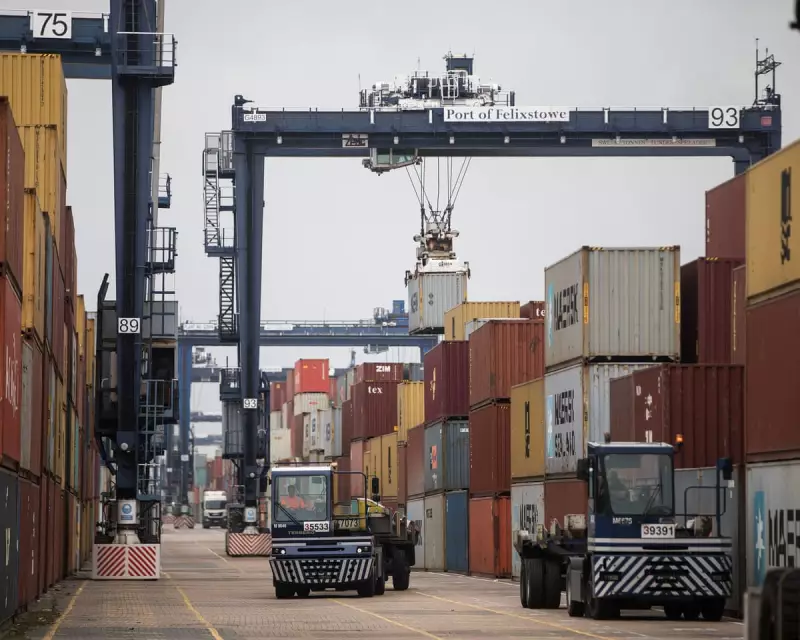
The Labour government is facing mounting pressure to forge a closer trading relationship with the European Union, after a major business group declared the current post-Brexit deal a failure for British companies trying to grow.
Businesses Report Growing Brexit Friction
The British Chambers of Commerce (BCC) has issued a stark warning, stating that the UK's existing Trade and Cooperation Agreement (TCA) is not helping firms increase their sales in the EU. This intervention comes from a survey of almost 1,000 businesses, predominantly small and medium-sized enterprises.
The data reveals a significant and worsening problem. More than half (54%) of the exporters surveyed said the deal negotiated under Boris Johnson and enacted in 2021 is not aiding their business. This marks a concerning 13 percentage point increase from the proportion of unhappy firms recorded in a similar survey just one year earlier.

Steve Lynch, the BCC's director of international trade, framed the issue in urgent terms. "With a budget that failed to deliver meaningful growth or trade support, getting the EU reset right is now a strategic necessity, not a political choice," he said. "Trade is the fastest route to growth, yet firms tell us it is becoming harder, not easier, to sell into our largest market."
Labour's EU Reset Under Scrutiny
The call from the BCC, which represents over 50,000 firms employing 6 million people, adds to the growing pressure on Keir Starmer's administration. It follows recent comments from senior Labour figures like Wes Streeting, who suggested exploring a deeper trading relationship, potentially including a customs union with the EU.
Such a move would represent a significant shift, as Labour's manifesto explicitly ruled out a return to the single market, customs union, or freedom of movement. However, several pro-European ministers within the government, including David Lammy and Bridget Phillipson, are believed to be pushing for a more ambitious reset.
The government has positioned improving EU relations as a top priority for 2026, following a landmark summit earlier this year. Recent steps include agreeing terms for the UK to rejoin the Erasmus+ student exchange programme in 2027.
Firms Detail 'Virtually Stopped' Export Sales
The BCC's report, titled a "business manifesto for the EU reset", paints a vivid picture of the daily challenges. It quotes frustrated business owners who are struggling with the cumulative impact of regulatory changes and trade friction since the first post-Brexit deal took effect in 2020.
One small manufacturing firm in Greater Manchester stated bluntly: "Since Brexit our export sales have virtually stopped. The TCA has had no impact in recovering any sales into the EU."
A small retailer in Hampshire linked the trade difficulties to broader economic pressures, saying: "Work has stopped coming to [the] UK due to high taxes and no longer being part of the EU. As a result, lots of companies have shut down and thousands of people have lost their jobs."
Adding to the criticism, the survey found that a mere four out of the 946 firms believed government support for navigating trade policy changes was comprehensive.
The BCC has proposed five key areas for negotiation with Brussels in 2026:
- A deal to reduce border checks on animal and plant products.
- Finalising links between the UK and EU emissions trading schemes.
- Establishing a youth mobility scheme.
- Securing full UK participation in the EU's SAFE defence fund.
- Enhancing cooperation on VAT and customs simplification.
A government spokesperson responded, saying: "This government is removing red tape and trade barriers to support jobs, business, and growth. That's exactly why we reset our relationship with the EU and are making strong progress in negotiations."