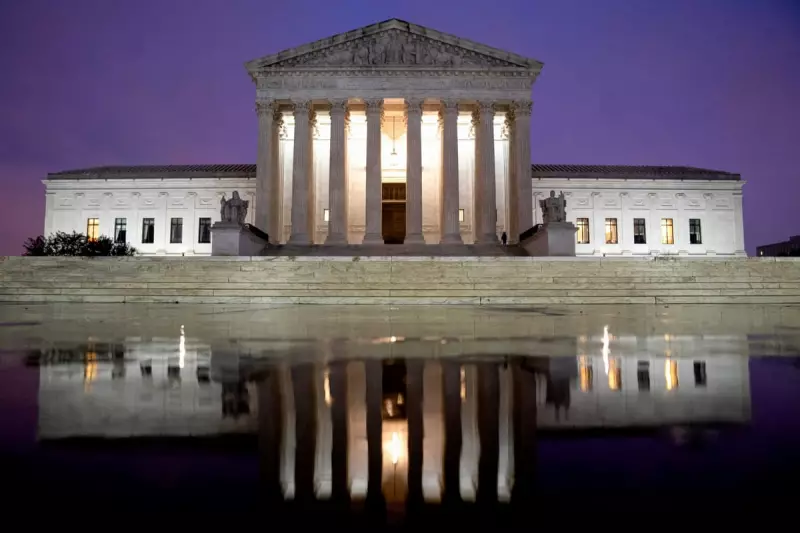
Legal scholars from Harvard and Yale have issued a stark warning: the United States Supreme Court is teetering on the brink of illegitimacy and must be fundamentally remade. In a provocative analysis, professors Ryan Doerfler and Samuel Moyn contend that the court's conservative supermajority, emboldened during Donald Trump's second presidential term, has abandoned any pretence of being a neutral arbiter, actively facilitating an era of oligarchic rule.
The Shattered Illusion of Judicial Neutrality
For decades, the court maintained an image of soaring above partisan politics, a reputation carefully guarded by chief justices like John Roberts. Public trust was rooted in the belief that the institution's legitimacy mattered to its justices. This perception was famously articulated in the 1992 case Planned Parenthood v. Casey, where Justices Anthony Kennedy, Sandra Day O'Connor, and David Souter jointly stated the court's power derived from the people's acceptance of its role.
That era is now over, the scholars argue. The pivotal shift began with the confirmation of Amy Coney Barrett to replace Ruth Bader Ginsburg, cementing a durable conservative majority. While liberal justices initially pleaded with their colleagues to preserve the court's standing—as seen in their dissent in the abortion case Dobbs v. Jackson Women's Health Organization—such appeals now fall on deaf ears.

A Court Unleashed in Trump's Second Term
Doerfler and Moyn detail a series of rulings that demonstrate the court's dramatic rightward lurch and its disregard for its own institutional credibility. The conservative majority has granted the president near-total control over federal spending, empowered federal agents to engage in racial profiling in 'Democrat-run' cities, and signalled an intent to dismantle key independent agencies like the Federal Trade Commission and the National Labor Relations Board.
Most alarmingly, the justices appear wholly unbothered by accusations of partisanship as they prepare to further weaken the Voting Rights Act. The liberal bloc—Justices Ketanji Brown Jackson, Elena Kagan, and Sonia Sotomayor—has grown more aggressive in dissent, but is divided on strategy. Justice Jackson has notably chosen to 'pull the fire alarm' and warn the public directly, a tactic her colleagues fear dilutes their impact.
Beyond Nostalgia: The Case for Radical Reform
The authors criticise mainstream liberal responses as insufficient. Focusing on procedural complaints, such as the increased use of the 'shadow docket', or yearning for a return to a more legitimate court, fails to address the core problem. They take aim at commentators like professor Stephen Vladeck, who they suggest prioritises getting justices to 'explain themselves' rather than questioning their power.
Some warn that declaring the court illegitimate veers into constitutional 'nihilism' or 'doomerism'. However, Doerfler and Moyn counter that this critique misunderstands a growing progressive movement. Instead of clinging to a broken institution, reformers are proposing creative, democratic alternatives—from expanding and disempowering federal courts to addressing undemocratic features of the Constitution itself, like the Electoral College and the Senate.
The scholars conclude with a radical prescription: the goal must no longer be to pull the court back from the edge of illegitimacy, but to push it over. They argue for a wholesale remaking of the Supreme Court to prevent decades of oligarchy-facilitating rule and to fulfil the promise of popular democracy, trading hollow hope in judicial power for the reality of self-rule.