

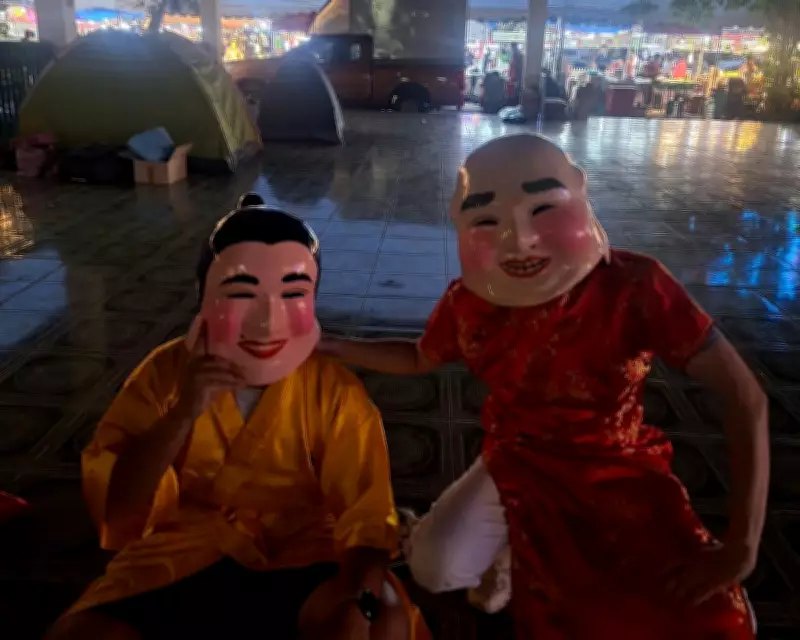
In a bold and unconventional approach to law enforcement, police officers from Bangkok's metropolitan bureau have been utilizing creative disguises to apprehend criminals, with recent operations including officers posing as lion dancers at a lunar new year temple fair. The tactics, which have garnered significant attention on social media and in international headlines, are defended by police as effective methods for catching elusive suspects.
The Lion Dance Operation
Police Captain Lertvarit Lertvorapreecha and his colleague had less than twenty-four hours to prepare for their undercover mission at a temple fair celebrating the lunar new year. Disguised as performers of a traditional lion dance, their objective was to track down and arrest a suspected thief with a history of evading capture. Captain Lertvarit admitted the dance was spontaneous, with no time for rehearsal, and in the rush, he accidentally wore his colleague's male mask along with a red silk dress, trousers, and tactical shoes.
Despite the hasty preparation, the disguise proved successful. Children eagerly joined in the dance, passersby laughed, and crucially, the officers managed to surprise the suspect, wrestling him to the ground amidst a flurry of red and gold fabric. The individual is now in prison awaiting trial, accused of stealing Buddhist artefacts valued at approximately £47,717. According to Captain Lertvarit, the inspiration for such disguises stems from fieldwork and criminal profiling, with the lunar new year festivities providing an ideal opportunity to blend into crowded celebrations.

Beyond Social Media: Serious Crime Apprehensions
While footage of these operations often goes viral online, police emphasize that the tactics are not merely for social media content but have led to real arrests for serious offenses. In one notable case from 2024, an officer crawled several hundred meters through rice fields in a ghillie suit, losing his headphones in the process, to apprehend a man wanted for sexually assaulting a minor. The suspect was living in an isolated hut surrounded by fields, making traditional approaches by car or motorbike easily detectable.
In another incident the same month, an officer dressed as a Lycra-clad wrestler as part of an elaborate undercover operation to arrest a Chinese tourist accused of rape and filming his victim. The suspect had requested a man dressed as a wrestler for swinging, and when he arrived at a hotel room, the undercover officer shouted a code word, prompting backup officers to emerge from wardrobes, the bathroom, balcony, and under the bed. Evidence, including videos on the man's phone, was seized, though the individual denied wrongdoing at the time.
Police Justification and Public Perception
Captain Lertvarit explained that disguises are typically reserved for experienced criminals or those with a history of fleeing arrest, aiming to surprise them when they are least expecting it. He stated, "The fastest way of arresting someone is to surprise them, when they're enjoying life, not knowing what's going on around them." The bureau has rejected criticism that these operations are geared toward social media, asserting they have enabled tangible arrests.
Public response has been overwhelmingly positive, according to Lertvarit, who hopes the shared footage demonstrates the police's commitment to fighting crime and serves as a warning to criminals that "the world is getting smaller every day." However, polling in Thailand reveals mixed attitudes toward the police, with some surveys showing high confidence levels while others indicate concerns about corruption.
These innovative undercover methods highlight a unique blend of traditional cultural elements, such as the lion dance, with modern policing strategies, showcasing Bangkok police's adaptability in tackling crime in dynamic urban environments.






