

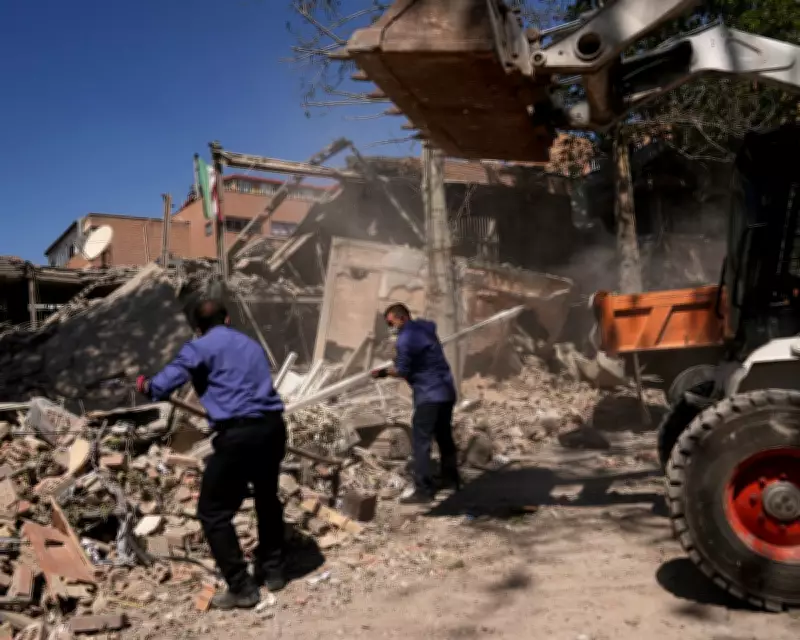
Workers have been clearing debris at Tehran's Sharif University of Technology complex, which Iranian authorities confirm was struck early on Monday in a joint US-Israeli military operation. This attack underscores the escalating violence as international mediators urgently push for a ceasefire to end the five-week-old conflict.
Ceasefire Proposals and Trump's Ultimatum
Proposals for an immediate ceasefire have been formally circulated to both Washington and Tehran, aiming to halt the war and prevent an extraordinary threat issued by former US President Donald Trump. Trump demanded on Sunday that Iran "Open the Fuckin' Strait" of Hormuz by Tuesday evening, warning he would otherwise target the country's power plants and bridges—a move legal experts condemn as a potential war crime due to its disproportionate impact on civilians.
Mediation Efforts and Iranian Response
Mediators from Pakistan, Egypt, and Turkey are advocating for both sides to suspend hostilities and reopen the Strait of Hormuz to merchant shipping. This would be followed by detailed negotiations to achieve a more comprehensive peace agreement. However, Iranian officials have privately rejected opening the strait as part of a temporary ceasefire, citing concerns that the US and Israel might continue periodic attacks despite any paper agreement.

Iran's foreign ministry spokesperson, Esmaeil Baghaei, stated that Tehran has responded privately to the proposals but emphasized that peace negotiations are "incompatible with ultimatums and threats to commit war crimes." The country's central military command has warned of a "much more devastating" retaliation if the US and Israel escalate further.
Ongoing Military Strikes and Casualties
Israel has intensified its bombing campaign, with recent strikes targeting Iran's critical infrastructure. Israeli Defense Minister Israel Katz claimed responsibility for attacks on Iran's South Pars petrochemical complex in Asaluyeh and the Mahshahr complex, stating these sites account for roughly 85% of Iran's petrochemical exports and have been disabled.
On Monday, Israel's military reported bombing Tehran again and confirmed a Sunday strike that killed Majid Khademi, head of intelligence for Iran's Revolutionary Guards. In retaliation, a missile strike in Haifa, northern Israel, destroyed a building and killed four people, with rescue teams recovering all bodies from the rubble. Additionally, Israel bombed Beirut's southern suburbs, a Hezbollah stronghold, following a Sunday attack in Lebanon that killed 15 people, including Pierre Mouawad, an official in an anti-Hezbollah Christian party.
Diplomatic Channels and Economic Impact
Ceasefire discussions have involved high-level diplomatic contacts, including Pakistan's army chief, Field Marshal Asim Munir, communicating with US Vice-President JD Vance, and Trump's special envoy, Steve Witkoff, engaging with Iran's foreign minister, Abbas Araghchi. Despite these efforts, Israeli political sources express skepticism, predicting the talks may collapse, though they believe Trump is seeking an exit strategy from the war.
The conflict has significantly impacted global oil markets. Brent crude futures fell to $107.11 a barrel on Monday morning, reflecting hopes for de-escalation, before rising above $108 as fighting persisted. This marks a sharp increase from pre-war prices of $70 a barrel in late February, when the US and Israel first attacked Iran.
As the war continues, both sides are preparing for further escalation, with Israel identifying additional targets for potential bombing of energy and infrastructure sites. The international community watches closely, hoping mediation efforts can avert a broader humanitarian and economic crisis in the Middle East.






