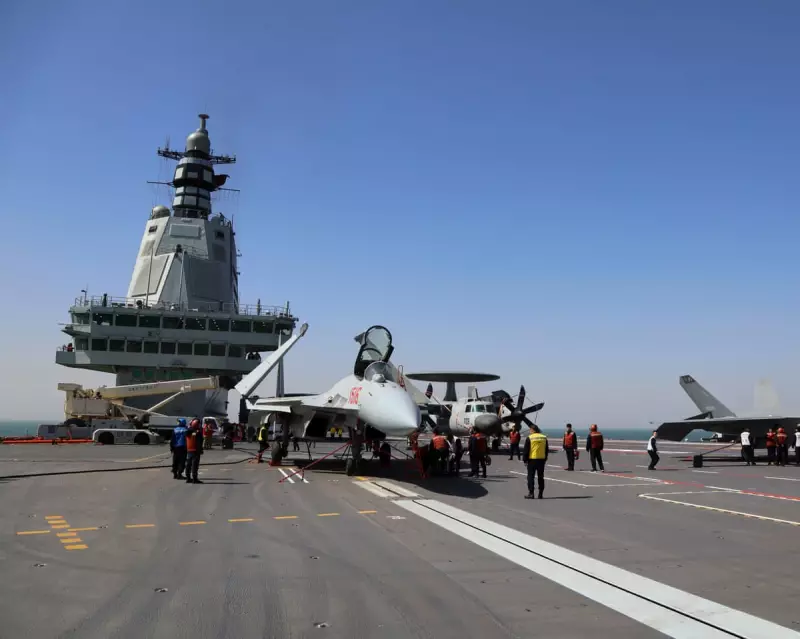
China's Naval Power Takes a Quantum Leap with New Fujian Carrier
China has officially commissioned its newest and most sophisticated aircraft carrier, the Fujian, marking a significant milestone in President Xi Jinping's ambitious military modernisation programme. State media confirmed the vessel's entry into active service following a ceremony presided over by the Chinese leader, representing a formidable addition to the world's largest navy by number of ships.
Advanced Technology and Strategic Capabilities
The Fujian represents China's first domestically designed and built aircraft carrier, distinguishing it from its predecessors. The vessel incorporates cutting-edge electromagnetic aircraft launch system (EMALS) technology, a feature currently found only on the United States Navy's latest Ford-class carriers. This advanced system offers substantial advantages over traditional steam catapults, including reduced stress on both aircraft and the ship, more precise speed control, and the ability to launch a broader range of aircraft types.
This technological leap enables China to deploy heavier aircraft with full fuel loads, such as the KJ-600 early warning and control plane, which successfully underwent testing during the Fujian's sea trials. State media has emphasised the carrier's enhanced capacity for faster fighter jet sortie rates, with the Chinese navy confirming successful launches of the new J-35 stealth fighter and J-15T heavy fighter from the Fujian's deck.

Expanding Chinese Naval Reach and Regional Implications
The commissioning elevates China to possess the second-largest carrier fleet globally with three active vessels, surpassing the United Kingdom, India, and Italy (each with two), though still significantly trailing the United States' fleet of eleven. The Fujian joins the Soviet-designed Liaoning and the Soviet-designed but Chinese-built Shandong in active service, representing the culmination of years of intensive shipbuilding efforts.
According to Greg Poling, director of the Asia Maritime Transparency Initiative at the Center for Strategic and International Studies, "Carriers are key to Chinese leadership's vision of China as a great power with a blue-water navy" capable of projecting power far beyond coastal waters. While carriers provide limited advantage within the First Island Chain—the arc of islands from Japan to the Philippines—they become crucial for contesting American dominance across the wider Indo-Pacific region.
Raymond Kuo of the Rand Corporation highlights how expanding to three carriers "severely complicates Taiwanese defensive plans". Taiwan's longstanding strategy of relocating war planes to its more protected eastern coast becomes considerably less effective as China can now cover multiple areas simultaneously with additional strike carrier groups.
The People's Liberation Army Navy has already demonstrated its expanding reach through unprecedented activities, including live-fire drills in the Tasman Sea between Australia and New Zealand earlier this year and a complete circumnavigation of the Australian continent, raising concerns among regional allies. Concurrent joint exercises with Russia further underscore China's growing global military partnerships.
Broader Military Modernisation Context
China's shipbuilding programme continues at an unparalleled pace, though its secretive nature forces analysts to rely on state media reports and satellite imagery for developments. Evidence suggests work may already be underway on a fourth carrier. Beyond carrier construction, the PLA has been testing innovative barge ships designed to create loading docks nearly a kilometre offshore and repurposing dual-use roll-on-roll-off ferries for military equipment transport across the Taiwan Strait.
Recent military parades in Beijing commemorating the 80th anniversary of what China terms the war of resistance against Japanese aggression showcased additional technological advances, including:

- Hypersonic missiles designed for anti-ship warfare
- Advanced underwater drones
- Electronic warfare planes that accompany fighter jets
- New submarine-launched and road-mobile intercontinental ballistic missiles
This diverse arsenal confirms China's development of a comprehensive nuclear strike capability across land, air, and sea platforms, signalling its determined ascent as a major global military power with particular focus on challenging American primacy in the Pacific region.