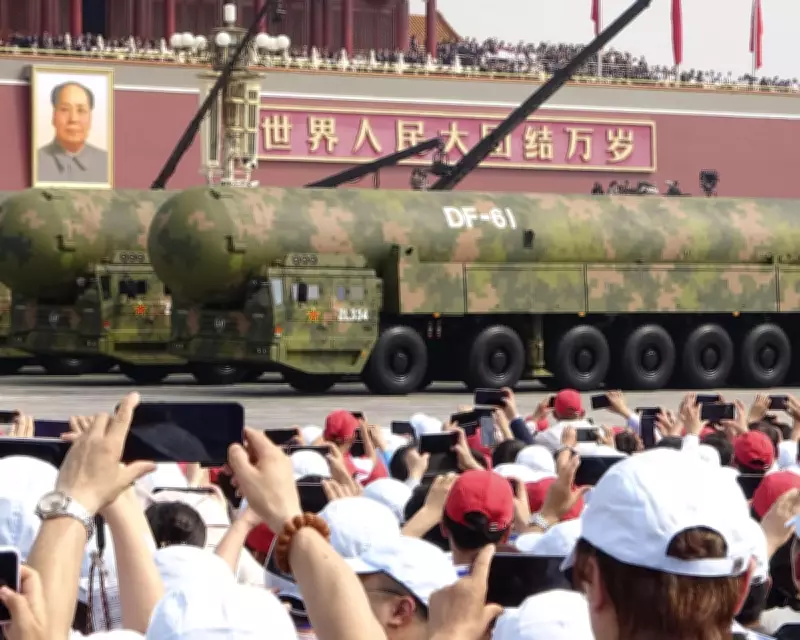
Chinese DF-61 intercontinental ballistic missiles were prominently displayed during a military parade in Beijing on 3 September 2025, marking the 80th anniversary of victory over Japan. This visual spectacle underscored a growing global concern that has been largely overlooked in recent diplomatic engagements.
Avoiding the Elephant in the Room
Keir Starmer's recent diplomatic overture to China has been received positively in Beijing, though less so in other western capitals. During his talks with President Xi Jinping, the British Prime Minister notably avoided several contentious issues, including human rights concerns and the situation surrounding Jimmy Lai. However, one critical topic was conspicuously absent from discussions entirely: China's alarming, rapid, and unexplained nuclear weapons buildup.
This omission occurs against a backdrop where the proliferation of weapons of mass destruction represents what many experts consider the most immediate existential threat to humanity, surpassing even the climate crisis and global health pandemics in its urgency.

The Doomsday Clock Advances
The Bulletin of the Atomic Scientists recently moved the symbolic Doomsday Clock forward to just 85 seconds before midnight, representing the closest humanity has ever been to global catastrophe in the clock's history. The organisation warned that nuclear and other global risks are escalating at unprecedented speeds, creating a dangerous new paradigm for international security.
Global nuclear disarmament diplomacy has reached a virtual standstill, with little expectation of progress at the upcoming Non-Proliferation Treaty review conference in New York. Meanwhile, the last remaining arms control treaty between the United States and Russia is set to expire, removing crucial safeguards that have helped maintain strategic stability for decades.
A Global Arms Race Accelerates
According to the Stockholm International Peace Research Institute's 2025 report, nearly all nine nuclear-armed states are pursuing intensive modernisation programmes. These include developing new weapons systems such as hypersonic missiles and so-called "useable" low-yield tactical nuclear weapons, while nuclear testing appears increasingly likely to resume globally.
The institute estimates that of approximately 12,241 warheads existing worldwide in January 2025, about 9,614 were in military stockpiles ready for potential deployment. The United States and Russia together possess around 90% of these weapons, but China's rapid expansion is changing the strategic landscape dramatically.
China's Accelerating Arsenal
While China currently maintains an estimated 600 warheads, significantly fewer than the major nuclear powers, its expansion pace is unprecedented. SIPRI calculations suggest China has been adding about 100 new warheads annually since 2023 and could potentially possess as many intercontinental ballistic missiles as either Russia or the United States by the end of this decade.
Beijing has offered no substantive explanation for this dramatic surge in nuclear capability and continues to reject multilateral arms control negotiations. An official white paper published in November restated China's position that countries with the largest arsenals must make unilateral reductions first, while China maintains its capabilities at "the minimum level required for national security" without defining what that level represents.
Growing International Concerns
The United States has expressed particular concern about China's nuclear developments. The Pentagon warned in December that China's military buildup has made the American homeland increasingly vulnerable, highlighting what it described as a more attack-ready nuclear posture. American defence officials claim about 100 ICBMs have recently been installed in silos in northern China and that Beijing is testing its ability to strike US forces in the Pacific region.
This capability could potentially cripple future American military assistance to Taiwan, with the Pentagon suggesting China expects to be able to fight and win a war over Taiwan by the end of 2027.

Xi Jinping's Strategic Calculations
President Xi Jinping's motivations for this nuclear expansion remain unclear but potentially multifaceted. Some analysts suggest it represents a simple quest for status parity with the United States and Russia, while others believe genuine security concerns drive the buildup. Xi reportedly told Starmer that "rampant" powers were following "the law of the jungle," an apparent reference to the Trump administration's policies.
Alternatively, nuclear muscle-flexing could serve Xi's ambition to make China the world's leading superpower and potentially facilitate the conquest of Taiwan, a long-standing strategic objective for Beijing.
Internal Power Dynamics
Disturbingly, questions have emerged about whether Xi maintains complete control over China's military establishment. His recent sacking of General Zhang Youxia, second only to himself in the military hierarchy, remains unexplained. The veteran general is reportedly accused of disloyalty and leaking nuclear secrets to the United States, raising the possibility of internal disagreements over Xi's confrontational nuclear and Taiwan policies.
This situation echoes cold war era concerns about command and control, with troubling questions emerging about who ultimately controls nuclear launch authority within China's political-military structure.
Britain's Complicated Position
Starmer's silence on China's nuclear expansion during the Beijing talks may reflect Britain's own complicated position regarding nuclear weapons. The United Kingdom is currently expanding its nuclear strike capability through the purchase of American F-35A nuclear-capable fighter jets and reportedly allowing the United States to store nuclear bombs at RAF Lakenheath for the first time in two decades.
This places Britain in a difficult diplomatic position, potentially undermining its moral authority to criticise other nations' nuclear programmes while simultaneously engaging in its own nuclear modernisation efforts.
A Dangerous New Era
As global arms control mechanisms collapse and nuclear weapons modernisation accelerates worldwide, we are entering one of the most dangerous periods since the height of the cold war. The failure to address China's nuclear buildup in high-level diplomatic discussions represents a significant missed opportunity to engage on what may be the defining security challenge of our time.
With the Doomsday Clock ticking ever closer to midnight and nuclear diplomacy at a standstill, the international community faces urgent questions about how to rein in a new arms race that threatens global stability and human survival itself.