

Lebanon Doctors Accuse Israel of Repeating Gaza's 'Scorched Earth' Hospital Policy
Medical professionals treating casualties from Israeli airstrikes in Lebanon have issued urgent appeals to global leaders, demanding immediate intervention to halt what they describe as daily breaches of international humanitarian regulations. British physicians with experience in Gaza have highlighted alarming parallels between Israeli military strategies employed in the Palestinian territory and current operations in Lebanon.
Systematic Targeting of Medical Infrastructure
Dr. Tom Potokar, who was present during the bombing of Gaza's European Hospital, stated unequivocally: "The violation of international humanitarian laws has become normalized. Once again we are witnessing assaults on medical infrastructure, just as we observed in Gaza, but now occurring in Lebanon. Once more, we see attacks directed at hospital personnel, ambulance crews, and emergency responders."
Dr. Potokar expressed frustration at the international response, noting: "There is the familiar condemnation and rhetoric from political leaders, yet no concrete action—nothing is implemented to prevent these violations. Hospitals should be sanctuaries where individuals can obtain treatment and are safeguarded under international law. Yet they and first responders persistently face targeting."

British Medics Witness Devastation Firsthand
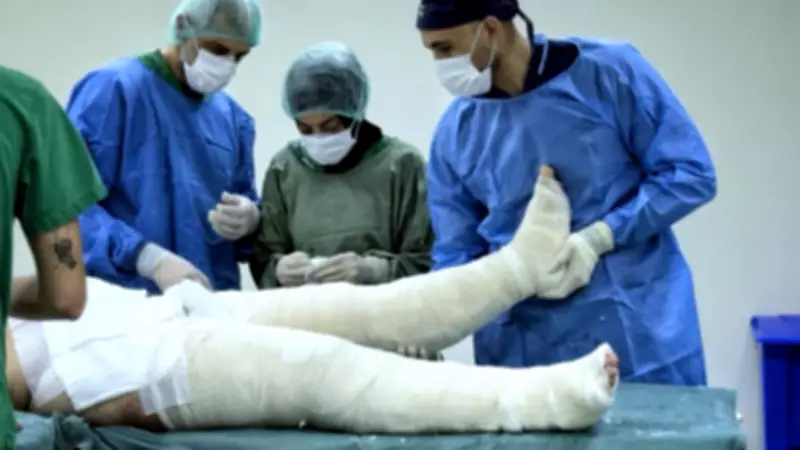
Currently working at Sidon government hospital in Lebanon, which houses the nation's primary specialist burns unit established through his Interburns charity, Dr. Potokar treated a patient sustaining 65% burns from an Israeli airstrike on his residence in Nabatieh. The victim's body is entirely wrapped in bandages, with recovery expected to require months. Two additional severe burns patients arrived from bombed homes in southern regions.
Among the medical team is Dr. Anna Joseph, a British medic who has taken leave from her National Health Service position to assist Lebanese victims. She reported: "The systematic demolition of healthcare facilities and staff both here and in Gaza has generated an enormous need. Individuals are suffering and dying while specialists capable of aiding them are being targeted, detained, denied entry, or even killed."
Echoes of Gaza Trauma in Lebanon
Mohammad Ziara, a young doctor exiled from Gaza who previously worked at Al Shifa hospital, perceives tragic repetitions of his experiences. "It is evident what is transpiring in Lebanon," he explained. "There exists an endeavor to degrade medical facilities to compel populations to depart, precisely as executed in Gaza—this will inflict terrible consequences on everyone. Until international law is uniformly applied to all parties, this pattern will persist."
The Israeli military asserts that Hezbollah conceals itself within civilian structures and utilizes ambulances for transporting military equipment, though no evidence has been presented. Lebanon's health ministry has vehemently rejected these allegations, characterizing them as Israeli attempts to "justify war crimes."
Scorched Earth Policy and Pediatric Casualties
British Palestinian physician Ghassan Abu Sittah, who operates a charity for children with a clinic in Beirut, detailed how military tactics are harming children. "When Israel mandated evacuation of southern Beirut suburbs, we lost four hospitals, including one containing a pediatric intensive care unit. Consequently, the healthcare system contracted due to inaccessible facilities. Ambulance crews now fear traveling to peripheral hospitals, and we have lost three children awaiting transfer."
Dr. Abu Sittah, having also worked in Gaza, identifies similarities in Lebanon: "What we are observing is a scorched earth policy. Scorched earth signifies rendering a location uninhabitable, invariably involving destruction of the health system. In urban settings, this functions as the social anchor; eliminating it facilitates ethnic cleansing... We witnessed this repeatedly in Gaza."

Civilian Suffering Amid Escalating Conflict
Combat between Israeli forces and Hezbollah has intensified significantly in recent days. The Israel Defense Forces claims to have eliminated hundreds of Hezbollah fighters and destroyed numerous military infrastructure sites, stating: "More than 30 terrorists were neutralized in close-quarters combat and from the air." Conversely, Hezbollah maintains resilience, announcing a record launch of 80 rockets into northern Israel within a single day.
The persistent drone of Israeli jets dominates southern Lebanese towns, interrupted by outgoing Hezbollah rocket fire. Civilian casualties continue mounting, with Mohammad Kobeissi, a burns victim at Sidon hospital, recounting the loss of his 15-year-old son during a nighttime airstrike on their Beirut apartment. "I have no emotions presently," he shared. "Our family previously numbered four—now it is three. I have lost my son. He was merely 15. What did he accomplish? We are simply civilians. Cease the war! Halt this slaughter."
Widespread Displacement and Infrastructure Destruction
Lebanon's health ministry reports over 3,000 injuries and more than 1,000 fatalities, without distinguishing combatants from civilians. The conflict has displaced over one million individuals, predominantly from southern border communities and Beirut's southern suburbs. Dahieh, a densely populated Beirut suburb and Hezbollah stronghold, contains many victims and survivors insisting they have no Hezbollah ties or political affiliations.
Israeli military tactics to establish a security "buffer zone" include demolishing bridges, bombing petrol stations, and striking power plants supplying electricity to entire cities. Israeli authorities have warned Lebanese residents to evacuate extensive areas south of the Litani River, with several officials declaring intentions for ground troops to occupy approximately 10% of Lebanese territory.





