

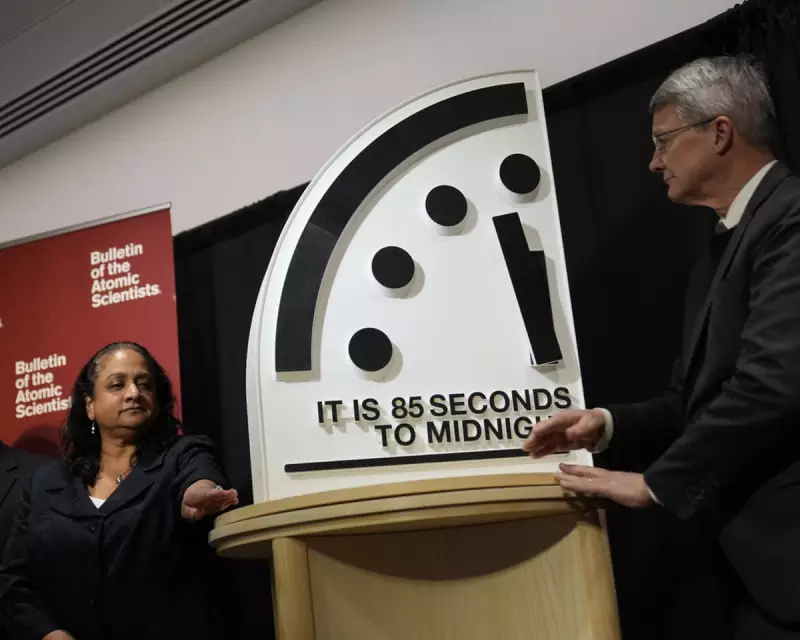
The symbolic Doomsday Clock has been advanced to just 85 seconds to midnight, representing the closest humanity has ever been to global catastrophe according to leading scientists. The Bulletin of the Atomic Scientists made this sobering announcement during a news conference in Washington DC, highlighting multiple existential threats that have intensified over the past year.
Escalating Global Tensions Drive Clock Forward
The advocacy group pointed to increasing aggression and nationalism among major world powers as primary factors in their decision. Russia, China, and the United States were specifically mentioned as nations whose adversarial postures are undermining international cooperation. This represents a significant deterioration from last year's setting of 89 seconds to midnight.
"Hard-won global understandings are collapsing, accelerating a winner-takes-all great power competition," the scientists warned in their official statement. They expressed particular concern about the potential for nuclear conflict, citing ongoing tensions in multiple regions.

Multiple Existential Threats Converge
The Bulletin identified four primary areas of concern that contributed to the clock's advancement:
- Nuclear warfare risks stemming from conflicts involving nuclear-armed nations
- Climate crisis impacts including extreme weather events and insufficient global action
- Potential misuse of biotechnology without adequate safeguards
- Uncontrolled development of artificial intelligence systems
Daniel Holz, chair of the group's science and security board, emphasized the critical need for international cooperation: "If the world splinters into an us-versus-them, zero-sum approach, it increases the likelihood that we all lose."
Specific Conflicts and Climate Failures
The scientists highlighted several specific situations contributing to global instability:
- The ongoing Russia-Ukraine conflict and its potential for escalation
- May's border tensions between India and Pakistan
- Concerns about Iran's nuclear capabilities following strikes by the US and Israel
- Global failure to implement meaningful climate agreements
Regarding climate change, the group singled out political actions that have hindered progress, including efforts to boost fossil fuel production and obstruct renewable energy development.
Historical Context and Measurement Changes
Established in 1947, the Doomsday Clock has served as a powerful symbol of humanity's proximity to self-destruction. At its most optimistic point following the Cold War, the clock stood at 17 minutes to midnight. In recent years, the increasing pace of global threats has necessitated a shift from measuring minutes to counting seconds until midnight.
The Bulletin emphasized that reversing the clock's movement remains possible if world leaders and nations commit to collaborative action addressing these existential risks. However, current trends suggest humanity is moving in the wrong direction, with multiple crises converging to create unprecedented global danger.






