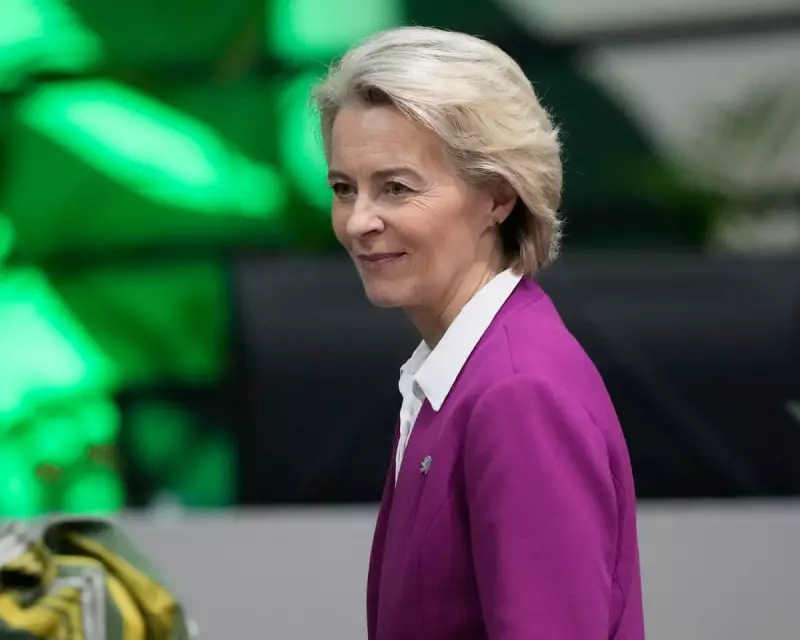
The European Union is taking decisive action to fortify its democratic institutions against a rising tide of foreign disinformation, with plans to establish a new Centre for Democratic Resilience.
This initiative forms the core of European Commission President Ursula von der Leyen's 'democracy shield' agenda, which she championed during her campaign for a second term leading up to the 2024 European elections.
The Growing Threat of Foreign Interference
According to a leaked document obtained by the Guardian, the EU executive has identified Russia's escalating hybrid attacks as a primary threat. The draft states that alongside its war in Ukraine, Moscow is waging an intense battle of influence against Europe.

This campaign involves spreading deceitful narratives and manipulating historical facts in an attempt to erode public trust in democratic systems. The EU's foreign service has documented dozens of instances of Russian disinformation, including the sophisticated Doppelganger campaign active since 2022.
This operation used websites that mimicked legitimate media outlets such as Germany's Die Welt, France's Le Point, Italy's La Stampa, and Poland's Polskie Radio. These copycat sites published and promoted fake articles on social media, aiming to discredit Western politicians and undermine support for Ukrainian refugees and military aid.
A Multi-Front Information War
The threat is not limited to Russia. The EU's diplomatic service has also identified China as a significant disinformation actor, alleging that Beijing uses private PR firms and social media influencers to create and amplify content that aligns with its political interests worldwide.
In 2024, researchers at Citizen Lab uncovered a network of 123 websites operating from China that posed as independent news outlets. These sites disseminated pro-Beijing misinformation across 30 countries in Europe, Asia, and Latin America.
The real-world consequences of such interference have been stark. Romania became the first EU member state to annul an election after declassified intelligence revealed a massive Russian campaign involving cyber-attacks on electoral IT systems and social media meddling to support an ultranationalist candidate.
Authorities in Moldova, an EU candidate country, have made similar allegations of Russian interference in their recent elections, citing extensive vote-buying schemes and propaganda campaigns.
Building the Democracy Shield
The proposed Centre for Democratic Resilience aims to serve as a central hub where EU institutions and member states can share intelligence and early warnings about foreign information manipulation.
Participation in the centre will be voluntary for both EU members and countries seeking to join the bloc. The commission has also suggested opening participation to like-minded partners, potentially including the United Kingdom.
Beyond the centre, the broader democracy shield strategy includes creating an independent network of fact-checkers to protect against misinformation during critical periods like elections, health emergencies, or natural disasters.
Brussels also plans to establish a voluntary network of internet influencers to raise public awareness about EU rules concerning democratic standards and internet governance.
The full details of the plan are scheduled for official release on 12 November, marking a significant step in the EU's coordinated response to the evolving challenge of digital disinformation.