

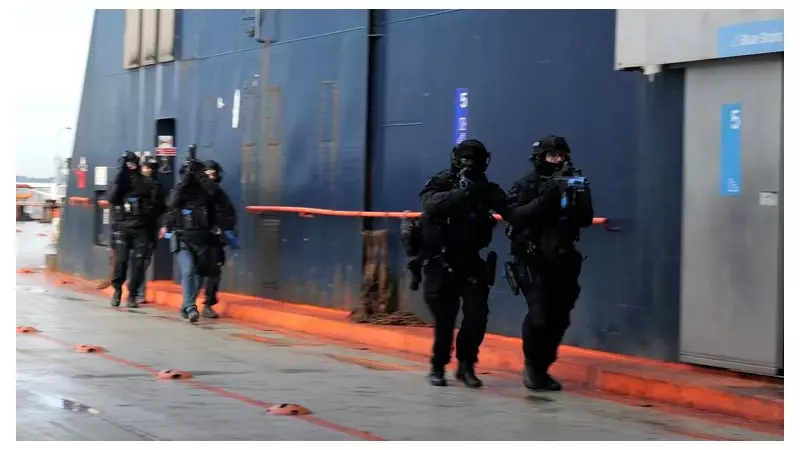
In a dramatic and high-stakes training scenario, specialist UK counter-terrorism police have stormed a hijacked ferry in a major exercise designed to test the nation's emergency response to a maritime terror attack.
Simulating a Channel Crossing Nightmare
Sky News was granted exclusive access to the large-scale, live-play drill at Poole Harbour on the south coast of England on Wednesday. The simulated crisis began with a chilling alert from the Coastguard around 9am: a group of gunmen had launched an attack on a vehicle and passenger ferry crossing the English Channel from France.
Urgent messages from those onboard revealed militants were opening fire on passengers, causing deaths and injuries. With the ferry headed for Poole, Counter Terrorism Specialist Firearms Officers (CTSFO) from across the region mobilised, alongside hundreds of paramedics, firefighters, and other emergency responders.

A Coastguard helicopter circled overhead as armed police raced onto a vehicle deck via a lowered ramp. The lifeless bodies of simulated victims were already visible, setting a grim scene for the five-hour operation.
Hostage Rescue and a Labyrinthine Search
The officers' first critical task was to regain control of the vessel. Teams systematically searched multiple decks, including cabins, open-plan seating, and canteens, while maintaining constant radio contact with a shore-based control centre.
A key alert came from the bridge, where the ship's captain had been taken hostage. Guided by a crew member, police burst into the bridge, shooting dead one mock attacker and rescuing the captain, who confirmed he had been held for about 45 minutes.
The operation then pushed deeper into the ferry's labyrinth of corridors and locked cabins. Using key cards to open doors one by one, officers discovered another militant holding a wounded woman hostage. Caught by surprise, he surrendered, and the victim—simulating a stab injury to her arm—was saved.
Negotiations Fail, Leading to Final Assault
However, the crisis was far from over. At another end of the ferry, two more gunmen had barricaded themselves in a room with around 20 hostages. One attacker demanded to speak with a negotiator.
Protected by armed colleagues, including one with a ballistic shield, police negotiators moved forward. The militants, who expressed sympathy for groups like Islamic State, made various demands. As negotiations progressed, the attackers grew agitated, and hostages could be heard crying out, threatened with beheading.
With the situation deteriorating, the command team made the decision to storm the room. Within seconds, the two attackers were neutralised. Police then ordered all survivors to hold their hands in the air or on their heads to ensure no further threats remained hidden among them.
Civilian Volunteers and Community Resilience
The "passengers" in this intense scenario were all civilian volunteers, including teenagers and older adults. Viktoria, a 16-year-old student from Germany, described the experience as intimidating despite knowing it was an act. Bernadette, 66, a police volunteer, said the sudden quiet before the simulated violence was scary.
"It really is a great opportunity and if it does happen, let's pray it never does, but if it does, we know we're ready in Dorset," Bernadette told Sky News, highlighting the exercise's value for community resilience.
In total, six pretend militants took part. The simulated outcome saw at least three killed and two captured, with the fate of one remaining unclear. There were multiple casualties, including dead and seriously wounded.
The exercise, involving police, paramedics, firefighters, and the Coastguard, was coordinated by Counter Terrorism Policing South West. Assistant Chief Constable Andy Hill stated it was a vital opportunity to develop, test, and strengthen counter-terrorism plans for a worst-case scenario. The scenario was not based on any specific intelligence but on a very real potential threat. The formal exercise concluded on Thursday, 15 January 2026.






