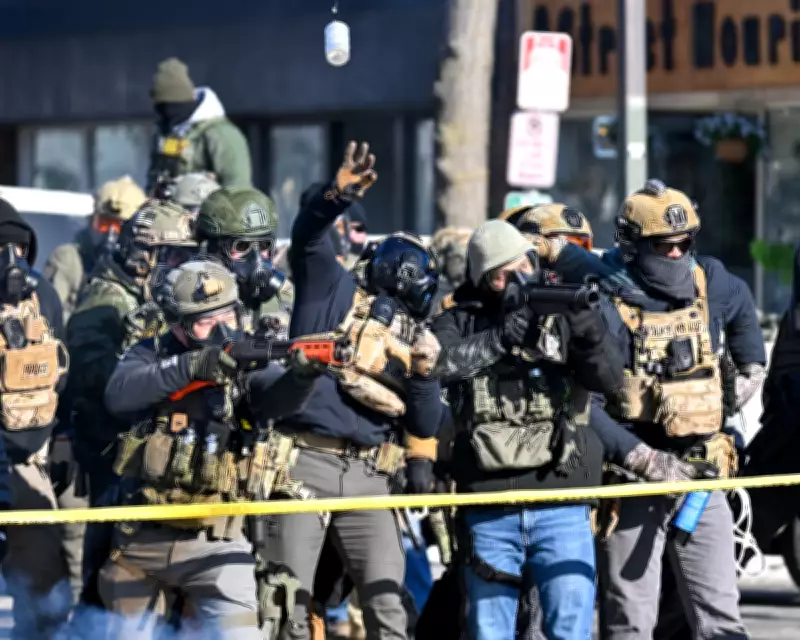
Federal Officers Deploy Tear Gas and Less-Lethal Rounds at Minneapolis Protesters
Federal officers have been observed throwing tear gas canisters and firing so-called "less-lethal" rounds at protesters in Minneapolis. This aggressive response has drawn significant attention, with photographic evidence capturing the intense scenes. The actions of these officers, often dressed in tactical gear, have sparked a broader discussion about the methods and aesthetics of enforcement agencies.
The Intimidating Yet Farcical Performance of ICE
An aspect of ICE's operations in Minneapolis that accompanies its mission to intimidate is the undeniably farcical tone of its aesthetic. Drawing parallels to Broadway musicals like Springtime for Hitler from The Producers and Das Ubermensch from Operation Mincemeat, which present fascism as a camp enterprise, ICE seems to fit this mould entirely. The costumes play a central role, with border patrol chief Greg Bovino noted for swishing around in a long, green trenchcoat, reminiscent of historical garb, as described by California Governor Gavin Newsom.
Rank and file ICE agents have been described by Minnesota Attorney General Keith Ellison as prancing about in "full battle rattle," complete with vests, fatigues, and goggles. This theatrical display suggests that for many, the allure lies in the accessories and the opportunity for self-admiration under the guise of team spirit. Meanwhile, their incompetence adds a darkly slapstick layer to events, such as videos showing large men in combat gear slipping on ice, providing a grimly humorous contrast to their intended menace.

Cultural Reactions and Broader Implications
If one laughs in their faces, there is a risk of being shot, but behind their backs, the farce continues. In New York, audiences at Operation Mincemeat have reportedly reacted strongly to a line that previously passed unremarked in London's West End production. The line, "If people like us just blindly follow orders, the fascists won’t need to bash the door down. They’ll have already won," has been stopping shows, with entire theatres rising to their feet in applause. This highlights how real-world events are influencing cultural perceptions and responses.
In other news, Nicki Minaj's appearance with Donald Trump in Washington DC, where she declared herself "probably the president's number one fan," has disappointed many. This follows a tradition of cultural icons shifting allegiances, from Kanye West to Roseanne Barr. Meanwhile, Scottish band Deacon Blue distanced themselves from Reform UK's Malcolm Offord, who referenced their song Dignity in a speech, emphasising that their lyrics should not be used to support ideologies contrary to their beliefs.
Light Relief and Sporting Catharsis
Amidst these heavy events, some have sought light relief. Caroline Fraser's book Murderland explores the link between lead poisoning and serial killers in the 1970s Pacific Northwest, offering a fascinating, if grim, read. Paired with David Fincher's Mindhunter on Netflix, it provides a deep dive into criminal profiling, though adjusting back to daily life can be challenging after such dark content.
At the Australian Open, Coco Gauff's racket-smashing incident backstage after her quarter-final loss to Elina Svitolina became a talking point. In 44C heat, Gauff explained that releasing frustration privately was preferable to doing so in front of young fans. Her actions, though unintended, may offer a cathartic release for those overwhelmed by the news cycle, as watching the repeated racket smash could serve as an emotional outlet.
Celebrity Responses and Corporate Alignments
The Sundance Film Festival saw celebrities like Natalie Portman and Olivia Wilde wearing "ICE Out" badges, signalling political stances against immigration enforcement. In contrast, the launch of Amazon's Melania documentary at the White House attracted figures such as Zoom's Eric Yuan and Apple's Tim Cook, showing support for Donald Trump amidst the turmoil in Minneapolis. This divergence underscores the complex interplay between entertainment, politics, and corporate interests in contemporary society.