

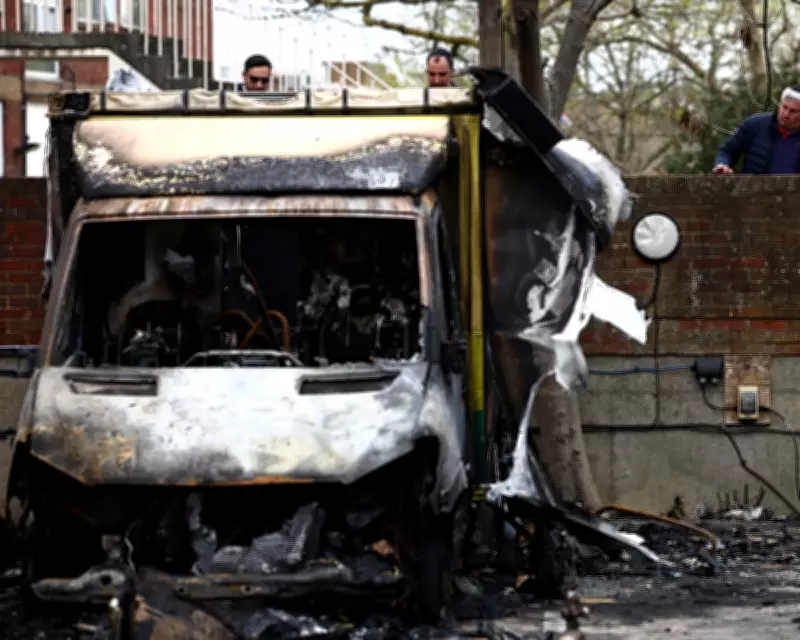
Golders Green Ambulance Arson Investigated as Antisemitic Hate Crime with Iranian Links
The arson attack on four ambulances belonging to a Jewish charity in Golders Green during the early hours of Monday morning is currently being treated as an antisemitic hate crime by British authorities. However, a complex investigation now suggests the incident may be part of a broader pattern of Iranian-sponsored attacks targeting Jewish communities across Western Europe.
The Tangled Trail from North London to Tehran
While Metropolitan Police Commissioner Mark Rowley has described a "very relevant and rolling threat" from Iran to the United Kingdom, particularly to Jewish targets, official investigators remain cautious about directly attributing the Golders Green attack to Tehran. Rowley emphasized it was still too early for definitive conclusions during a public event on Monday evening.
Security experts and officials less constrained by diplomatic considerations have been more direct in their assessments. Multiple sources point to Iran's involvement, noting striking similarities between the Golders Green incident and a series of recent attacks on Jewish sites throughout Western Europe, all employing relatively low-tech incendiary devices.

Pattern of Attacks Across Europe
The Golders Green attack follows a concerning pattern of incidents across the continent:
- On March 9, an improvised explosive device detonated outside a synagogue in Liège, Belgium
- Four days later, another device exploded near a Rotterdam synagogue
- Jewish schools and commercial centers in Amsterdam were targeted with amateurish incendiary bombs
- Two teenagers were arrested after a vehicle outside a Jewish-owned business in Antwerp was torched
These European incidents occurred alongside attacks in Azerbaijan, Kuwait, Qatar, and the United Arab Emirates, all of which local authorities have linked to Iranian involvement.
The Mysterious HAYI Group and Iranian Connections
Following the Golders Green attack, a video surfaced on Telegram from a group calling itself Harakat al-Ashab al-Yamin al-Islamia (HAYI), or the Islamic Movement of the Companions of the Righteous. The video showed footage of the burning vehicles and claimed a "historic bond" between Israel and the Machzike Hadath synagogue, where the ambulance service is based.
Security officials close to the investigation now believe HAYI may not exist as an independent organization. Their current "working assumption" suggests the group is "a front and a brand invented by Iranian intelligence or the Quds force." The video first appeared on social media channels affiliated with Asaib Ahl al-Haq, a pro-Iranian Shia militia organized, funded, trained, and equipped by Iran's Revolutionary Guards.
Iran's History of Plausible Deniability
Magnus Ranstorp, a veteran expert on Iranian involvement with extremist groups, notes that Tehran has consistently maintained "plausible deniability" since its early involvement in major attacks, including the 1982 bombing of a US military base in Lebanon and the 1992 and 1994 bombings in Buenos Aires targeting Israeli and Jewish institutions.
Recent investigations in Sweden, Greece, and the United States have revealed how Iranian intelligence or Revolutionary Guards officials recruit individuals to carry out attacks, often collaborating with criminal networks for manpower and resources. Just last week, two Iranians were charged with conducting hostile surveillance on London's Jewish community for Tehran.
Context of Rising Antisemitism in the UK
The Golders Green attack occurs against a backdrop of increasing antisemitic incidents in Britain. According to the Community Security Trust (CST), 2025 saw 3,700 antisemitic incidents recorded in the UK, representing the second-highest level ever documented and a 4% increase from the previous year. This incident follows an attack on a Manchester synagogue less than six months earlier.
Ranstorp observes that the recent wave of attacks appears deliberately non-lethal. "The Iranians have a record of killing people or trying to kill people, so for them to clearly try quite hard not to kill anyone is interesting," he noted. "There is no need for them to put out big statements ... but this is still about sending a message."

While the investigation continues with the incident officially classified as an antisemitic hate crime rather than a terrorist act, the emerging evidence points toward sophisticated state-sponsored operations with clear geopolitical motivations extending far beyond the streets of north London.





