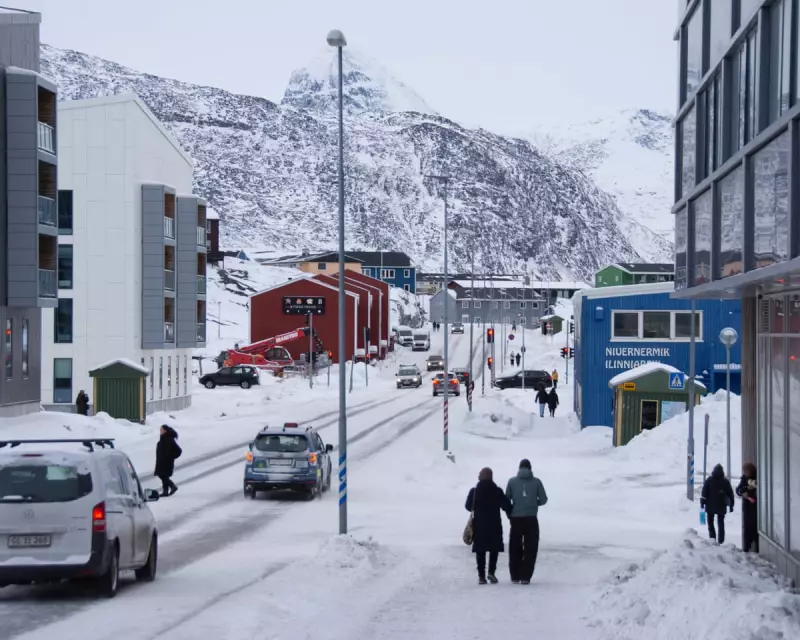
The long-held sense of unshakeable safety in Greenland has been shattered for its 57,000 residents. In the space of two weeks, repeated threats from former US President Donald Trump to militarily acquire the vast, autonomous Arctic territory have transformed abstract geopolitical tension into a palpable, daily fear for its population.
A Population Grappling with Powerlessness
For Najannguaq Hegelund, a 37-year-old working for the NGO Sila360, the shift has been surreal. Once a comforting joke during global instability—"Well we will just go to Greenland, nothing ever happens in Greenland"—the territory is now the epicentre of a potential international crisis. "Look where we are today," she says incredulously from a Nuuk coffeeshop. "It's just so crazy."
Like many, Hegelund now contemplates evacuation plans, whether to flee to Denmark pre-emptively, and how to answer her children's questions about becoming American. The mood in the snow-covered capital has darkened from the lighthearted scepticism of a year ago, when Trump first floated the idea, to one of open alarm. The critical difference now, Hegelund notes, is the precedent set by recent invasions elsewhere, making the threat feel frighteningly plausible.

"What could we do?" she asks, highlighting a widespread feeling of powerlessness. "We are like 20,000 in Nuuk. How are we going to go against American troops?"
Daily Anxiety and a Lack of Guidance
The anxiety manifests in sleepless nights and hyper-vigilance. Hedvig Frederiksen, 65, and her daughter Aviaja Fontain, 40, have taken surveillance into their own hands. Fontain, struggling to focus on university exams, watches the harbour, while Frederiksen monitors flight trackers, recently panicking at the sight of a Hercules plane leaving the US base at Pituffik.
Their fears are deeply personal. Frederiksen is one of 143 Greenlandic women who recently won a legal case against Denmark after being forcibly fitted with IUDs. "If the soldiers are coming here, then what will they do?" she asks, through translation by her daughter. "We are all just thinking that they are going to do bad stuff to us because we don't want to be US citizens."
Fontain voices a profound dread of imported violence and a second wave of colonial trauma. "I'm so afraid if they take over are they going to bring their violence here? We are not violent here," she says.
Despite the Danish government's announcement in October of an additional 27.4 billion Danish kroner (£3.26bn) for Arctic security, including new vessels and a headquarters for the Joint Arctic Command (JAC), residents feel a stark lack of practical information on what to do if an invasion occurs.
Societal Divisions and a Search for Solidarity
The crisis is also fracturing Greenlandic society. Aviâja Korneliussen, a 19-year-old artist, says the easy, worry-free camaraderie has evaporated. "Now someone has a different idea of how Greenland will be and another has a whole different idea and if they clash you cannot be friends," she observes. She finds the global discourse dehumanising, reducing her homeland to a tradable object.
Yet, amidst the fear, there is a renewed assertion of Indigenous identity. Korneliussen notes a growing embrace of Inuit culture, tattoos, and art, and a conscious separation from a Danish (Qallunaaq) identity.
Political responses vary. Pele Broberg, leader of the US-friendly Naleraq party, sees an opportunity for Greenland to discuss a free association deal with the US, a possibility long denied by Denmark. However, on the eve of high-stakes talks in Washington, Greenland's Prime Minister, Jens-Frederik Nielsen, struck a unifying tone alongside Danish PM Mette Frederiksen, stating clearly: "If we have to choose between the US and Denmark here and now, we choose Denmark, Nato and the EU."
This statement brought relief to figures like Aqqaluk Lynge, a founder of the Inuit Ataqatigiit party. "That is what we have been waiting for," he said.

For independence advocates like film-maker Aka Hansen, the situation presents a painful paradox. "Which is weird for me to say as someone who fights for independence that I actually have to rely on Denmark right now," she admits, citing the invasions of Ukraine and Venezuela as proof that international law is "ineffective." Her hope, for now, rests on Danish protection.
As Greenland's foreign minister, Vivian Motzfeldt, and Denmark's Lars Løkke Rasmussen prepare to meet US Secretary of State Marco Rubio—with the added, worrying presence of Vice-President JD Vance—the people of Greenland wait, caught between fear of a superpower's ambition and hope for diplomatic resolution.