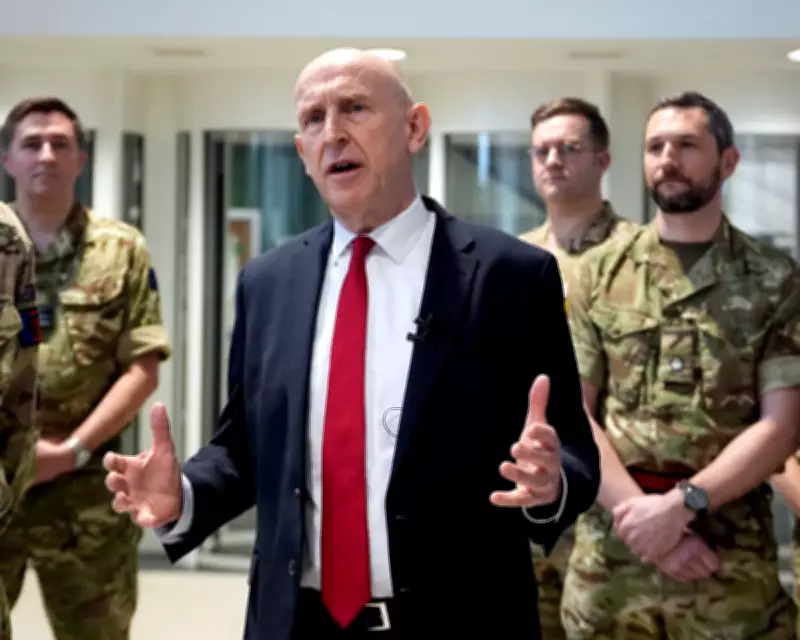
UK Defence Secretary Healey Points to Putin's Influence on Iran's Drone Tactics
UK Defence Secretary John Healey has asserted that Vladimir Putin's hidden hand is behind Iran's military methods, following a briefing at the British military's headquarters in north-west London. This statement came after a night of drone strikes on a western military base in Erbil, northern Iraq, where British personnel are stationed.
Russian Tactics Adopted by Iranian Drone Pilots
During the briefing, senior British army officers informed Healey that Iranian drone pilots and their proxies are increasingly using tactics from the Russians. Lieutenant General Nick Perry, the chief of joint operations, explained that Iranian pilots are now flying Shahed drones much lower, making them more effective at hitting targets. This adjustment has proven problematic, as Shahed drones have become one of Tehran's more potent weapons as the conflict approaches its third week.
Iran has launched over 2,000 Shahed drones across the Middle East in response to the US-Israeli attack that began on 28 February. Perry noted that Russia appears to have passed tactical advice back to Iran and its proxies on how to operate these drones more efficiently.

Overnight Drone Attacks and UK Response
Overnight, multiple drones struck a western military base in Erbil, where British forces are based. A UK counter-drone team successfully shot down two other drones, with no British casualties reported. Healey, speaking to journalists after the briefing, emphasized that Putin's influence extends to Iranian tactics and potentially their capabilities.
He argued that Putin benefits from sky-high oil prices, which provide fresh funds for his war in Ukraine. Since Russia's invasion of Ukraine in 2022, military cooperation between Russia and Iran has intensified, with Iran supplying Shahed 136 deltawing drones and sharing their design. In return, US sources indicate that Moscow has provided Tehran with military intelligence in the past fortnight, though the Kremlin denies this.
Strait of Hormuz and Regional Tensions
Healey also discussed the effective closure of the Strait of Hormuz with the E5 group of European defence ministers. He reported clearer indications that Iran is attempting to mine this strategic waterway, through which about one-fifth of the world's oil supply passes. The UK has some autonomous systems in the Middle East that could search for Iranian mines, though the mine-hunting vessel HMS Middleton has returned to the UK for maintenance.
Drone attacks on oil tankers and cargo vessels have contributed to the strait's closure, pushing oil prices to around $100 a barrel. Healey suggested that de-escalating the conflict is the quickest way to end the blockade. While he did not rule out UK participation in a possible convoy of merchant shipping through the waterway, no formal proposal is imminent due to US hesitation.
Currently, Britain has no available warships in or near the region, aside from HMS Dragon, which set sail for Cyprus to protect UK airbases and is expected to take up to a week to arrive.