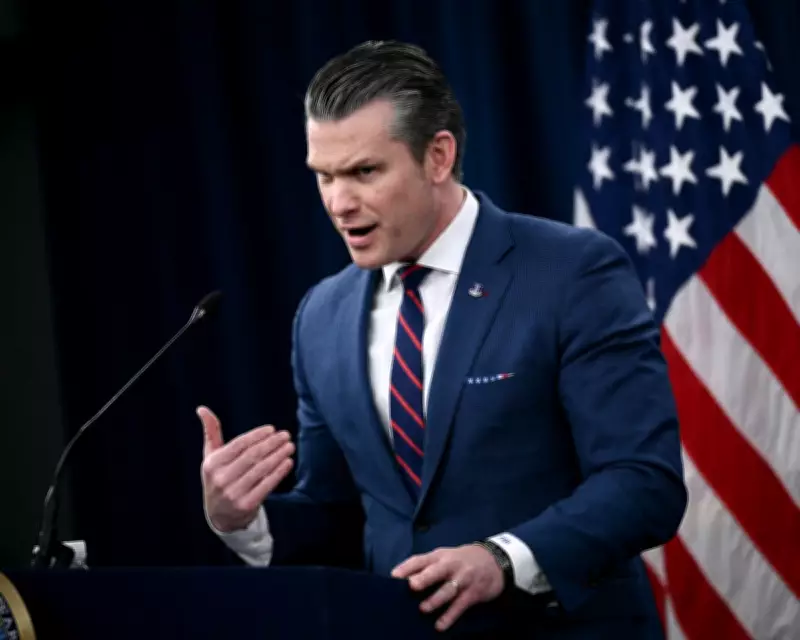
US Defense Secretary Pete Hegseth launched a pointed critique against media coverage of the ongoing military campaign in Iran during a Pentagon press conference on Friday, March 13, 2026. The defense secretary proposed alternative television headlines that he argued would more accurately reflect what he described as unprecedented success in the conflict.
Hegseth Challenges Journalists on War Reporting
During the briefing, Hegseth claimed that after thirteen consecutive days of sustained strikes, Iran's military capabilities had been severely degraded. According to his assessment, the country no longer possesses a functional air force, navy, or missile defense network. The defense secretary emphasized that combined US-Israeli air operations had successfully targeted over 15,000 strategic locations since hostilities commenced.
"What should the banner on television read?" Hegseth challenged reporters present. "How about 'Iran increasingly desperate'?" he suggested, criticizing what he perceived as negative framing of US military achievements in mainstream media coverage.

Trump Escalates Rhetoric Against Iranian Leadership
Meanwhile, President Donald Trump intensified his verbal attacks on Iranian leadership during separate remarks. The president characterized Iranian regime officials as "deranged scumbags" and warned that Tehran would face severe consequences in the coming days. Trump described targeting Iranian leadership as a "great honor" while residents of the Iranian capital reported experiencing relentless aerial bombardment throughout Friday.
The president's comments coincided with successive waves of attacks launched by US and Israeli warplanes against targets in Tehran and other locations. These statements signaled a potential escalation in the ongoing military campaign against Iran, which has already resulted in significant regional instability across the Middle East.
Additional Developments in US Politics
Several other significant political developments emerged on March 13, 2026:
- Immigration and Customs Enforcement agents testified in Oregon court proceedings about using custom surveillance applications to identify neighborhoods and individuals for targeting, while confirming the existence of daily arrest quotas during operations
- A federal judge ordered ICE to release a Minneapolis asylum seeker who had been unlawfully detained for fifty consecutive days
- New polling data revealed that approximately seventy percent of Americans believe Trump's tariff policies have directly resulted in higher consumer prices, with seventy-two percent of all voters viewing the tariffs negatively
- Multiple US airports requested public donations to support Transportation Security Administration staff affected by the ongoing partial government shutdown, with employees missing their first complete paychecks
- A federal judge blocked Justice Department attempts to subpoena Federal Reserve Chair Jerome Powell regarding inquiries about central bank renovation management
Broader Political Context
The day's events occurred against a backdrop of increasing political tension. In Texas, protesters were convicted on terrorism support charges in a case where prosecutors alleged anti-ICE activists constituted an antifa cell. United Nations human rights monitors issued warnings about "grave human rights violations" resulting from what they described as racist political rhetoric and intensified migration crackdowns in the United States.
Additional international developments included Cuban officials engaging in talks with US representatives regarding the longstanding economic blockade against the Caribbean nation. Meanwhile, a comprehensive public health study warned that Trump administration policies could contribute to rising rates of lung disease and premature mortality across the United States.
The convergence of military developments in Iran with domestic political controversies highlights the complex challenges facing the Trump administration as it navigates both foreign conflicts and internal policy debates during a period of significant political polarization.