

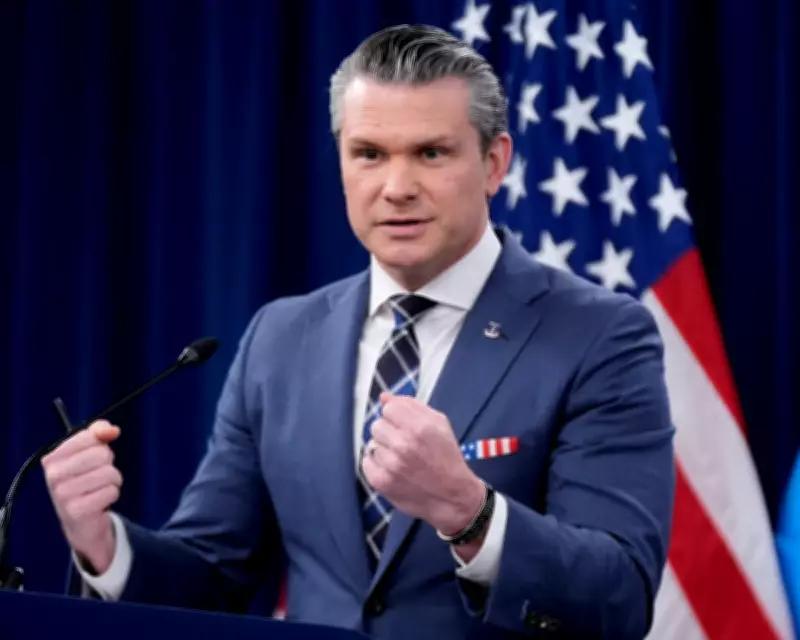
Hegseth's Media Critique Amid Iran Strategy Questions
When even your own mother labels you a cheat and a liar, it is a strong indicator of character flaws. Despite this, Donald Trump appointed Pete Hegseth as his defense secretary, or as Trump prefers, his war secretary. The rationale appears simple: why possess advanced military hardware if not to deploy it? Over the past two weeks, Hegseth has served as the president's chief cheerleader for the war on Iran, and over the weekend, he turned his ire toward the media for lacking sufficient enthusiasm.
According to Hegseth, journalists have been preoccupied with trivial matters, such as inquiring about the overall plan for the war. The president initially discussed regime change, only to backtrack when it became evident that despite the death of Ayatollah Ali Khamenei, the regime remained intact. Trump also claimed to neutralize Iranian nuclear facilities, despite asserting he had already accomplished this last year. Furthermore, he declared the war won while expressing a desire for additional victories, even as Iranians insisted they were not defeated.
Strategic Blunders and Global Repercussions
Trump initially dismissed British involvement, arguing it was too little, too late, and unnecessary. However, a week later, he sought assistance from the UK and other European allies to keep the Strait of Hormuz open. It emerged that in the hasty planning for the war, Trump's war cabinet overlooked the critical fact that the strait handles 20% of the world's oil supply. A simple map might have clarified this oversight.

This perspective, however, is dismissed as old-school pessimism, failing to recognize the benefits. Russia, for instance, has emerged as a clear winner. With oil prices exceeding $100 a barrel, Russia gains an estimated $250 million daily, inadvertently funded by the US to support its war in Ukraine. The conflict has largely been framed as entertainment, with Trump mentioning bombing Kharg Island "for fun."
UK Political Turmoil and Leadership Challenges
The Iraq war marked the beginning of the end for Tony Blair, as the public never forgave him for the dodgy dossier. In contrast, Keir Starmer has managed the current crisis adeptly so far. He declined the American invitation to join the bombing campaign and send ships to the Strait of Hormuz, instead focusing on the war's legality and the absence of a clear strategy.
Kemi Badenoch and Nigel Farage have engaged in revisionist narratives, attempting to deny their initial support for the war despite documented evidence. Nevertheless, Starmer's leadership during wartime may not suffice to secure his position. Challenges include a flatlining economy, high unemployment, a lost byelection, and anticipated setbacks in the May local elections.
Mandelson Appointment Controversy
A potential nail in Starmer's coffin is his decision to appoint Peter Mandelson as ambassador to the US. At a press conference, Starmer attributed the issue to a process failure, claiming he had worked tirelessly to tighten procedures. This explanation misses the point: vetting documents highlighted reputational risks, and national security adviser Jonathan Powell noted the process seemed unusually rushed.
Critically, Mandelson maintained a friendship with Jeffrey Epstein while Epstein was imprisoned for child prostitution. The situation becomes baffling, as it is unclear whether Starmer genuinely wanted Mandelson or was influenced by his then chief of staff, Morgan McSweeney. Starmer displayed a bewildering lack of interest in the appointment, stating he was lied to by Mandelson but with no record of addressing concerns directly. This lack of curiosity may prove his downfall.
Personal Reflections on Grief and Loss
Life's challenges continue unabated. The first anniversary of my mother's death recently passed, a loss that was both expected and unexpected. At 101, she had lived in a care home for seven years due to Alzheimer's, appearing physically well moments before her death. A month later, our dog, Herbie, died in our arms on a sunny April afternoon.

Shortly after, my wife, Jill, was diagnosed with cancer, leading to nine months of hospitals and clinics as she endured major surgery and chemotherapy. Recovery has been painfully slow for both of us. I have realized I have not properly grieved my mother, assuming it could be postponed amid more immediate life-and-death matters. However, my psyche indicates unfinished business, with mental health struggles and heightened anxiety.
Grieving is complicated. I loved her deeply, but our relationship was not always easy, exacerbated by her dementia. It felt as though I was grieving her while she was alive, witnessing her decline into someone she never wanted to be. Her death brought relief, but with Alzheimer's, loss occurs twice: once during life and again at death. This second loss remains unresolved a year later. Acknowledging it may be the start of the process, allowing gentleness toward both my mother and myself, enjoying warmth and longer days, and finding solace in nature.
Sports Drama: Spurs' Unpredictable Performance
Part of me felt disappointed when Spurs secured a late equalizer against Liverpool, not because the point was unwelcome, but because it offered a reprieve to interim manager Igor Tudor. Tudor had lost his first four games, and his management style was questionable. He publicly criticized the team, stating there were three issues: no defense, no midfield, and no attack, and urged players to toughen up.
While Tudor's assessment might have been accurate, trash-talking the team publicly seemed counterproductive for a side in freefall. The low point came when Spurs fell 4-0 to Atlético Madrid in the Champions League, with Tudor ignoring a substituted young goalkeeper. Sacking Tudor appeared to be the best hope to avoid relegation.
However, in the second leg against Madrid, Spurs transformed, playing with passion and self-respect, winning 3-2 and nearly overturning the deficit. It is unclear whether this was due to the manager or in spite of him. Tudor walked straight down the tunnel post-game without congratulating players, leaving fans perplexed. As Spurs face Nottingham Forest in a crucial relegation battle, it is uncertain which version will appear: the resilient team from Wednesday or the fragile side that only performs when all seems lost. Spurs continue to be a source of torment for their supporters.





