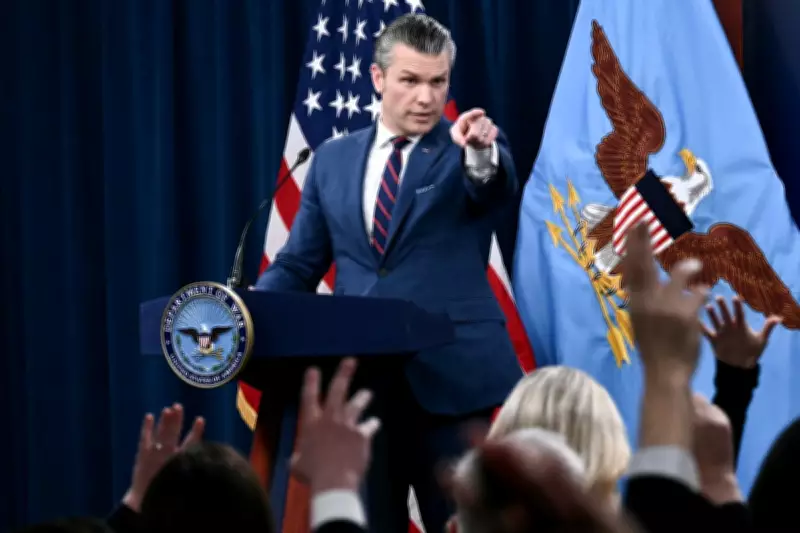
Defense Secretary Hegseth Details Unprecedented Iran Strikes While Refusing Operational Timeline
Defense Secretary Pete Hegseth has characterized the joint United States and Israeli military strikes against Iran as "the most lethal and precise air power campaign in history" during his first public remarks since hostilities commenced over the weekend. Speaking from the Pentagon on Monday, Hegseth emphatically stated that the United States would not become "bogged down" in the conflict but notably declined to establish any definitive timeline for how long American military operations might continue.
Strategic Objectives and Presidential Authority
Hegseth outlined three primary strategic objectives for the ongoing campaign: destroying Iran's naval capabilities, eliminating ballistic missile production facilities, and dismantling Tehran's potential to develop nuclear weapons. The defense secretary repeatedly emphasized that this operation does not constitute a "democracy-building exercise" and bears no resemblance to previous prolonged conflicts in the region.
When pressed for specifics regarding an exit strategy, Hegseth deferred completely to presidential authority, stating: "President Trump has all the latitude in the world to talk about how long it may or may not take. Four weeks, two weeks, six weeks. It could move up, it could move back." This position was reinforced by General Dan Caine, Chairman of the Joint Chiefs of Staff, who acknowledged that this would not be an overnight operation and warned that additional American casualties should be expected.

Ground Troops Speculation and Presidential Contrast
While Hegseth confirmed that the United States currently has no boots on the ground in Iran, he carefully avoided ruling out future deployment of ground forces, stating he wouldn't speculate about "what we will or will not do." This position created an immediate contrast with President Donald Trump, who separately told the New York Post that he does not rule out sending US ground troops into Iran "if they were necessary."
The president distinguished his approach from previous administrations, stating: "I don't have the yips with respect to boots on the ground - like every president says, 'There will be no boots on the ground.' I don't say it ... I say 'probably don't need them,' [or] 'if they were necessary.'"
Operational Details and Regional Escalation
General Caine revealed that President Trump authorized the strikes on Friday, earlier than previously disclosed, just before departing for Texas. The operation commenced with cyber and space command actions that blinded Iranian communications and sensor networks, followed by simultaneous launches of more than 100 aircraft from land and sea platforms. Two carrier strike groups - the Lincoln and the Ford - participated alongside B-2 stealth bombers flying from the continental United States.
The conflict has rapidly expanded across the Middle East, with Iran launching ballistic missiles and attack drones at eight additional countries including Israel, Saudi Arabia, Bahrain, Qatar, the United Arab Emirates, Kuwait, Jordan, and Oman. Major shipping companies have suspended operations through the strategically vital Strait of Hormuz, raising concerns about global oil prices and economic stability as markets prepared to open Monday.
Casualties and Rhetorical Posture
Hegseth confirmed that four US service members were killed when a ballistic missile penetrated allied air defenses, striking a fortified tactical operations center. The defense secretary described these weapons as "powerful" and acknowledged that despite sophisticated air defense systems, occasional "squirters" might penetrate defenses.
In characteristically blunt rhetoric, Hegseth declared: "We didn't start this war, but under President Trump we're finishing it. It turns out the regime who chanted 'death to America' and 'death to Israel' was gifted death from America and death from Israel." He praised Israel as "capable partners" while criticizing traditional allies who "wring their hands and clutch their pearls ... about the use of force."

The defense secretary, known for his criticism of military "political correctness," celebrated what he described as operations conducted "all on our terms, with maximum authorities" without "stupid rules of engagement" or "nation building quagmire." Hegseth's remarks represented the first public comments by any administration official other than President Trump in the more than 48 hours since strikes began, which resulted in the death of Iran's Supreme Leader Ayatollah Ali Khamenei.