

Defense Secretary's Prayer Draws from Hollywood Rather Than Scripture
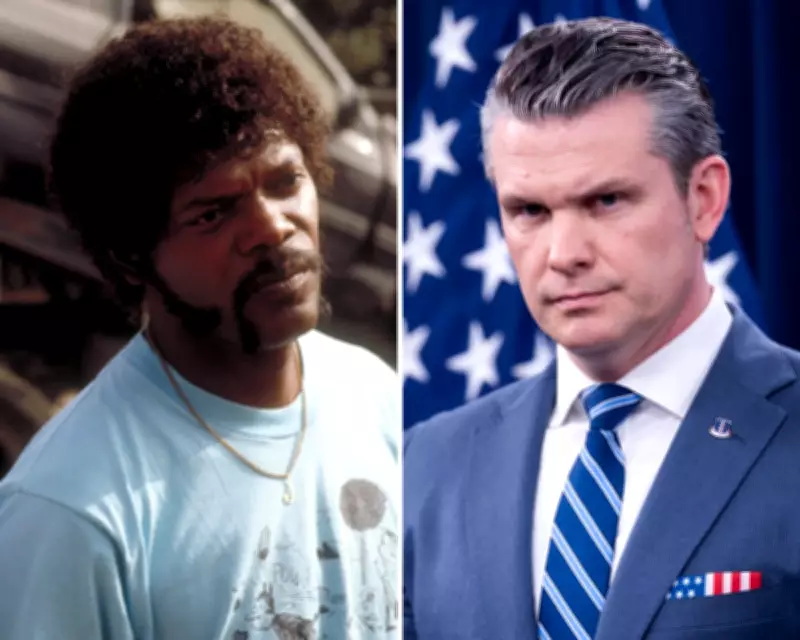
In a bizarre twist at the Pentagon, Defense Secretary Pete Hegseth delivered a prayer that quoted a nonexistent Bible verse, which was actually a famous line from Samuel L. Jackson's character in Quentin Tarantino's 1994 cult classic Pulp Fiction. The incident occurred during a worship service to bless the Iran war effort, where Hegseth presented the words as a military prayer based on Ezekiel 25:17.
Confusion Between Scripture and Cinema
Hegseth, a former Fox News host known for his Christian nationalist views, stood at the podium and recited a passage he claimed was inspired by the Old Testament. However, the wording closely matched Jackson's monologue from Pulp Fiction, where his character Jules Winnfield declares vengeance before an execution. The defense secretary made no mention of the film or Tarantino's screenplay during the event.
The original Bible verse from Ezekiel reads: "And I will execute great vengeance upon them with furious rebukes; and they shall know that I am the Lord, when I shall lay my vengeance upon them." In contrast, Hegseth's version expanded significantly, mirroring the cinematic dialogue with phrases like "The path of the downed aviator is beset on all sides by the iniquities of the selfish and the tyranny of evil men."

Pentagon Acknowledges Hollywood Inspiration
Following the prayer, Pentagon Press Secretary Sean Parnell posted on X, acknowledging that the prayer was "obviously inspired by dialogue in Pulp Fiction", though Hegseth had not referenced the film. Parnell defended the secretary, stating that claims of misquoting Ezekiel were "peddling fake news and ignorant of reality."
Newsweek provided a side-by-side analysis of the three texts: the actual Bible verse, Jackson's movie speech, and Hegseth's prayer. The military prayer, dubbed CSAR 2517, was described as commonplace for combat search-and-rescue crews, specifically referencing a recent mission to rescue an air force colonel from an Iranian mountain.
Broader Context of Controversy
This incident adds to a series of controversies surrounding Hegseth this week, including articles of impeachment brought by Democratic lawmakers. The defense secretary has been vocal in condemning the media, comparing reporters to Pharisees from the New Testament during a press briefing on the Iran war. He accused the press of having "hardened hearts calibrated only to impugn" and questioned their allegiance amid the ongoing conflict.
The Trump administration has asserted that the six-week war with Iran is already won, with claims that Iranian leaders are "begging for a deal"—statements that have been met with skepticism from the media and denials from Tehran. Hegseth's use of a Hollywood-derived prayer highlights the unusual dynamics of his tenure, blending religious rhetoric with pop culture in a high-stakes military setting.






