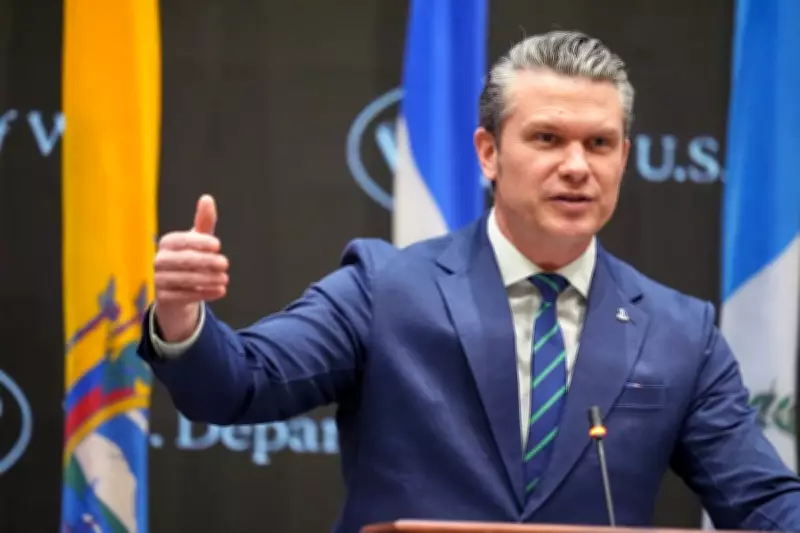
US Defense Secretary Calls for United Front Against Drug Cartels
US Defense Secretary Pete Hegseth has issued a stark warning to Latin American nations, urging them to adopt a more aggressive military approach against drug cartels or face potential unilateral action from the United States. Speaking at the inaugural Counter Cartel Conference in Florida on Thursday, Hegseth emphasized that America is prepared to "go on offence alone if necessary" but prefers regional cooperation.
Escalating US Intervention in Latin America
The defense secretary's remarks come amid escalating US military and political intervention across the region, which recently culminated in the capture of Venezuelan dictator Nicolás Maduro. This marked the first US ground military attack on a South American country in decades. For months, the Trump administration has used the "war on drugs" to justify strikes on small boats that have killed 152 people and a substantial military build-up along Venezuela's borders.
President Trump later admitted that his primary objective was accessing Venezuela's vast oil reserves, raising questions about the true motivations behind the increased military presence. The administration has invested billions in military aid to Latin American allies over recent decades, yet cocaine production has reached record highs while global drug prices sit at historic lows.

Conference Attendance and Notable Absences
Representatives from sixteen Latin American and Caribbean countries attended the 2026 Americas Counter Cartel Conference at US Southern Command in Miami. The attendees included delegations from:
- Argentina
- Bolivia
- Ecuador
- Chile
- Paraguay
- El Salvador
- Honduras
- Dominican Republic
However, three key nations with significant drug production or trafficking operations—Colombia, Mexico, and Brazil—were notably absent from the gathering. This absence highlights potential regional divisions regarding the appropriate approach to combating cartels.
White House Advocates Military-Only Approach
White House homeland security adviser Stephen Miller, widely viewed as one of the main advocates for the Venezuela attack, argued forcefully that drug cartels can only be defeated through military means. "What we have learned after decades of effort is that there is not a criminal justice solution to the cartel problem," Miller stated.
"The reason why this is a conference with military leadership and not a conference of lawyers is because these organisations can only be defeated with military power," he added, comparing cartels to terrorist organizations like ISIS and Al-Qaeda that require "brutal" and "ruthless" treatment.
Critics Warn Against Oversimplified Military Solution
David Marques, programme manager at the Brazilian Forum on Public Safety, described the exclusively military approach to drug trafficking as "a very absurd simplification." He emphasized that narco-trafficking involves complex transnational supply chains that cannot be dismantled through force alone.
"If the fight is not multi-dimensional, it will be fruitless, and will produce only death and spectacular, politically 'sellable' actions, but very little efficiency in tackling the business that is supposedly being targeted," Marques warned. He noted that countries like Mexico have deployed military forces against cartels for decades with limited success.
Marques further criticized what he called American hypocrisy: "The US created the concept of the 'war on drugs' in the past, and no longer uses that framing internally—look at how it has handled cannabis, for example—but continues trying to impose it externally with an interventionist zeal."
Historical Context and Ideological Framing
In his conference speech, Hegseth invoked historical American foreign policy, stating that "for too long, leaders in Washington abandoned the simple wisdom of the Monroe doctrine." This reference to the "America for Americans" policy established in 1823 has historically been used to justify US-backed military coups throughout Latin America.

The defense secretary urged countries to remain "Christian nations, under God, proud of our shared heritage with strong borders" while warning against what he termed "radical narco-communism, anarcho-tyranny ... and uncontrolled mass migration." This ideological framing adds a cultural dimension to what has primarily been presented as a security issue.
Recent Developments and Regional Cooperation
Earlier this week, the United States and Ecuador announced the start of "joint operations" to combat drug trafficking groups, though few operational details have been disclosed. Analysts note that US military advisers have maintained active presence across the region for years, suggesting these latest announcements represent an escalation rather than a new initiative.
The conference and Hegseth's remarks signal a potential shift toward more overt military confrontation with cartels, raising concerns among regional experts about the consequences of such an approach. With key drug-producing nations absent from the discussions and critics warning against oversimplified solutions, the path forward remains uncertain despite the Trump administration's apparent determination to escalate the conflict.