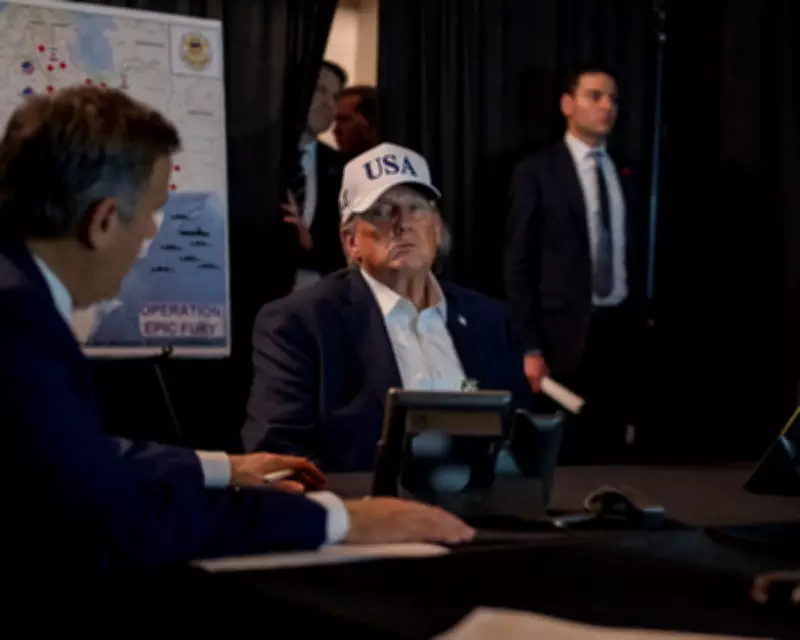
Inside Trump's Decision to Attack Iran: A Window of Opportunity
Donald Trump initiated attacks against Iran on Saturday as part of a coordinated operation with Israel, following intelligence that suggested a unique chance to target the country's highest-ranking clerics and commanders at once, according to two sources familiar with the deliberations.
The Israelis had been monitoring the movements of Iran's supreme leader, Ayatollah Khamenei, and identified a brief window of opportunity to launch strikes while key figures were gathered, the sources revealed. The strategy behind decapitating the Iranian regime stemmed from a belief that while the Iranian Revolutionary Guard might show deep loyalty to Khamenei, they would not support his successors with the same intensity in the event of his death.
The two individuals spoke anonymously to discuss sensitive details of the ongoing operation. Another person briefed on Israeli military preparations added that multiple gatherings were targeted that morning, ensuring a broad impact.

Confirmation of Strikes and International Reactions
On Saturday afternoon, a US official confirmed that the US believed Khamenei and five to ten top Iranian leaders had been killed in an Israeli strike on a compound in Tehran. Trump later posted on Truth Social that Khamenei had been eliminated.
Trump did not provide a specific reason for launching the attacks when he announced the start of what could be a days-long operation in a video on Saturday, but the opportunity to target Khamenei accelerated the timeline for strikes, according to the sources.
The attacks were condemned by Oman's foreign minister, Badr Albusaidi, who had assisted in brokering talks. In a post on X, he expressed dismay, stating that active and serious negotiations had been undermined, and neither US interests nor global peace were served by this action.
Background and Negotiations Leading to the Strikes
The strikes followed a week of rapid developments and depended partly on whether Trump's special envoys, Steve Witkoff and Jared Kushner, concluded that Iran was stalling during talks at the residence of Oman's ambassador in Geneva, as first reported by the Guardian.
In discussions that lasted all day Thursday, Witkoff and Kushner pressured Iran to agree to destroy its three main nuclear enrichment sites at Fordow, Isfahan, and Natanz—targets of Trump's bombing campaign the previous year—and deliver its remaining stockpile to the US. They also insisted that any deal must be permanent, without the sunset provisions that phased out restrictions in the 2015 accord negotiated with the Obama administration, from which Trump withdrew during his first term.
However, Witkoff and Kushner ended the day disappointed. On Friday, Trump was briefed on his military options by Gen Dan Caine, the chairman of the joint chiefs of staff, and US Navy Adm Brad Cooper, the commander of US Central Command.
Rationale and Intelligence Behind the Attacks
Senior US officials stated on Saturday that Trump considered multiple factors for the strikes. One official cited Iran's arsenal of conventional missiles as the primary rationale, describing it as an intolerable threat that Iran refused to address, even in discussions with regional partners.
Another official expressed suspicion about Iran's claim that its nuclear enrichment was for peaceful purposes. The US offered free nuclear fuel indefinitely, but Iran rejected this, which was seen as a significant indicator to negotiators. Additionally, intelligence indicated that Iran was rebuilding enrichment sites destroyed in Trump's Operation Midnight Hammer the previous year, with the US believing Iran was stockpiling partially enriched uranium and ultimately did not desire a deal.
The official emphasized that Trump had no choice, as the US could not tolerate a world where Iran possessed missiles and the capacity to produce them continuously, refusing to be held hostage or allow a first strike.
Trump traveled to his Mar-a-Lago club on Friday, seen emerging from Air Force One wearing a white USA baseball cap, similar to the one he wore in his taped address announcing the start of the Iran operation.