

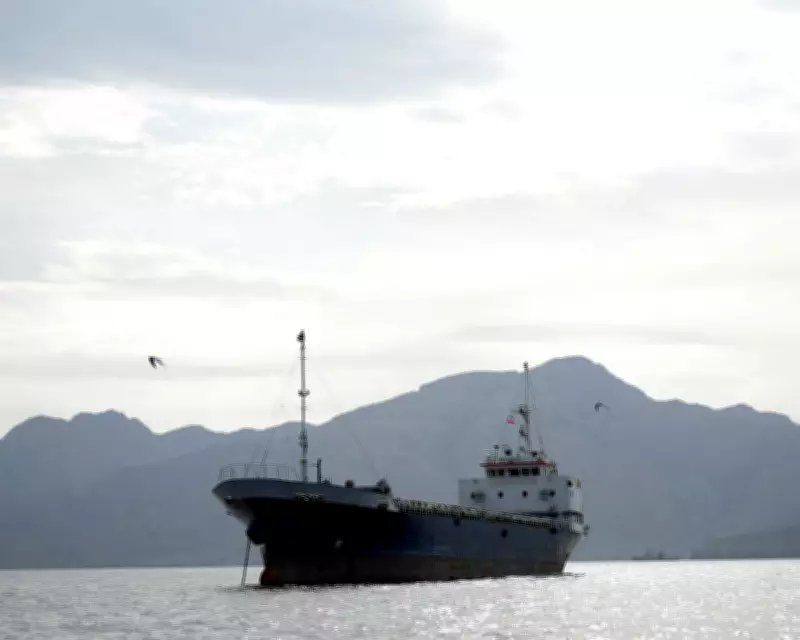
On the inaugural full day of the United States blockade targeting Iranian ports, three tankers associated with Iran successfully navigated the strategic Strait of Hormuz, as reported by Reuters, which cited comprehensive shipping data. The news agency clarified that these vessels were not destined for Iranian ports, thereby exempting them from the blockade's stringent restrictions. This development underscores the complex maritime dynamics in a region teetering on the brink of heightened conflict.
Diplomatic Moves to Reopen Critical Waterway
In response to the escalating tensions, UK Prime Minister Keir Starmer and French President Emmanuel Macron are set to co-host a pivotal summit in Paris this Friday, with a sharp focus on concerted efforts to reopen the Strait of Hormuz. A spokesperson from Downing Street emphasized, "The summit will advance work towards a coordinated, independent, multinational plan to safeguard international shipping once the conflict ends." Macron revealed earlier this week that he had engaged in discussions with both Iranian President Masoud Pezeshkian and US President Donald Trump, advocating for renewed dialogue between Washington and Tehran and urging an immediate halt to any potential escalation. He further asserted on social media platform X that the strait must be reopened unconditionally at the earliest opportunity.
Regional Talks and Humanitarian Concerns
Amidst these diplomatic maneuvers, Reuters provided additional insights, noting that US Secretary of State Marco Rubio will participate in talks scheduled in Washington later today. These discussions will involve the Israeli ambassador to the US, Yechiel Leiter, and his Lebanese counterpart, Nada Hamadeh Moawad, as the Iranian-linked militia Hezbollah pressures Lebanon to withdraw from the negotiations. Concurrently, the marine intelligence platform Windward identified a "new potential blockade breaker" in the Strait of Hormuz—a Comoros-flagged bulk carrier that reappeared after being "dark" since the conflict's onset on February 28, having disabled communications to conceal its location.

International humanitarian groups have initiated emergency relief deliveries to Iran via overland routes, marking some of the first aid shipments since US-Israeli strikes commenced in late February. Aid workers report soaring needs following six weeks of intensive strikes, yet emergency supplies remain stranded in Dubai warehouses due to blocked shipping and air routes exacerbated by the expanding conflict.
Global Reactions and Economic Implications
The Egyptian Foreign Minister, Badr Abdelatty, is en route to Washington to confer with US Secretary of State Marco Rubio on the latest Middle East developments, as Egypt aligns with Turkey, Saudi Arabia, and Pakistan in a four-nation bloc aimed at de-escalating the US-Israel war on Iran. In a significant policy shift, Italian Prime Minister Giorgia Meloni announced the suspension of Italy's defence agreement with Israel, citing the current volatile situation without elaborating further.
Economically, the International Energy Agency (IEA) anticipates the steepest quarterly decline in crude oil demand since the COVID-19 pandemic, with forecasts hinging on a "base case" assumption that oil shipments through the Strait of Hormuz will resume in May. The strait has been effectively closed by Iran since the war began, disrupting global energy markets. UK Chancellor Rachel Reeves expressed profound frustration and anger over the United States' perceived lack of a clear exit strategy or defined objectives for the war, telling the Mirror newspaper, "This is a war that we did not start. It was a war that we did not want. I feel very frustrated and angry that the US went into this war without a clear exit plan, without a clear idea of what they were trying to achieve."
Adding to the international friction, China has vowed to impose "countermeasures" if the US follows through on President Donald Trump's threat to levy new tariffs on Chinese goods, contingent on Beijing providing military assistance to Iran. Chinese Foreign Ministry spokesperson Guo Jiakun warned, "If the US insists on using this as an excuse to impose additional tariffs on China, China will definitely take resolute countermeasures," highlighting the broader geopolitical stakes at play.






