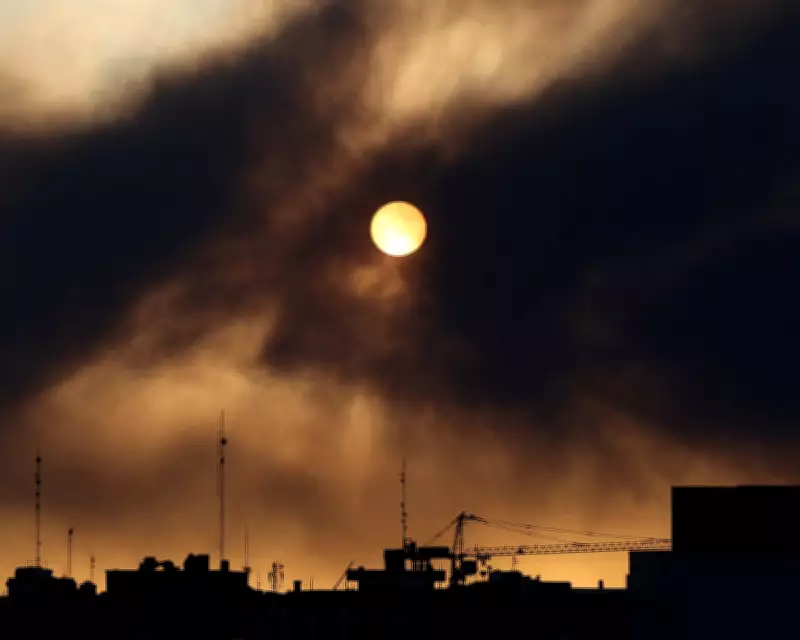
Smoke Rises Over Tehran as US-Israeli Airstrike Ignites Regional Uncertainty
Smoke billowed over Tehran in the aftermath of a coordinated US-Israeli airstrike, captured in photographs by Majid Asgaripour for Reuters. This devastating attack has plunged Iran into a state of crisis, raising urgent questions about the country's future trajectory. With the United States and Israel lacking a clear postwar strategy, the situation remains volatile, prompting analysts to explore four distinct scenarios that could unfold in the coming weeks and months.
The objectives of the assault, as pieced together from statements by US and Israeli officials, appear focused on crippling key pillars of Iranian power. Specifically, the strike targeted Iran's nuclear and missile programs, along with the Islamic Revolutionary Guard Corps (IRGC), a dominant military and political force. Former US President Donald Trump has framed this aggressive action as a pivotal opportunity for the Iranian populace to reclaim their government, potentially paving the way for a popular uprising against the cleric-led regime that has governed for 47 years.
However, regime change seems more an aspiration than a concrete plan, leaving outcomes to chance and unpredictable factors. Experts caution that the Middle East conflict could hinge on which side exhausts its missile or interceptor supplies first. Below, we delve into four broad scenarios ranked by their potential for peace, from orderly transition to utter chaos.

The Swift Transition: A Dream Scenario
In this ideal outcome envisioned by US and Israeli leaders, Iran's armed forces and the IRGC would surrender their weapons as demanded. Opposition factions would unite to form an interim government, possibly led by Reza Pahlavi, the exiled son of the former shah. This administration would oversee elections, dismantle the nuclear program by handing over centrifuges and 440kg of highly-enriched uranium to the US, renounce long-range missiles, and grant US oil companies major access to Iran's energy market.
Yet, analysts deem this scenario highly improbable. Historical patterns show that collapsing dictatorships often give way to new authoritarian regimes, especially when violence drives the change. Bombs dropped from high altitudes rarely foster democracy. The IRGC is unlikely to disarm, fearing retribution, while many Iranians distrust Pahlavi due to his father's brutal rule. A secular interim government, bound by nationalism, might resist surrendering Iran's geopolitical assets.
The Maduro Model: Regime Survival Through Capitulation
Inspired by the US intervention in Venezuela, this scenario involves the removal of Supreme Leader Ayatollah Ali Khamenei and his replacement by a more cooperative figure, such as former president Hassan Rouhani or a pragmatic hardliner. The new leadership would capitulate to US and Israeli demands, surrendering the nuclear program, accepting missile limits, and offering oil concessions to US companies. In exchange, the regime would be allowed to persist and suppress dissent.
This outcome could swiftly end the war, but it faces challenges. A new leader emerging on a platform of total surrender is unlikely, though compromise talks with the Trump administration might yield a livable agreement. The US could withdraw forces, leaving Israel to enforce any deal with bombing threats if Iran deviates.
The Regime Weathers the Storm: Hardline Resilience
Here, regime survivors hunker down, launching missiles and drones sporadically. A hardline cleric or a weak figure controlled by the IRGC would assume leadership, encouraged by Trump's talk of a limited campaign. They might expect US withdrawal after a few weeks, leaving Israel to continue bombing with dwindling resources. Many analysts view this as a likely outcome.
In a worst-case variant, Iran could take its nuclear program underground, abandon Khamenei's fatwa against nuclear weapons, and race to build a bomb using its HEU stockpile. This could transform Iran into an isolated, paranoid nuclear state akin to North Korea, brutally quashing opposition.

Civil War and Chaos: Fragmentation and Conflict
As US-Israeli bombing drains regime forces, defections within the IRGC could embolden protesters to flood the streets. Separatist movements among minorities like Kurds and Azeris might arm themselves, exploiting open borders from targeted posts. Ethno-nationalist groups, such as Baluchi separatists, could intensify fighting in southeastern provinces.
Postwar Iran could fray at its edges, with instability spreading along ethnic lines or neighboring states exploiting weakness. In the center, Pahlavi's monarchists would vie for power against other opposition groups, leading to chaotic infighting. The 440kg of HEU could become a contested prize, potentially sold abroad. While not the most probable, this worst-case scenario remains a grim possibility.
The future of Iran hangs in the balance, with these scenarios highlighting the profound uncertainties following the airstrike. As the Middle East crisis deepens, the world watches closely to see which path Iran will take.