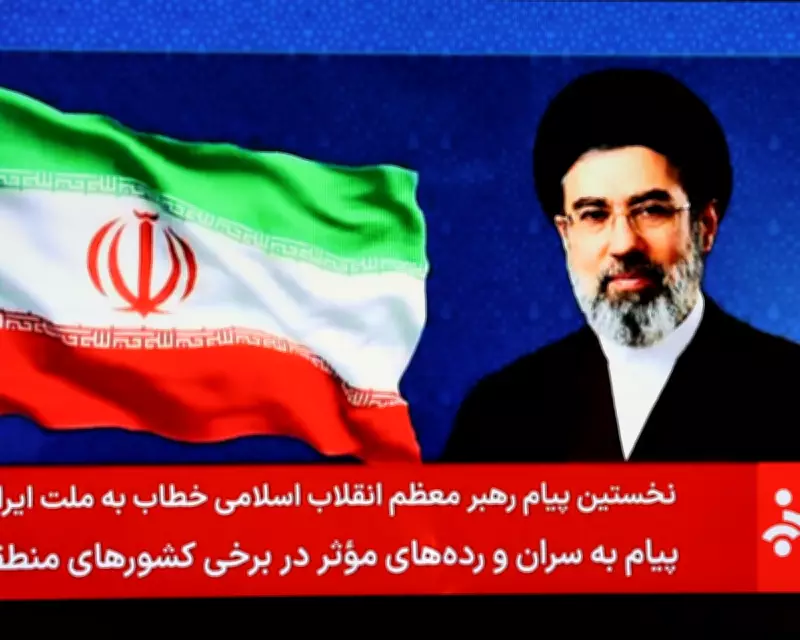
Iran's New Supreme Leader Issues First Message Vowing Continued Confrontation
Iran has delivered its inaugural official communication under the name of newly appointed Supreme Leader Mojtaba Khamenei, declaring Tehran's unwavering commitment to maintaining the closure of the strategic Strait of Hormuz and persisting with assaults on American military installations throughout the Middle Eastern region. The significant pronouncement was broadcast on Iranian state television this Thursday, though notably presented as a pre-recorded speech read by an announcer rather than delivered live or through video footage by Khamenei himself.
Questions Surround Leadership and Message Authenticity
This method of dissemination is unlikely to alleviate mounting international skepticism regarding the actual vitality and condition of the fifty-six-year-old successor to the late Ayatollah Ali Khamenei. Following the lethal assault on his father's residential compound during the initial phase of the coordinated United States and Israeli offensive, serious doubts have circulated concerning Mojtaba Khamenei's physical wellbeing, with widespread speculation suggesting he sustained injuries during the attack. The state television broadcast is consequently anticipated to undergo meticulous scrutiny by global intelligence agencies and regional analysts seeking initial indications about the leadership approach of this previously behind-the-scenes political figure.
Described consistently by regional experts as an uncompromising hardliner with established connections to Iran's powerful Islamic Revolutionary Guards Corps, Khamenei's message addressed the nation's recent internal fractures only briefly, instead praising what he termed "the masses of people who have gathered in magnificent assemblies to reaffirm their allegiance to the system." He emphasized the critical importance of national unity during periods of adversity, urging Iranian citizens and factions to overlook existing disagreements for the greater good of the Islamic Republic.

Strategic Military Posturing and Regional Diplomacy
The newly proclaimed Supreme Leader articulated a firm strategic vision, asserting his certainty that the Iranian populace desires continuity along the nation's current path. He explicitly confirmed that "certainly the leverage of blocking the strait of Hormuz must continue to be utilized," while revealing that military strategists have conducted extensive studies regarding the potential opening of additional conflict fronts where American forces possess limited experience and would consequently face severe vulnerability. Khamenei further issued a stark warning to the United States government, demanding substantial financial compensation for American attacks on Iranian territory and assets, threatening the targeted destruction of equivalent American resources should Washington refuse compliance.
Addressing complex relations with neighboring Gulf states following Tehran's sustained campaigns of missile and drone strikes, Khamenei acknowledged that some regional nations have permitted the establishment of American military and financial bases over recent years. He insisted that Iranian forces had exclusively targeted these foreign installations during recent operations, despite prior warnings to host nations, and vowed to continue such actions while simultaneously expressing Iran's enduring belief in the necessity of friendship with neighboring countries. The Supreme Leader urged Gulf leadership to publicly clarify their positions regarding what he described as "the aggressors of our dear homeland and the killers of our people," recommending the immediate closure of American bases while asserting that Washington's promises of regional security have proven entirely fraudulent.

Personal Loss and Leadership Transition
In strikingly personal revelations, Khamenei disclosed that he learned about his elevation to the supreme leadership position through television broadcasts, admitting the profound difficulty of assuming such immense responsibility amidst personal tragedy. He mourned not only his father, whose death has become a matter of public record, but also detailed the loss of his "dear and loyal wife," a devoted sister who dedicated her life to serving their parents, her young child, and another sister's wife, all of whom he said have joined "the caravan of martyrs" following the violent attacks. The Supreme Leader further confirmed that he has personally viewed his father's remains, though no official date has been announced for the late Ayatollah's state funeral.
Khamenei's message included specific praise for regional allies, notably acknowledging the Houthi movement in Yemen and Hezbollah in Lebanon for their supportive stance toward Iran despite significant obstacles, even as the Houthis have thus far remained formally outside the active conflict. He solemnly vowed that Iran would exact vengeance for "the blood of your martyrs," specifically referencing approximately one hundred seventy-five individuals killed in a missile strike on an elementary school in Minab, an incident that preliminary American military investigations have reportedly attributed to United States forces.