Supreme Leader Killed as US and Israel Wage War on Iran: Key Developments on Day Two
Iran's supreme leader, Ayatollah Ali Khamenei, was killed in a major attack by Israel and the United States, as confirmed by Iranian state media early on Sunday. This event has plunged the future of the Islamic Republic into uncertainty and heightened the risk of widespread regional instability. President Donald Trump announced the death hours earlier, declaring it offered Iranians their "greatest chance" to "take back" their country.
Details of the Attack and Immediate Aftermath
State media reported that Khamenei, aged 86, died in an airstrike targeting his compound in downtown Tehran. Satellite imagery from Airbus revealed the site was heavily bombed. According to state TV, his death at his office demonstrated his commitment to standing with the people and confronting what officials term "global arrogance." In response to the strikes, Iran issued warnings of retribution, with the cabinet stating this "great crime will never go unanswered." The paramilitary Revolutionary Guards threatened to launch their "most intense offensive operation" ever against Israeli and American bases.
Leadership Transition and Casualty Reports
The Islamic Republic news agency has indicated that the Iranian president, the head of the judiciary, and a jurist from Iran's Guardian Council will temporarily assume leadership duties. Additionally, state media confirmed the deaths of the head of Iran's Revolutionary Guards and a top security adviser to Khamenei in the airstrikes. Citing unidentified sources, the semiofficial Fars news agency, which is believed to have ties to the Revolutionary Guards, reported that several of Khamenei's relatives were also killed, including a daughter, son-in-law, daughter-in-law, and grandchild.

Public Reaction and Mourning Declarations
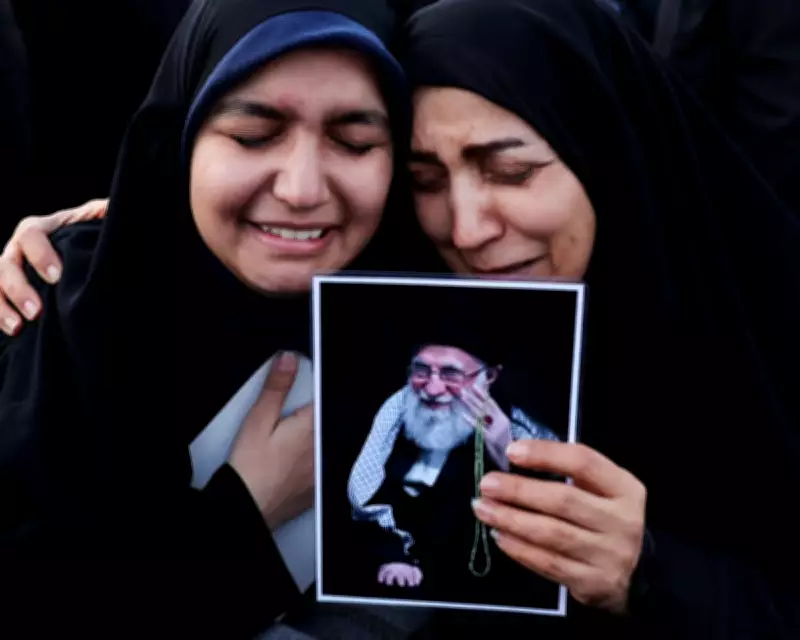
As news of Khamenei's death spread, eyewitnesses in Tehran told the Associated Press that some residents celebrated, with cheers from rooftops, whistles, and ululations. Conversely, mourners raised a black mourning flag over the Imam Reza shrine in Mashhad, Iran's second-largest city and a significant pilgrimage site for Shiite Muslims. The Iranian government has declared 40 days of public mourning and a seven-day nationwide public holiday to commemorate Khamenei's death.
Regional Impact and Military Escalations
Khamenei was killed during a wave of strikes by Israel and the US on Iran on Saturday morning. Iran's Red Crescent reported over 200 deaths and 747 injuries in daylong attacks across 24 provinces. In retaliation, Iran launched hundreds of missiles and drones, targeting US troops in the region and cities in Israel and Arab countries allied with Washington. Dubai's international airport and the Burj Al Arab hotel sustained damage, with four people injured. Abu Dhabi Airports initially reported one fatality and seven injuries at Zayed International Airport but later deleted the post.
Israel stated it launched another wave of strikes on Iran on Sunday, targeting ballistic missile and air defence systems. Iranian state media reported an explosion heard in Tehran on Sunday morning. The Revolutionary Guards announced that Iran's armed forces would soon retaliate again with their largest offensive operation ever against US bases and Israel.
Travel Disruptions and Global Repercussions
Hundreds of thousands of travellers have been stranded or diverted to other airports after Israel, Qatar, Syria, Iran, Iraq, Kuwait, and Bahrain closed their airspace following the onset of the US-Israel war on Iran. This has caused significant disruptions to international travel and heightened tensions across the Middle East.