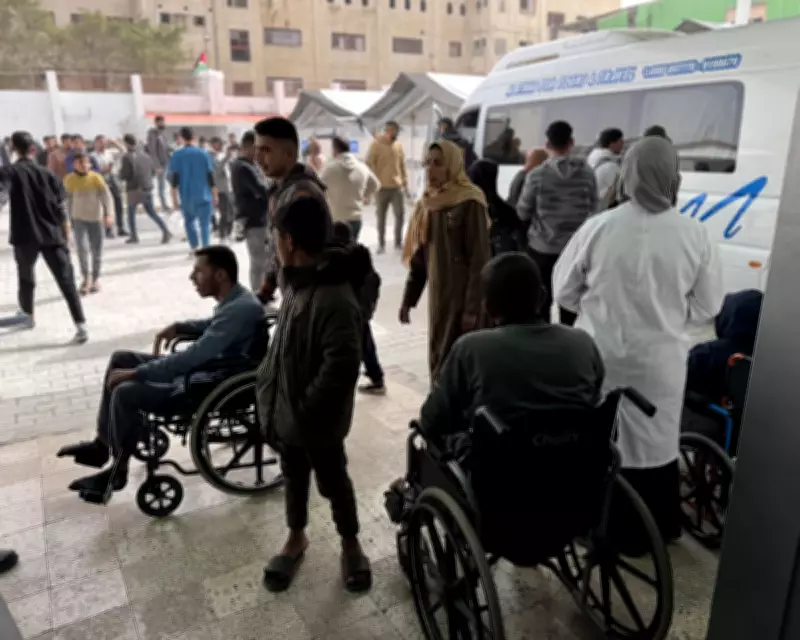
Israel Approves Restricted Rafah Border Access for Gaza Medical Evacuations
Israel has authorised the limited reopening of the Rafah border crossing between Gaza and Egypt, permitting a small number of Palestinians on foot to cross each day for medical treatment. This development comes as fragile diplomatic efforts to stabilise the ongoing conflict in the region show incremental progress.
Critical Lifeline Reopens Under Tight Security
The Rafah crossing, which Israeli forces seized control of in May 2024 citing security concerns about weapons smuggling by Hamas, represents Gaza's sole border not shared with Israel. Its closure had effectively isolated the territory, severing a vital conduit for Palestinians requiring medical care, international travel, and commercial trade.
Israeli authorities have emphasised that all movement through the crossing will undergo rigorous joint Israeli-Egyptian security screening. Initially, only a minimal number of Gaza's tens of thousands of wounded and ill residents will be allowed to exit daily. An Egyptian official, speaking anonymously to the Associated Press, indicated that just 50 Palestinians would be permitted to cross in each direction on the first day of operations.

Healthcare System in Ruins as Patients Await Evacuation
Gaza's healthcare infrastructure has been devastated by Israeli airstrikes, with hospitals reduced to rubble. In a particularly devastating blow, Israel destroyed Gaza's only specialised cancer treatment hospital in March 2025, eliminating the territory's sole provider of oncology care. Medical professionals have since been forced to operate in makeshift clinics with severely limited resources, including inadequate diagnostic tools.
According to Gaza's health ministry, at least 20,000 patients are currently awaiting medical evacuation, with thousands registered with the World Health Organization for urgent transfer. Doctors without Borders reports that more than one in five of these patients are children, while the sick include over 11,000 cancer patients. Health officials in Gaza estimate approximately 4,000 individuals with official referrals for treatment in third countries remain unable to cross the border.
Personal Tragedies Amid the Waiting Lists
The human cost of the border closure is starkly illustrated by individual stories. Tamer al-Burai, a 50-year-old suffering from obstructive sleep apnoea who relies on a CPAP machine to breathe during sleep, told Reuters: "I have appealed to humanitarian groups, to the WHO, to the Palestinian Authority – to anyone – so that I can leave, save my life, and reunite with my family."
For some, the reopening arrived tragically late. Dalia Abu Kashef, aged 28, died last week while awaiting permission to cross for a liver transplant. Her husband, Muatasem El-Rass, explained to Reuters: "We found a volunteer – her brother – who was ready to donate part of his liver. We were waiting for the crossing to open so we could travel and do the surgery, hoping for a happy ending. But she deteriorated badly and died." The World Health Organization reports that 900 people, including children and cancer patients, have already perished while awaiting evacuation.
Family Reunions and Diplomatic Significance
The restricted reopening also presents a rare opportunity for families separated by more than two years of conflict to reunite. Many Palestinians who fled to Cairo early in the war never anticipated such an extended absence from their homeland.
Mohammad Talal, a 28-year-old currency trader whose home in Jabalia in northern Gaza was destroyed, expressed his longing to return: "I love Gaza, and I don't see any other place that feels like home. Going back to live in a tent? I don't care. I can't wait to take my father into my arms and place a kiss on his forehead."
Diplomatically, the reopening is viewed as a crucial step as the US-brokered ceasefire agreement progresses into its second phase. The initial phase involved hostage exchanges, increased humanitarian aid, and partial Israeli troop withdrawals. The more complex second phase calls for establishing a new Palestinian committee to govern Gaza, deploying an international security force, disarming Hamas, and initiating reconstruction efforts.

Kaja Kallas, the EU's top diplomat, described the crossing's opening as "a concrete and positive step in the peace plan" for the war-torn territory, noting that the EU's civilian mission is on site to monitor operations and support Palestinian border guards.
A Fragile Hope Amid Ongoing Crisis
While the limited reopening of the Rafah crossing offers a glimmer of hope for medical evacuations and family reunifications, it represents merely a fractional response to Gaza's overwhelming humanitarian needs. The daily allowance of 50 crossings stands in stark contrast to the tens of thousands awaiting urgent medical care, highlighting the profound challenges facing diplomatic efforts to address the region's deepening crisis.