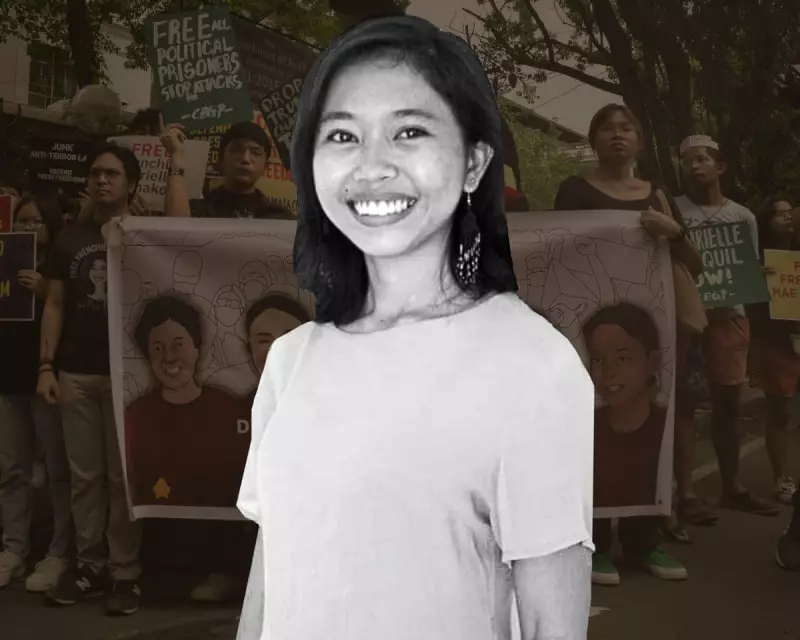
Filipino Journalist Faces 40 Years After Six-Year Detention Without Trial
Frenchie Mae Cumpio, a Filipino journalist arrested at the age of 21, has been imprisoned for almost six years on terrorism charges without a trial. Her case, which has been condemned as a travesty of justice, is set for a verdict this Thursday, potentially sentencing her to up to 40 years in prison.
Intimidation and Arrest
In the weeks leading up to her arrest in February 2020, Cumpio experienced a series of disturbing incidents. As a young journalist hosting a radio show and serving as executive director of a local news website, she reported that a stranger had been inquiring about her at her boarding house. She received a bouquet of flowers typically used for graves and noticed two men following her on a motorcycle.
Cumpio believed these acts were deliberate intimidation, likely linked to her investigative work. She had recently published reports on poor rural farmers who alleged harassment by army units in the region. Frenchie found that as the militarisation grew more intense, it was small farming communities who were being terrorised and forced to leave their villages, says Neil Eco, a journalist colleague and friend. Eco adds that her critical reporting put her in the eye of the government and the army.

Raids and Alleged Evidence
Concerned about false accusations, Cumpio and human rights activist Alexander Abinguna requested an inspection of their offices by the Philippines Commission on Human Rights to verify no illicit materials were present. However, before this could occur, police and military raided Cumpio's boarding house at night. During the search, she was taken outside, and about 15 minutes later, police claimed to have found a hand grenade, firearm, and communist flag in her bed.
It's like theatre, says Eco, who campaigns for her release. Sleeping with a grenade under your pillow? Cumpio maintains her innocence, asserting the weapons were planted and she has no involvement in terrorism. She, along with Abinguna and three other activists arrested that night, has spent nearly six years in a Tacloban prison awaiting a ruling.
Charges and Condemnation
Prosecutors initially accused Cumpio of double murder for allegedly killing two soldiers in an ambush, but those charges have been dropped. She still faces charges of funding terrorism, based on cash seized from a fundraising campaign, and possessing illegal weapons. A coalition of high-profile press freedom organisations has condemned the case, calling the charges fabricated and her detention inhumane. Her lawyer describes it as pure harassment.
Campaigners argue that Cumpio's detention is part of a broader attack on human rights activists and journalists in the Philippines, where they are often red-tagged as part of the communist insurgency. This issue worsened under former president Rodrigo Duterte, whose administration saw widespread police abuses and violent crackdowns. Investigations have revealed patterns of unlawful arrests, executions, and evidence planting.
Press Freedom Context
According to Reporters Without Borders (RSF), the Philippines is among the most dangerous countries for journalists, particularly radio presenters. Since 1986, at least 147 Filipino journalists have been killed on the job, with 89 of them being radio hosts. The Philippine government denies allegations that charges against Cumpio are baseless or politically motivated, stating it stands on high moral ground and rejects red-tagging rhetoric.
UN special rapporteur Irene Khan has reported numerous accounts from the Philippines of red tagging followed by arrest on fabricated charges and prolonged detention to harass journalists. Regarding Cumpio's case, she says, Even if she is found innocent ... she has been languishing in prison for five years, waiting for a trial for five years – that to me is a travesty of justice.

Prison Conditions and Personal Impact
Conditions in the women's prison where Cumpio is held have been dire at times. Designed for about 30 inmates, it has housed up to 80 women in a small dormitory. The warden stepped down in late 2025 after complaints about inadequate meals and medical care. In a handwritten letter from 2025, Cumpio describes the allegations as a story that's so absurd that if this was a class debate, you wouldn't even try to rebut.
She writes, This more than five years of detention is robbing us of so many things – time, family, dreams, plans, future. People call us brave for holding on, although I would have to admit I sometimes feel otherwise. The fact that they are capable of charging us through mere lies. The fear that we still won't be safe even when we're out of this facility – nonetheless, we hold on.